
Chin filler or chin implant: which to choose

 BeforeSimulation
Quick facts
- Question
- Gel or implant to project the chin
- Filler
- Absorbable, adjustable gel, no surgery
- Chin implant
- Solid implant placed surgically, usually permanent
- Who decides
- A qualified professional, following the rules of their professional council
The chin is the point that changes the profile most with the least volume. That is why a patient with a small chin often arrives with two options in mind: "get an implant once and for all" or "just fill." The choice between reversible and permanent, between adjustable and fixed, is what carries the conversation. And it begins with understanding whether the concern is volume, bone position or the proportions of the face.
This page helps you organize the comparison without choosing for the patient. Indication, technique, product and surgery are the responsibility of a qualified professional, following the rules of their professional council.
What each one does
Chin filler uses hyaluronic acid to project the chin and, at times, lengthen or widen it. It can be done in the office, in small volumes, with adjustments over sessions.
A chin implant is a solid device placed surgically over or alongside the chin bone. There are also bone surgeries, which reposition the bone itself, and which the surgeon evaluates according to the deficiency. The choice among them belongs to the surgical team.
| Criterion | Chin filler | Chin implant |
|---|---|---|
| Material | Absorbable gel | Solid implant |
| Access | Injection | Surgery with an incision |
| Reversibility | Can be broken down with hyaluronidase | Another surgery to remove or replace |
| Fine adjustment | Easier, over sessions | Limited to the shape of the implant |
| Recovery | Days, with swelling | Longer, with postoperative care |
| Duration | Months, with maintenance | Permanent, until removed |
| Typical risk | Vascular occlusion, nodules, asymmetry | Infection, shifting, bone resorption around it |
How to know which path makes sense
Assessing the facial profile is the starting point. The professional looks at the relationship between forehead, nose, lips and chin, bone projection and jaw position. In a mild recessed chin, gel is usually enough. With a larger deficiency, or when the bite is affected, the conversation may involve orthodontics, orthognathic surgery or genioplasty.
Patients tend to underestimate how much the chin matters to facial harmony. A recessed chin accentuates the nose and hides the jawline; an exaggerated chin hardens the face. For the app's chin area, see the page explaining the chin to the patient.
Filler as a "trial"
Many patients feel safer with a trial before permanent surgery. The gel lets you see how the face responds to greater projection without committing to the decision. It is not an exact rehearsal, because the implant occupies a different space than gel, but it helps set expectations. Chin filler also suits those who want to stay reversible for personal reasons.
For the most frequent question, "how long does it last," see the page on botox or filler in the chin, which helps distinguish the toxin case from the gel case. And genioplasty or chin filler goes deeper into the surgical side.
Simulation in Harmy
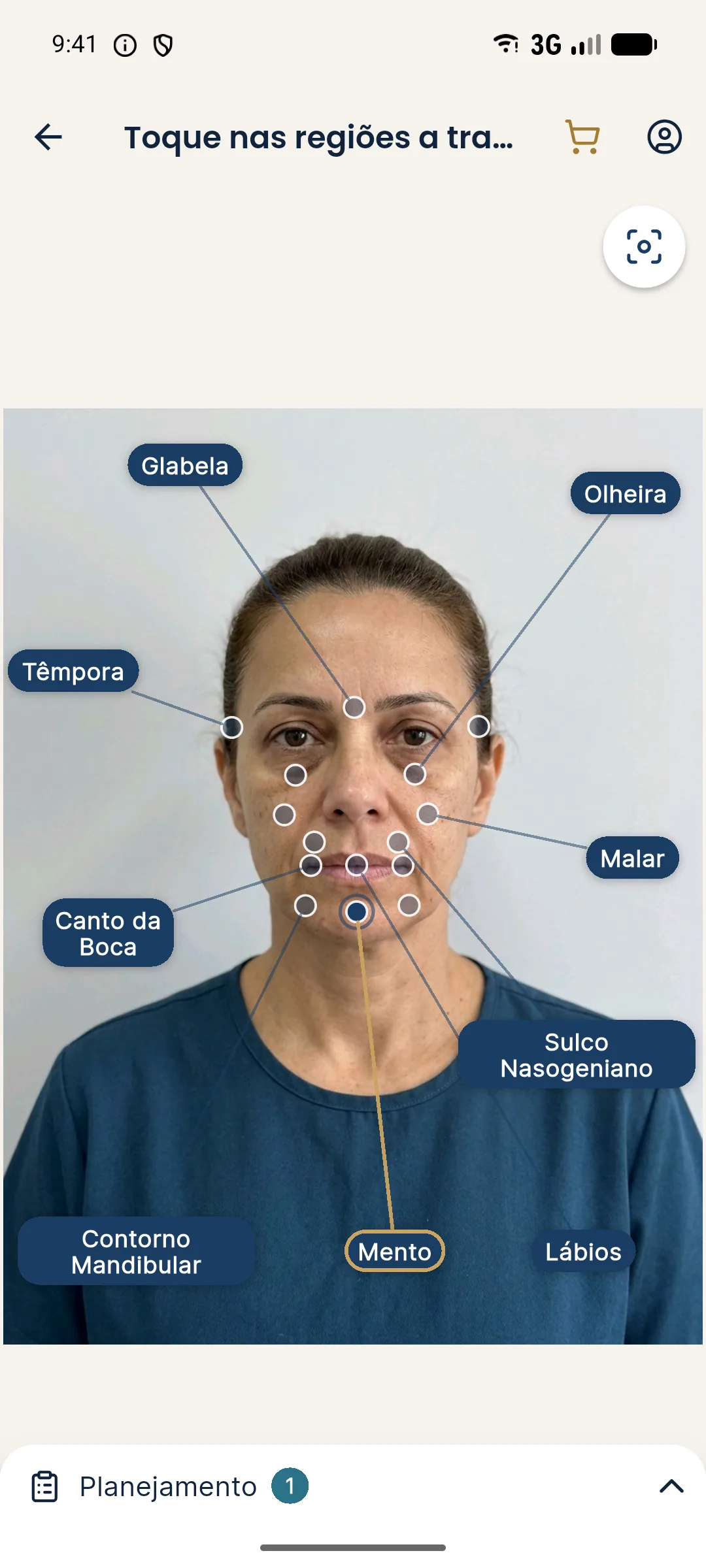
In Harmy, the Chin area generates an illustrative projection of the chin with the chosen ml on the patient's front-facing photo. By comparing different volumes, the patient sees the point at which the face starts to look heavy. Because it uses only the front-facing photo, the projection does not show the side profile, which is exactly where the chin shows most. The patient should be told this: the simulation helps start the conversation, but the profile assessment is done in person.
Risks in both options
The gel carries a risk of vascular occlusion, asymmetry and nodules, with hyaluronidase available. The implant adds the risks of surgery: infection, shifting, asymmetry and resorption of the bone under the implant. This information belongs in the informed consent, along with the alternative of doing nothing.
In closing: there is no winner. Gel is the gradual, reversible path; the implant is the structural, permanent route. Good practice is to align expectations and respect the patient's time to decide.
Frequently asked questions
Does chin filler replace an implant?
In mild to moderate cases of a recessed chin, filler can improve projection. When the bone deficiency is large, an implant or another surgery may be discussed.
Is a chin implant permanent?
It is a solid implant, generally intended to be permanent, but it can be removed or replaced with another surgery.
Does chin filler hurt more than an implant?
They are different experiences. Filler is done with topical anesthetic in the office; an implant requires surgery with anesthesia and recovery.
Can I try filler before getting an implant?
Some patients use the gel as a projection trial. It helps show how the profile responds, but it does not exactly reproduce the effect of the implant.
Harmy images are illustrative simulations generated by AI from the patient's photo to support the conversation between practitioner and patient. They are not a promise of results. Indication, technique, product and volume are solely the decision of the licensed practitioner. This content is for information only and does not replace a clinical assessment.