
Consent Forms in Facial Harmonization: What You Sign
Quick facts
- Question
- What does the facial harmonization consent form cover
- Usual content
- Procedure, risks, alternatives, care, images and data
- What it does not do
- It does not remove the right to ask questions or replace the explanation
- Who decides
- The professional, according to the rules of their professional board
Patients almost always sign the consent form at the front desk, with a pen in hand and their mind on the appointment. Professionals, on the other hand, sometimes treat the document as a formality that "protects". Neither reading is ideal. The form is the record of a conversation, and it is worth as much as the conversation that preceded it. This page shows what it covers, what it does not cover and how to use it well.
What is informed consent?
Informed consent is a process: the professional explains, the patient understands, asks questions and decides. The written form is the proof that the process took place. It is based on the duty to inform and on respect for patient autonomy: no one should undergo a procedure without knowing what it involves.
For that reason, the form cannot be read as "I accept whatever happens". The document must describe clearly what will be done and what may happen, in language the patient understands.
What does a good form usually contain?
| Item | Why it matters |
|---|---|
| Identification of the patient and the professional | Records who consented and who informed |
| Procedure and area | Avoids ambiguity about what was agreed |
| Product used, without promise of results | Allows tracing of batch and registration |
| Risks and expected effects | Swelling, bruising, asymmetry, nodules and rare complications |
| Alternatives, including not treating | Shows there was a choice |
| Care before and after | Guides the patient on what to do |
| Individual result | Acknowledges that results vary between people |
| Images and data | Separate authorization, with purpose and duration |
| Date, place and signature | Gives the record validity |
The images and data section deserves emphasis. The LGPD (Brazil's personal data protection law) requires an appropriate purpose and legal basis, and the use of a photo on social media should not be hidden in the middle of the clinical form. A separate authorization, such as an image use release, avoids confusion. The general guidance is in consent and LGPD for photos.
Does the patient have the right to ask questions?
Yes, and asking is part of the process. The professional should set aside time to clarify, without hurry and without making the patient uncomfortable. A patient who asks about the risk of vascular occlusion, what happens if they do not like the result or the cost of any touch-ups is exercising a right.
What the form does not do
Four common misconceptions worth clearing up at the consultation:
- It does not exempt the professional from responsibility for an error. Consent covers disclosed and inherent risks, not technical failure or negligence. See civil liability.
- It does not guarantee results. No document turns an estimate into a promise.
- It does not replace the consultation. A form signed in the waiting room, with no explanation, has little ethical or legal value.
- It does not replace the patient record. The record keeping follows its own rules and the form is part of it.
How to use the form in day-to-day practice
The safest process usually has four moments: explanation at the consultation, delivery of the form for reading before the day (when possible), a final conversation to answer questions and signature at the moment of decision, with a date. If the patient is in a hurry or anxious, the professional can offer another day to think it over, especially for higher-risk or higher-cost procedures.
There are supporting templates on the site, such as the consent form for facial harmonization, the consent form for lip filler and the procedure refusal form. They are a starting point, not a ready-made solution, and need legal review.
What if the patient regrets it later?
Regret about the aesthetic result does not invalidate consent, but it calls for a supportive response and, where appropriate, an adjustment plan. Having recorded the conversation and the before photos makes the dialogue much easier. The difference between what was promised and what was disclosed is where the form shows its value: if the document says the result is individual and the professional promised nothing different, the dialogue is based on facts.
Where Harmy fits in
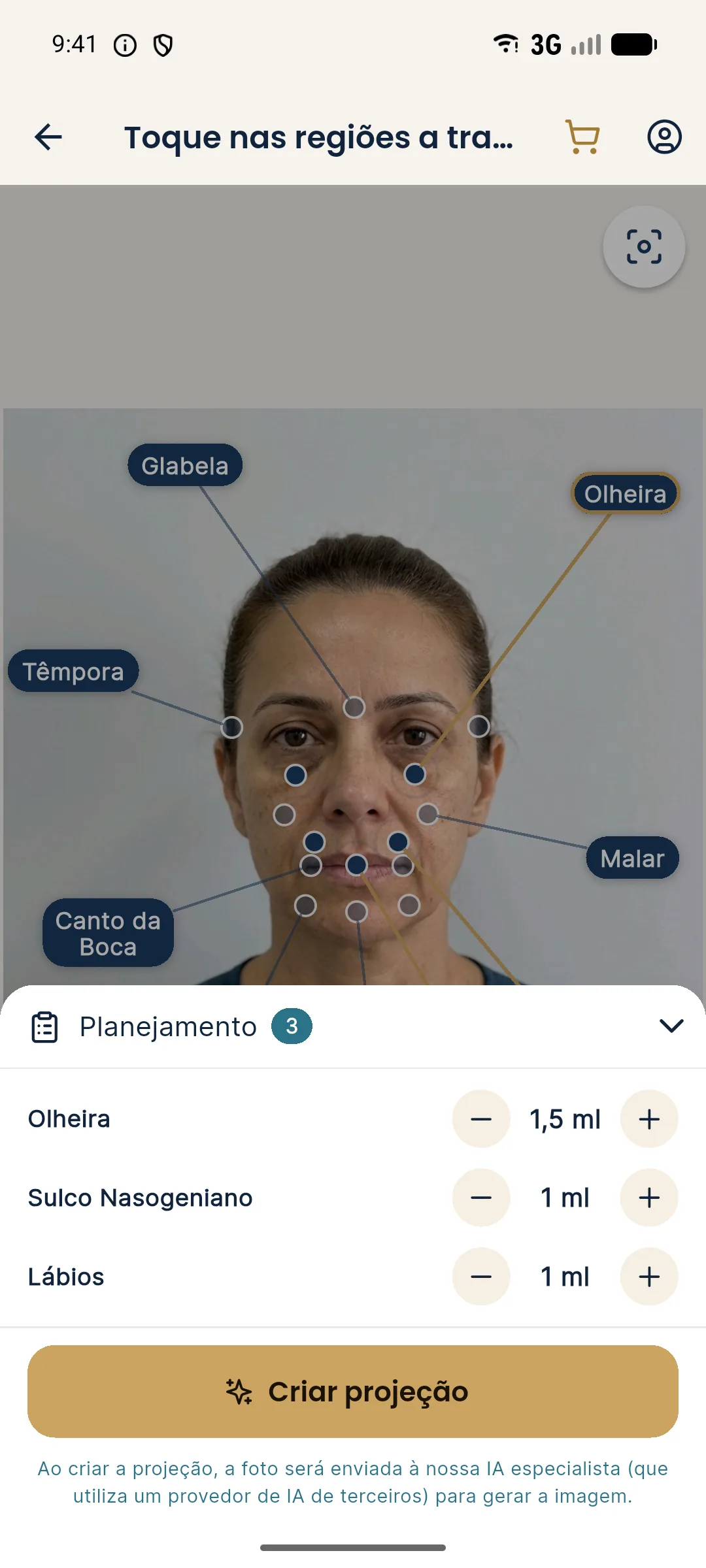
Harmy helps make consent more informed, not replace it. The projection shows the patient, before the decision, what was planned for each area, with volume and intensity, as an illustrative simulation and not a promise of results. It is worth showing the slider and the list of areas in the conversation before the form, so the person signs knowing what will be done. The photo sent to the AI requires the professional's acceptance in the app, and using the patient's images in publicity still depends on its own authorization.
Frequently asked questions
What is the consent form in facial harmonization?
It is the document that records that the patient was informed about the procedure, the risks, the alternatives and the aftercare, and agrees to have it done. It complements the conversation but does not replace it.
Does signing the form mean I cannot complain about anything?
No. The form does not remove the patient's rights or exempt the professional from responsibility for an error. It documents the information given.
Can I ask for a copy of the form?
Yes, the patient can ask for a copy of what they signed. The clinic is responsible for keeping the original according to the applicable rules.
Can I refuse to sign part of it?
Yes, and the professional should listen to the objection. If a part is essential to the safety of the procedure, the professional may make continuing conditional on understanding it, or decline to perform it.
Harmy images are illustrative simulations generated by AI from the patient's photo to support the conversation between practitioner and patient. They are not a promise of results. Indication, technique, product and volume are solely the decision of the licensed practitioner. This content is for information only and does not replace a clinical assessment.