
Downturned mouth corners: what facial harmonization offers

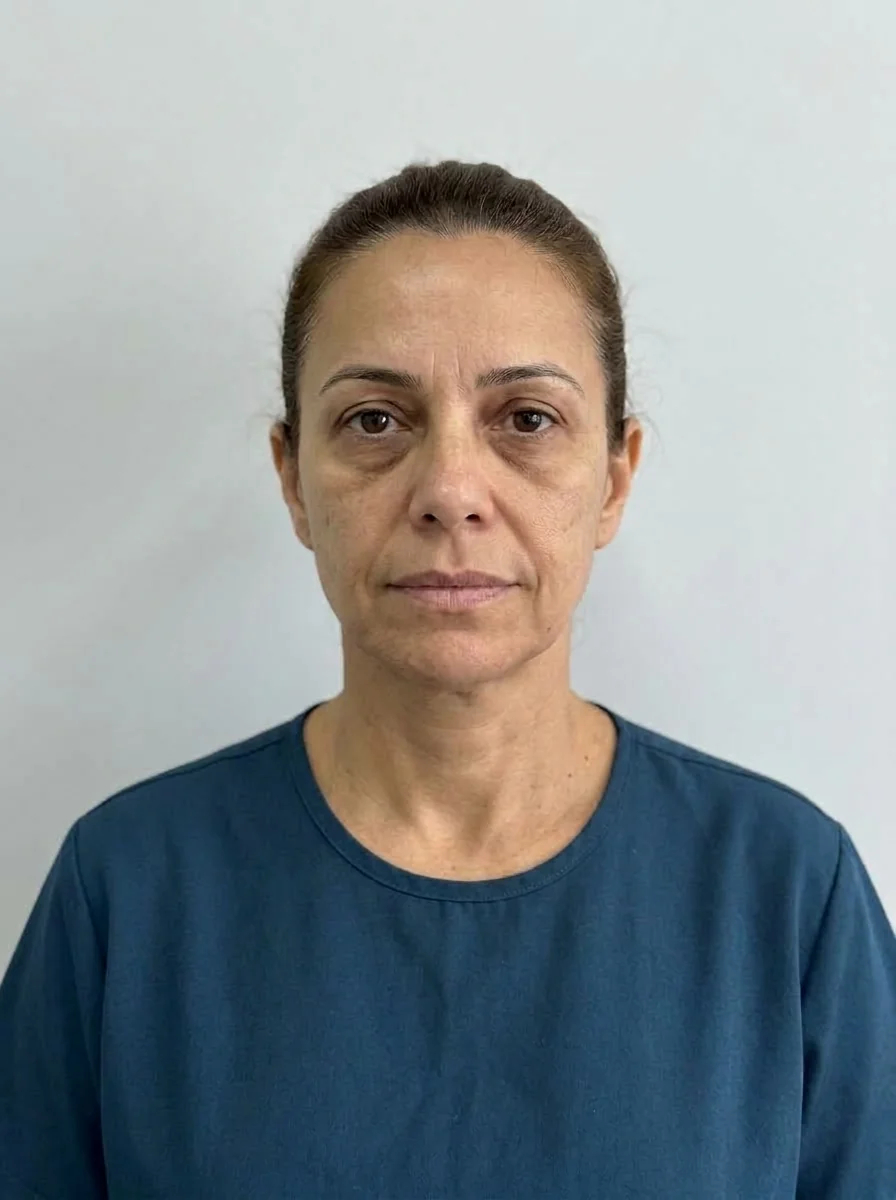 BeforeSimulation
- Muscle
- Highlighted area
Quick facts
- Concern
- Mouth corners turned downward, giving an unintended look of tiredness or sadness.
- Usual causes
- Active depressor muscle, loss of volume and support, marionette lines.
- Options
- Toxin in the depressor, hyaluronic acid, biostimulator, at the professional's discretion.
- Caution
- A mobile, well-vascularized area: risks of asymmetry and vascular complication.
Few concerns are as personal as that of the patient who hears "are you sad?" when they are simply at rest. The cause is almost always anatomical: the mouth corners point downward and, over time, the lateral lines accentuate that shape. The concern is common, and there is more than one treatment option.
Why do the mouth corners droop?
Three factors usually add up:
- Muscle action. The depressor anguli oris muscle pulls the corner downward. In some people it is more active, and the corner tilts down even at rest.
- Loss of volume and support. Over time, the lower face loses support and tissue tends to descend, deepening the marionette lines.
- Anatomy and habit. Some faces have this shape from a young age. The habit of tensing the chin and lower lip also contributes.
What does each option do?
| Approach | What it usually treats | Limit |
|---|---|---|
| Botulinum toxin | Reduces the depressor's pull, easing the downturned corner | Does not fill; requires fine anatomical assessment |
| Hyaluronic acid | Restores support at the corner and in associated lines | Mobile area; risk of asymmetry and vascular problems |
| Collagen biostimulator | Gradually improves support of the lower third | Slow effect; does not correct the muscle |
| Combination | Treats different causes at the same time | Requires a plan and reassessment |
The table is not a protocol. It shows that each resource treats one part of the problem and that the result depends on the right combination for that face.
What to tell the patient about the result
The realistic expectation is softening, not a designed smile. The mouth corner is an area where excess is visible: too much product can leave a heavy look or change the smile. For that reason, the starting point is generally conservative.
What are the risks?
Possible effects include swelling, bruising, asymmetry, and nodules. With toxin, the specific risk is a change in the smile if the product reaches muscles that were not the target. With hyaluronic acid, there is the possibility of vascular occlusion, rare but serious.
When to look beyond the mouth corner
The downturned corner is often a consequence of what happens around it: a chin losing projection, a pronounced nasolabial fold, a jawline losing definition. Treating only the corner may give a limited result. That is why assessing the nasolabial fold, the chin, and overall support is part of the reasoning.
Myth or fact
How to show it in Harmy
The Mouth Corner point is one of the areas in the app, and the projection uses 1 ml as a reference in the site's simulations. When the area is marked, the patient sees on the Before/After slider how discreet support can change the shape of the corner. The projection only works with volume: it does not simulate muscle action (toxin is only simulated in the glabella and the chin), and it is always an illustrative simulation. More in mouth corner filler.
Frequently asked questions
What causes downturned mouth corners?
The action of the muscle that pulls the corner down, loss of volume and support in the lower face, and the formation of marionette lines combine. The weight of each factor varies from person to person.
Does Botox lift the corner of the mouth?
Toxin can reduce the action of the depressor anguli oris muscle, which eases the downward pull in some patients. It does not fill, and the effect depends on the professional's assessment.
Is filler in the mouth corner safe?
It is a mobile, well-vascularized area, with a risk of asymmetry, nodules, and, more rarely, vascular complication. Hyaluronidase must be available and the technique is at the professional's discretion.
Does one procedure solve it?
Not always. Many cases call for a combination of approaches, depending on the cause, and for assessing the whole face, not just the mouth corner.
Harmy images are illustrative simulations generated by AI from the patient's photo to support the conversation between practitioner and patient. They are not a promise of results. Indication, technique, product and volume are solely the decision of the licensed practitioner. This content is for information only and does not replace a clinical assessment.