
PDO threads: how many per area and how many sessions

Quick facts
- Question
- How many PDO threads and how many sessions
- Short answer
- There is no fixed number; it depends on thread type, area and laxity
- What influences it
- Degree of laxity, skin thickness, thread type and goal
- Who decides
- The licensed professional, after assessment
Asking "how many threads?" is the equivalent of asking "how many medications?": the quantity only makes sense once you know what is being treated. With PDO threads, the variation is large. There are smooth, spiral, barbed and cone threads, in different lengths and thicknesses, and each serves a purpose (collagen stimulation or lifting). That is why a serious public page does not set a number.
Here you will find the reasoning that determines the quantity, the phases of treatment and how to explain to the patient that "more" is not always better. Thread choice, number and technique are decisions for the licensed professional, according to the rules of their professional council (in Brazil).
What defines the quantity
| Factor | How it influences |
|---|---|
| Thread type | Smooth, spiral and barbed threads have different functions and quantities |
| Degree of laxity | Mild laxity calls for fewer than moderate; pronounced laxity may not be an indication |
| Skin thickness and quality | Thin, loose skin responds differently |
| Area | Midface, jaw, neck and brow each have their own demands |
| Goal | Skin quality stimulation or lifting |
| History | First time or booster; previous response |
| Anatomy | Fat distribution and ligament position |
In general, the right question is not "how many threads" but "what problem am I treating and which thread serves it". For types and areas, see PDO threads: areas of the face.
Smooth threads and lifting threads
Smooth and spiral threads are generally designed to stimulate collagen and improve skin quality, and can be used in larger numbers, spread across an area. Barbed or cone threads aim to provide mechanical support, and are usually used in smaller numbers and with more care, because of the risk of marks, traction and discomfort.
This distinction helps the patient understand that "10 threads" of one type cannot be compared with "10 threads" of another. It is the same problem that arises when comparing toxin units between brands. On differences in expectations, the page myth: PDO threads lift everything is useful.
How many sessions
Some plans include booster sessions months apart, others end in a single session with annual maintenance. The need depends on the thread type, the patient's response and the goal. There is no fixed rule. For how long the effect lasts, see PDO threads: how long they last.
Aftercare is in PDO threads: recovery, and some everyday questions are in PDO threads and the gym and PDO threads and sleeping.
How to guide the patient at quote time
Patients tend to compare prices per thread. This creates distortion, because different threads cost and work differently. Prefer to present the plan by area and by goal, describing what will be done and what the limits are. Explain that the number of threads is a consequence of the plan, not the other way around.
Threads or another option?
When laxity is mild to moderate, threads can enter the conversation. When there is volume loss, filler is the more logical choice; when tissue quality is the issue, a biostimulator. The comparison appears in biostimulator or PDO threads, PDO threads or hyaluronic acid and botox or PDO threads.
Where Harmy fits in
Harmy simulates volume per area in ml, and threads are not volume. That is why the app does not simulate the effect of threads. It can be useful when the plan combines threads with filler, to illustrate the volume part; the explanation about the threads happens in the conversation. The projection is illustrative, an illustrative simulation and not a promise of results, and never replaces the assessment.
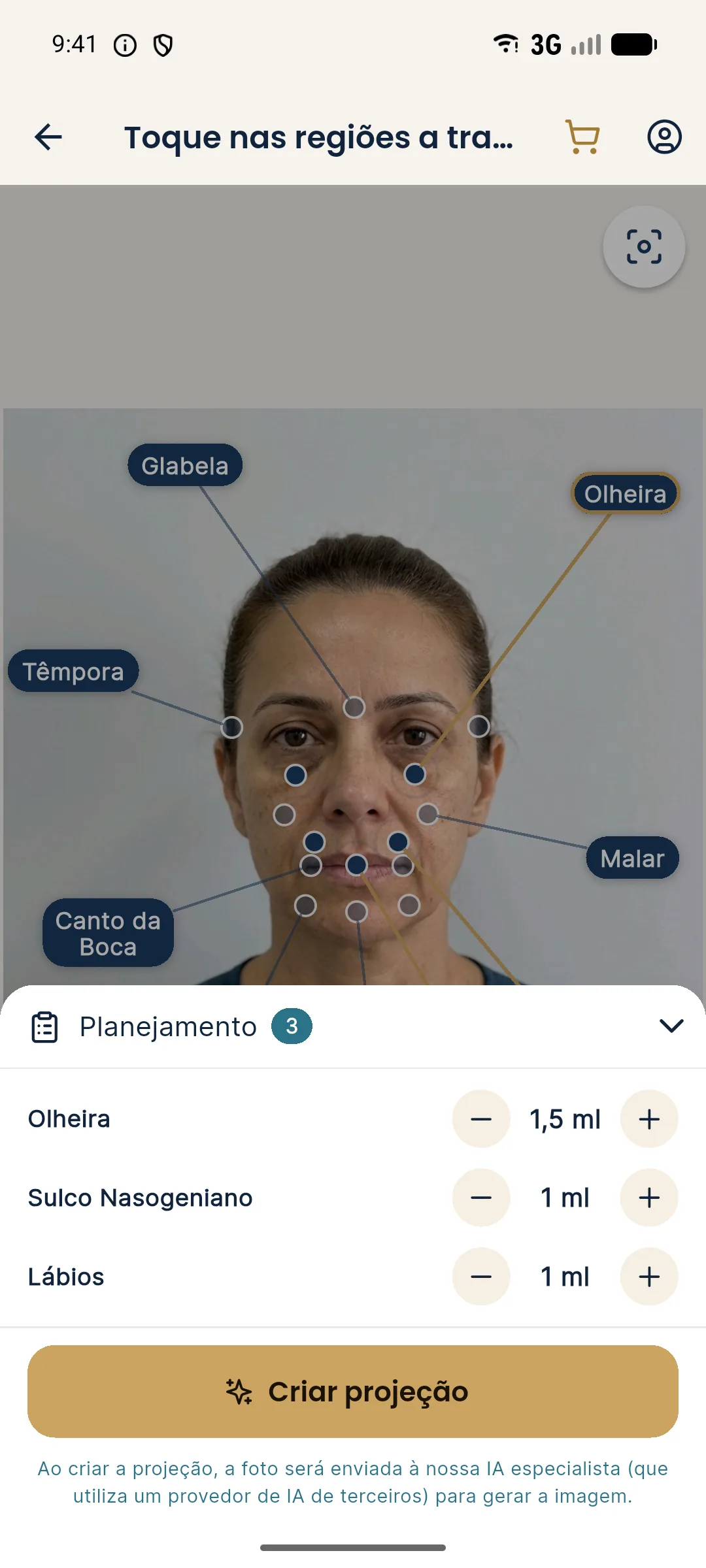
To close: ask about the problem first, choose the thread next and let the number follow. That order protects the result and the relationship with the patient.
Frequently asked questions
How many PDO threads are needed for the face?
It depends on the type of thread, the area and the degree of laxity. There is no single number, and the plan is set by the professional after assessment.
Do I need more than one thread session?
Some plans include booster sessions, especially with stimulating threads. The interval and the need depend on the case and the type of thread.
Do more threads mean more effect?
Not necessarily. Too many threads increase the risk of irregularities, discomfort and complications without guaranteeing a better result.
Do PDO threads replace surgery?
No. The lifting effect is subtle, and pronounced laxity may call for a different approach.
Harmy images are illustrative simulations generated by AI from the patient's photo to support the conversation between practitioner and patient. They are not a promise of results. Indication, technique, product and volume are solely the decision of the licensed practitioner. This content is for information only and does not replace a clinical assessment.