
Microfocused ultrasound after filler: is it safe?

Quick facts
- Question
- Can I have microfocused ultrasound after filler
- Key point
- A heat-based technology and the injected product in the same area
- Usual approach
- Respect an interval and avoid the treated layer, at the professional's discretion
- Who decides
- The professional, depending on the device, the area, and the product
Combining technologies that tighten and stimulate collagen with injectables that fill and contour is common in HOF clinics. But order and interval matter. The question "can I have microfocused ultrasound after filler?" comes up often, and the honest answer is: it depends, and the available literature is limited. This page organizes the reasoning.
Why does the question exist?
Microfocused ultrasound delivers concentrated energy at chosen depth points, producing localized heat. Hyaluronic acid is a biocompatible gel that breaks down over time, and the breakdown of hyaluronic acid can be influenced by factors such as enzymes, heat, and free radicals. The worry is that heat from the device, delivered at the same depth as the product, could speed up the loss of the filler or cause inflammation.
Other concerns: residual swelling from recent filler makes it harder to judge the right place for the energy; bruising and tenderness can add to discomfort; and there is a theoretical risk of injury in an area that has already received product and is still settling.
In what order are procedures usually considered?
| Situation | Common reasoning | Note |
|---|---|---|
| Device first, then filler | The device improves support and the filler refines | Wait for the response and swelling from the device |
| Filler first, then device | Respect an interval and avoid the treated area | More caution with the product layer |
| Same day | Possible in some services, with a defined order | Requires a protocol and risk assessment |
| Area without product | Less concern | Other areas can be treated |
| Old filler, breaking down | Less concern, but still depends | Assess the remaining volume |
A common strategy is to separate territories: treat areas without recent product with the device and reserve filler for specific areas. See also threads or microfocused ultrasound and laser and ultrasound after filler.
What factors go into the decision?
- Type of product: density, cross-linking, and time since injection.
- Area: the midface, jaw, and neck have different anatomies and depths.
- Cartridge depth: the depth of the energy may or may not coincide with that of the product.
- Time since filler: swelling resolved, product settled.
- Goal: support, skin quality, or contour.
- Device manufacturer's instructions, which may mention precautions with implants and fillers.
- Operator experience, which is part of safety.
In a planning conversation, show the patient that the order is not a "trend": it is a decision to protect their investment and reduce risk. If the patient already has recent filler and wants the device for an event, offer a staged plan.
What to tell a patient who asks
Patients often ask because they saw someone on social media "melting" their filler. Answering calmly and without absolutes works better.
Risks and warning signs
The risks of heat-based technology include pain, swelling, burns, paresthesia, and, more rarely, pigmentation changes. When combined with injectables, the professional should watch for:
If the patient also uses a collagen biostimulator or has already had radiofrequency, planning depends even more on a careful schedule, because several technologies add up in the same area. Overlapping stimuli are not always beneficial.
How Harmy fits into the plan
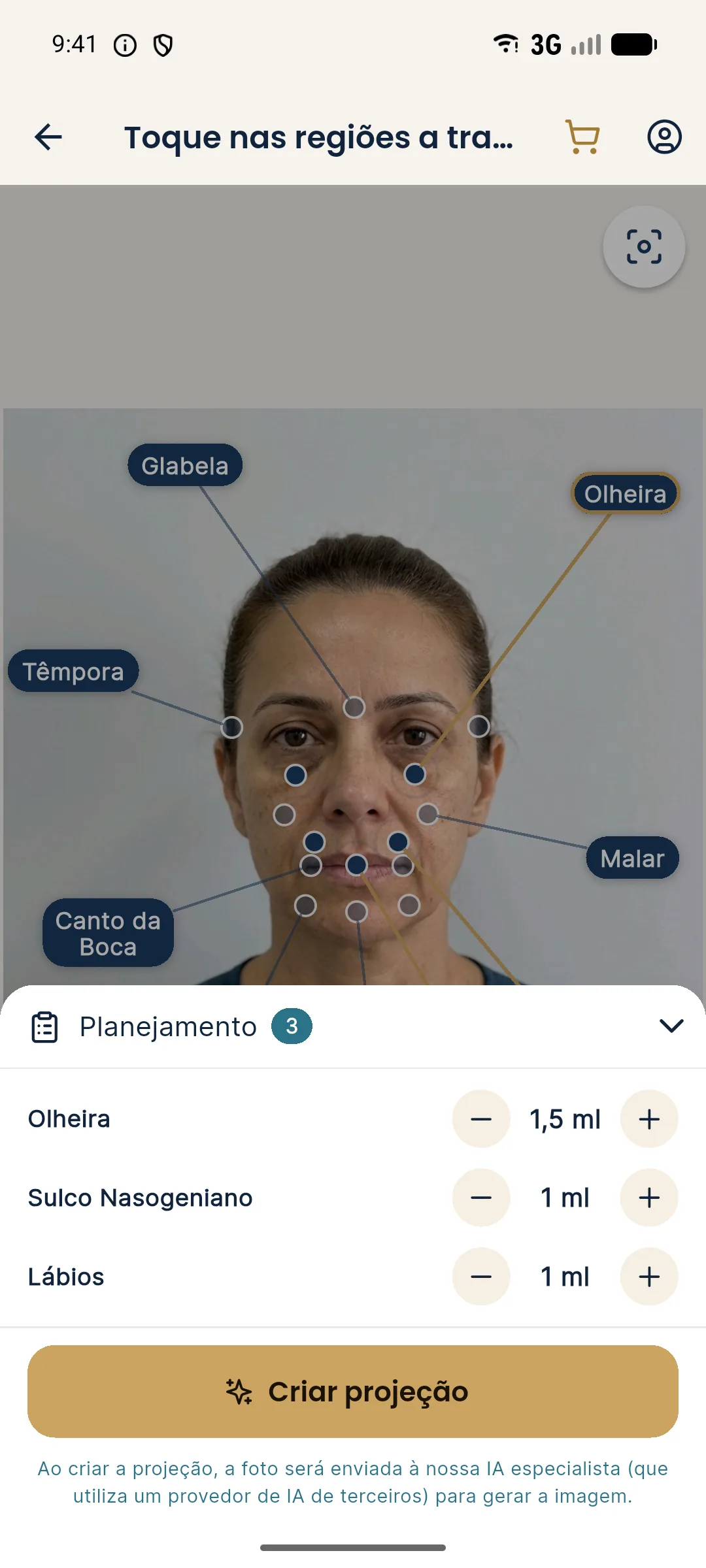
Harmy does not simulate devices: the projection is based on volume in ml. But it serves the planned filler: mark Cheekbone, Jawline, or Nasolabial fold, choose the volume and the intensity, and show the projection. In a mixed plan, the projection covers only the filler part, and that should be said. It is an illustrative simulation, not a promise of results.
Frequently asked questions
Can I have microfocused ultrasound on an area with filler?
It depends on the device, the area, and the product. Many professionals avoid using the technology over recent hyaluronic acid and respect an interval, because of the heat and the possible breakdown of the gel.
How long should I wait between filler and ultrasound?
There is no single interval that can be cited. Guidance varies with the product, the area, and the device manufacturer, and the professional decides.
Does microfocused ultrasound destroy filler?
There is concern that the heat could speed up the breakdown of hyaluronic acid, so planning usually considers the order of procedures. The evidence is limited.
Which comes first, ultrasound or filler?
Many professionals prefer the device first and the filler afterward, to refine volume and contour. The order is individual.
Harmy images are illustrative simulations generated by AI from the patient's photo to support the conversation between practitioner and patient. They are not a promise of results. Indication, technique, product and volume are solely the decision of the licensed practitioner. This content is for information only and does not replace a clinical assessment.