
Purple or Hollow Under-Eyes: Which Is Yours and What Treats It

 BeforeSimulation
- Highlighted area
Quick facts
- Question
- Purple or hollow under-eyes, which is mine
- Most common types
- Hollow (structural), purple (vascular or pigmentary) and mixed
- Simple test
- Light from above, raking light and stretching the skin
- Who decides the treatment
- The professional, after assessment
The short answer: before talking about treatment, find out which kind of circle it is. The hollow kind is a contour shadow (volume loss in the tear trough), the purple kind is color (pigment, vessels or thin skin), and many are mixed. The right treatment for one is useless, or even counterproductive, for the other. This page offers a self-test you can do in seconds to guide the conversation.
Why separate the types?
Because the patient's concern is the same ("I look tired"), and the cause changes. Filler in a pigment-type circle barely improves the color. A skin treatment on a contour-type circle does not fill the groove. Understanding the type first saves time, avoids frustration and protects the patient from unnecessary risks in a delicate area. The anatomy and types are in under-eye circles: types and assessment.
Self-test: hollow or purple?
The test is a guide, not a diagnosis. The clinical assessment defines the type.
What does each type usually call for?
| Type | Characteristic | Treatment conversation |
|---|---|---|
| Hollow (structural) | Shadow that follows the contour, improves when the skin is stretched | Volume replacement, at the professional's discretion, see under-eye filler |
| Purple (vascular) | Bluish color, thin skin, visible vessels | Strategies aimed at the skin and vessels, not the contour |
| Brown (pigmentary) | Brownish color, constitutional or post-inflammatory | Pigment treatment, see post-inflammatory hyperpigmentation |
| Mixed | A combination of contour and color | Combined plan and realistic expectations |
| With bags | Protrusion of eyelid fat | Specific assessment, see eye bags and filler |
Options vary and can be combined. To choose between volume and collagen, see under-eyes: filler or biostimulator and botox or filler for under-eye circles.
Which risks call for attention?
The periorbital area is delicate: the skin is thin, and the Tyndall effect (a bluish tone from the product) and persistent swelling are known complications of filler. There are also vascular risks and, in severe cases, ocular ones. See under-eye filler: risks and Tyndall effect under the eyes.
How does the app help with the conversation?
For hollow under-eyes, the projection helps show what volume replacement would do to the shadow. In Harmy, the area is called Tear Trough. You mark the point, choose the ml and the intensity, and the patient compares on the Before/After slider. The "First time" shortcut suggests tear trough 1 ml at Subtle intensity, which fits the caution this area calls for.
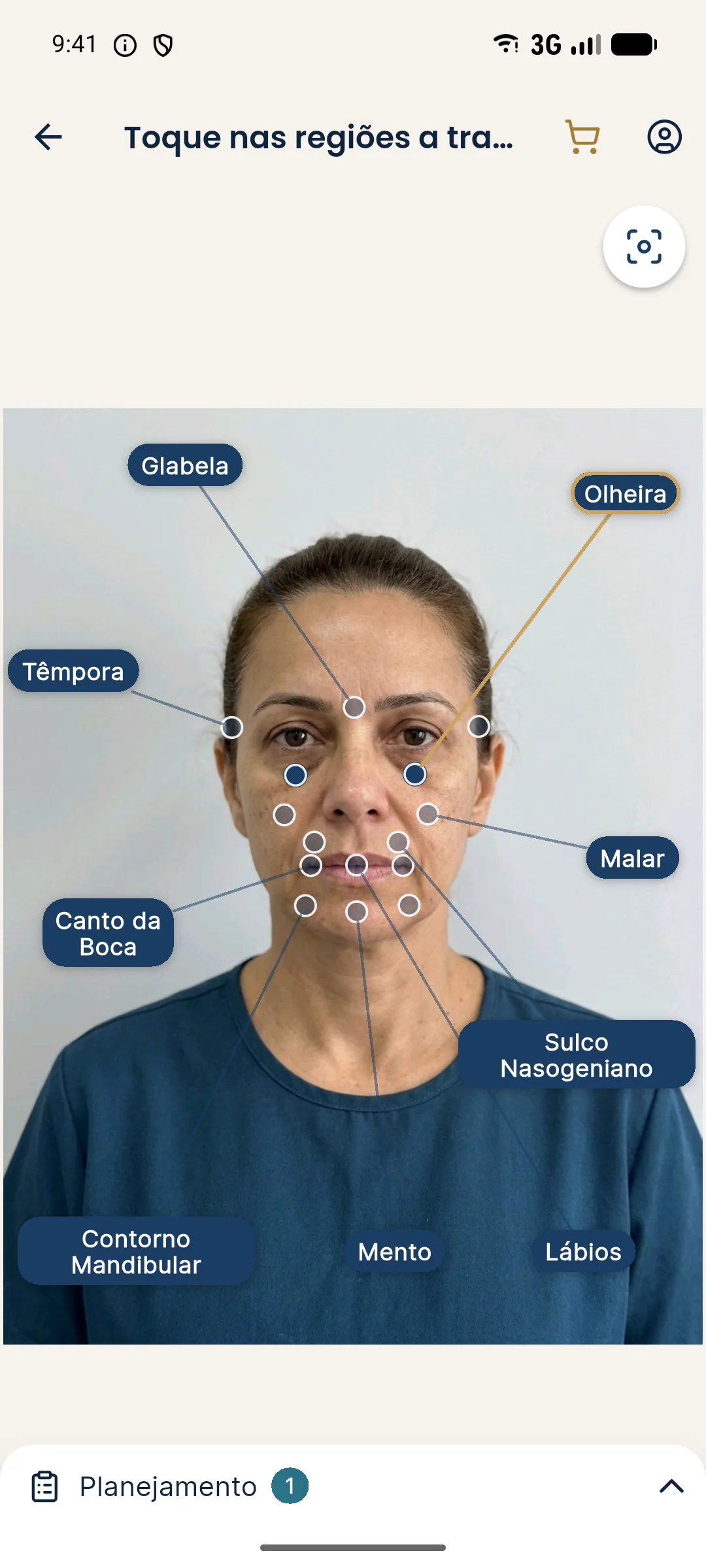
The projection is illustrative and changes the contour (volume), not the color. If the concern is color, the patient needs to know that the simulation does not represent that kind of change.
How do you record it?
Photograph under standardized light, from the front, with the gaze on the horizon and another with a slight downward tilt of the head, and record the identified type in the patient record. This helps track progress and justify the plan. See standardized clinical photography.
Frequently asked questions
How can I tell if my under-eye circles are hollow or purple?
A simple test helps: if the shadow disappears when you stretch the skin or under frontal light, it is usually contour (hollow). If the color stays, it usually has a pigment or vessel component (purple). Many cases are mixed.
Does filler fix purple under-eye circles?
Filler acts on contour, not on pigment. For purely purple circles, improvement with volume tends to be limited, and other strategies come into the plan.
Can dark circles be treated?
It depends on the cause. It may involve pigment, visible vessels or the shadow of the contour, and each cause calls for different approaches, defined after assessment.
Does everyone with under-eye circles need a procedure?
No. Some circles are constitutional or tied to sleep and habits. Whether a procedure is indicated depends on the assessment and on what the patient wants.
Harmy images are illustrative simulations generated by AI from the patient's photo to support the conversation between practitioner and patient. They are not a promise of results. Indication, technique, product and volume are solely the decision of the licensed practitioner. This content is for information only and does not replace a clinical assessment.