
Harmonization Quote Template by Area
A well-built quote does two things: it makes clear what will be done and how much it costs, and it protects both sides from misunderstandings. In orofacial harmonization (HOF, a Brazilian dental specialty), patients usually understand the proposal better when it comes by area, with the planned volume and the price of each part, rather than a single number with no explanation.
This template provides the structure of a quote by area, ready to print. For the logic of pricing per ml, see pricing per ml. For the flow in the app, see building a quote per ml in Harmy.
What needs to be written
| Field | What it is for |
|---|---|
| Identification (clinic, professional, patient) | Gives the document origin and validity |
| Area | The patient understands where each item acts |
| Planned volume in ml | Basis for calculation and comparison |
| Price of the area | Transparency per item |
| Discount and condition | Shows what was granted and why |
| Payment method | Avoids doubt when closing |
| Validity in days | Defines until when the conditions hold |
| Notes and notice | Records that the plan may be adjusted clinically |
Quote template
Filled-in example
Hypothetical example, only to illustrate the math, unrelated to prices in practice:
| Area | ml | Price per ml | Price of the area |
|---|---|---|---|
| Lips | 1.0 | R$ 1,000.00 | R$ 1,000.00 |
| Cheekbone | 2.0 | R$ 1,000.00 | R$ 2,000.00 |
| Chin | 1.0 | R$ 1,000.00 | R$ 1,000.00 |
Subtotal of R$ 4,000.00. With an agreed discount of R$ 200.00, the total would be R$ 3,800.00. The numbers are only there so the math works out; the price per ml of each area is up to you.
How Harmy fits into this flow
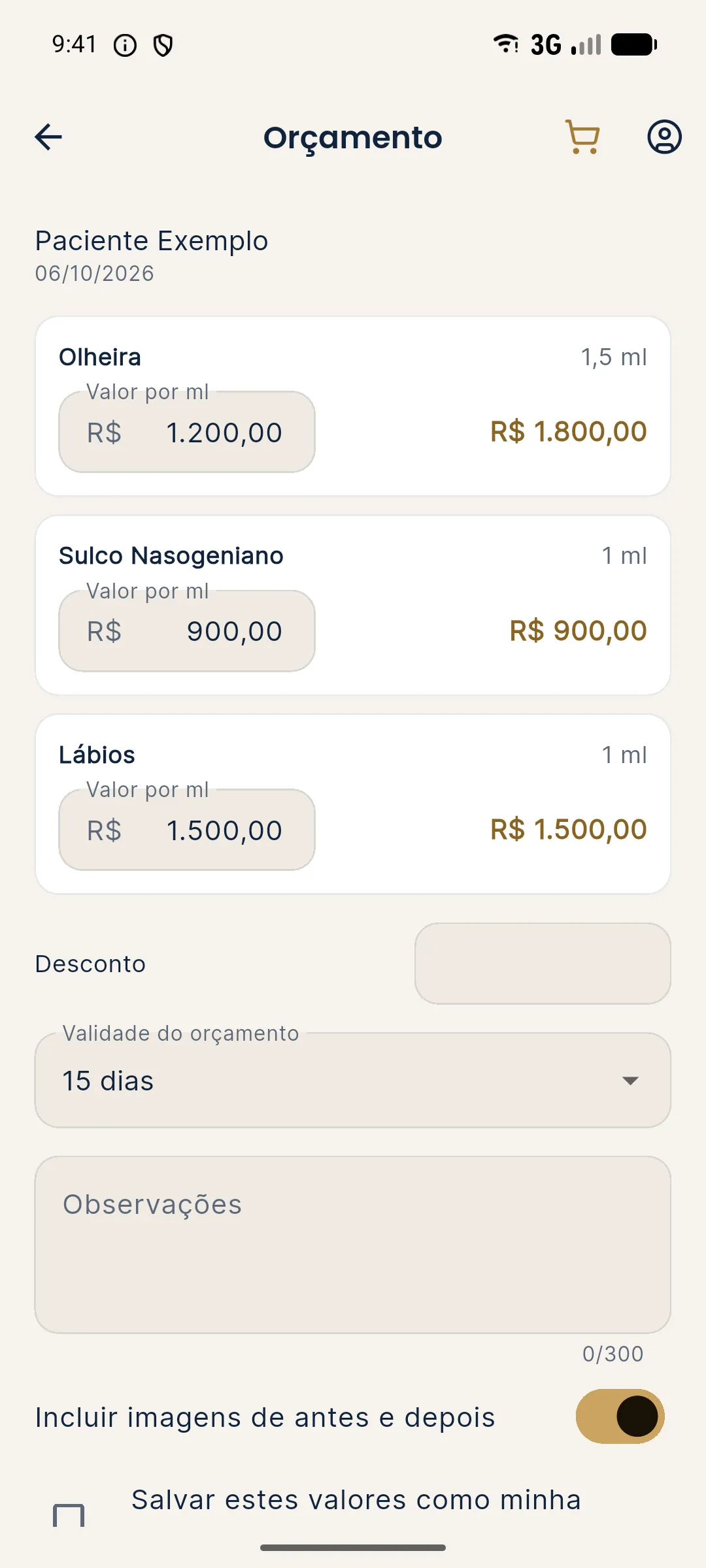
If you want to show the simulation alongside, remember that it is an illustrative projection, not a promise of results. The quote should be consistent with what was agreed at the assessment and with the informed consent.
Common mistakes
- A single number with no detail. The patient does not know what they are paying for and tends to ask for a discount on the total.
- Missing validity. A quote with no deadline becomes an open commitment.
- Guarantee language. Write "planned" and "at the professional's discretion", never "guaranteed".
- Mixing alternative treatments into the total. Keep the options separate.
- Forgetting the return visit. State whether the review is included or not.
Final step
Hand over the quote without rushing and let the patient decide. Record the date sent and the reply. If they accept, formalize it with the document suited to the procedure. If they ask for changes, generate a new version and void the previous one, so that two documents with different conditions are not circulating.
Frequently asked questions
What should a harmonization quote contain?
Identification of the patient and the clinic, planned areas, volume in ml per area, price of each item, discount, payment method, validity and a notice that the plan may change after the clinical assessment.
Is the quote a contract?
Not necessarily. It is a proposal with conditions and a deadline. Informed consent and the services contract, when there is one, are separate documents.
Can I include prices for treatments the patient has not yet decided on?
You can, as separate, labeled options so they can compare. Make clear what is included in the total and what is an alternative.
How does Harmy help build the quote?
In Harmy, the PDF quote uses the price per ml of each area, accepts a discount and a validity period, and comes out with the clinic's name and logo. The installments shown are informational.