
Patient photo record form template for facial harmonization

A well-made clinical photo is one of the best follow-up tools in orofacial harmonization (HOF): it allows objective comparison, guides planning and documents the patient's initial condition. A poorly recorded photo, with no date, no standard and no consent, becomes a problem.
The form below organizes the record: which angles, when, under what conditions and for what purpose. For technique, see standardized clinical photography and the standardized patient photo checklist.
What does the form need to record?
| Item | Why record it |
|---|---|
| Date and phase (before, immediate post-procedure, follow-up) | Enables the timeline |
| Angles taken | Ensures comparison |
| Device and distance | Reproduce the conditions |
| Light and background | Reduce variation |
| Expression | Neutral or dynamic |
| Purpose | Clinical, teaching, promotion |
| Consent | Basis for use |
| Storage location | Data security |
Form template
Why does standardization matter?
A change in light or angle can make an area look larger or smaller when nothing has changed. That is why the form records the conditions. When you know the follow-up photo was taken under the same conditions as the initial one, the comparison has clinical value and can be used more safely in the conversation with the patient.
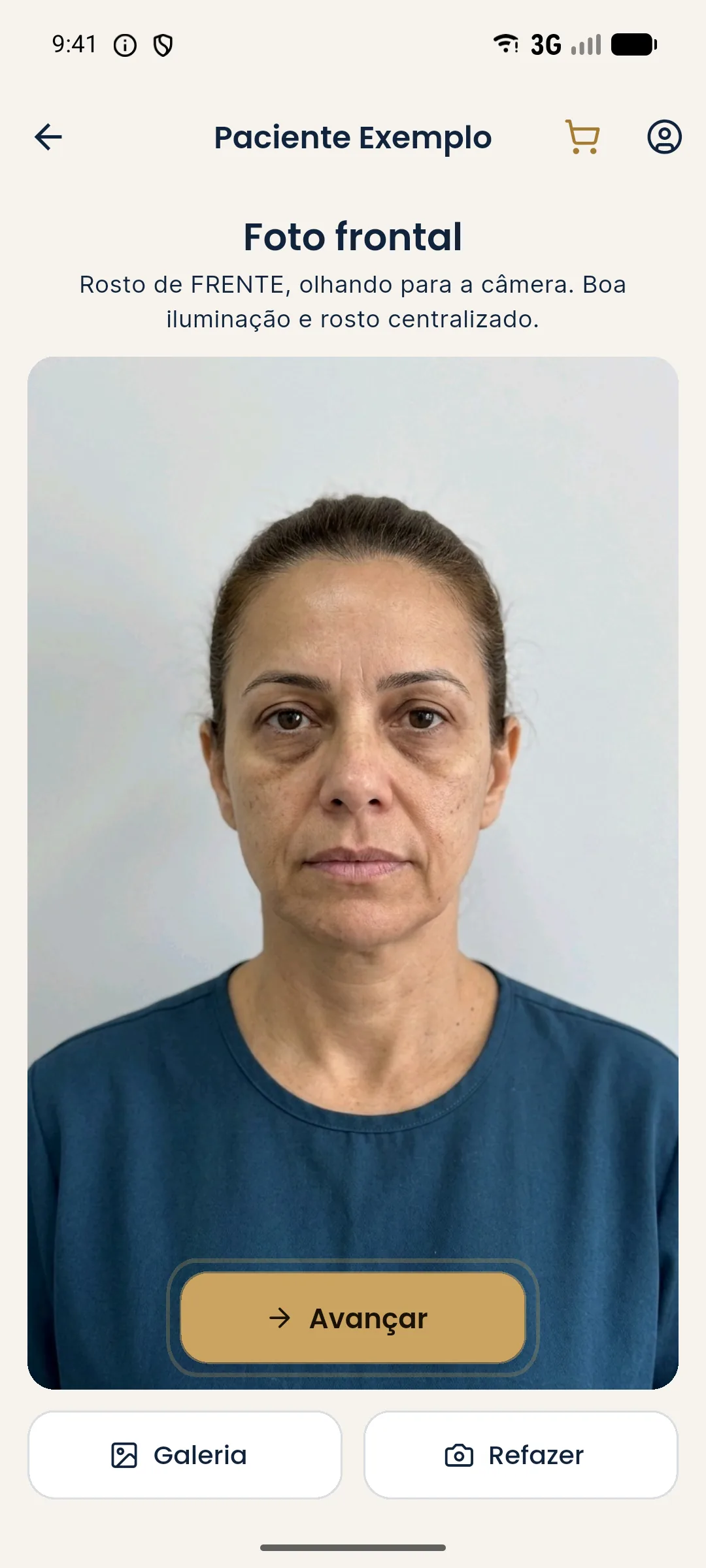
The frontal photo is also the basis of the projection in Harmy. If the photo is well taken, the marking of points and the reading of the slider are clearer.
Consent and LGPD
A photo of the face is personal data and, in a health context, sensitive data. Ask for written consent and separate the purposes. If you will use the image for promotion, use a dedicated document, such as the patient image use consent form, and check the rules on what you may publish.
The LGPD requires purpose, security and restricted access. Avoid leaving photos in the phone's personal gallery, sharing them through open apps or sending them in groups. For teaching use, apply anonymization where possible and confirm the face does not identify the patient.
Suggested routine
Always photograph before any procedure, after the procedure when it makes clinical sense and at the agreed follow-ups. Name files using a pattern (for example, date and phase), without exposing the full name in the file if the storage location is shared. Record it on the form, attach it to the patient record and review every six months what still needs to be kept and what can be discarded according to applicable rules.
Frequently asked questions
Which angles should be photographed in facial harmonization?
The routine usually includes frontal, right and left profiles, oblique views and, in some cases, views from below and above, plus expressions. The professional defines the list according to the purpose of the record.
Can I use patient record photos for promotion?
Only with specific authorization for that purpose and in compliance with the advertising rules of your professional council and CONAR (Brazil's advertising self-regulation council). A patient record photo has a clinical purpose.
Where should patient photos be stored?
In a secure place with access control, outside the phone's personal gallery whenever possible. They are health data and personal data, protected by the LGPD (Brazil's General Data Protection Law).
Does the form need to record the date of each photo?
Yes, along with the conditions (device, distance, lighting). Without that, the before and after comparison loses value.