
How to explain the touch-up to the patient

Quick facts
- Core message
- A touch-up is a planned adjustment, not the correction of a mistake
- When to bring it up
- Before starting, together with the plan and the quote
- Usual window
- Generally after the result settles, about two weeks
- Caution
- Make the cost and the touch-up policy clear in writing
The word "touch-up" has two meanings in the patient's mind. It can be understood as a natural part of the process or as an admission that the first session fell short. If the patient arrives at the follow-up thinking the second, the conversation turns defensive. If they heard the first from the start, the touch-up is simply the next stage. That is why the explanation has to come before the first needle touches the skin.
How to define a touch-up in one sentence?
The sentence has the definition, the reason and removes the stigma. The glossary entry on touch-up explains the concept for the professional.
What types of touch-up exist?
Distinguishing the types helps the patient understand that it is not just one thing.
| Type | How to explain it | When it usually happens |
|---|---|---|
| Planned touch-up | Second stage built into the plan | After the result settles, generally about two weeks |
| Refinement touch-up | Fine adjustment of contour or symmetry | After assessing the settled result |
| Asymmetry touch-up | Correction of a difference between the sides | When the difference persists after the swelling |
| Resorption touch-up | Replacement when the effect fades | Months later, and close to maintenance |
The last type is easily confused with maintenance. See explaining maintenance of the harmonization for the difference.
Why plan in two stages?
Three practical reasons the patient understands well:
- Safety. Starting with a conservative volume lowers the risk of overdoing it.
- Natural look. Swelling makes it hard to judge the result on the day; waiting shows the real effect.
- Control. The patient takes part in the decision to go further or stop.
This is especially useful the first time, with mature skin and in areas where excess is noticeable. See aligning expectations at the first consultation and aligning expectations about natural results.
How to agree on the touch-up policy?
This is the most common source of misunderstanding. Before starting, make clear and put in writing:
- whether the touch-up is included in the price or charged separately;
- within what period the patient can request it (for example, within a window of days);
- that the professional assesses the need, not the other way around;
- that any additional product has a cost.
How does Harmy help plan in stages?
Harmy lets you simulate a conservative volume and a larger one for the same patient, and show the difference. This helps the patient understand why the first stage is more discreet. The "First time" shortcut already applies small volumes (lips 1 ml Moderate; tear trough 1 ml Subtle), and the "Maintenance" option applies volumes of 0.5 to 1 ml at Subtle intensity.
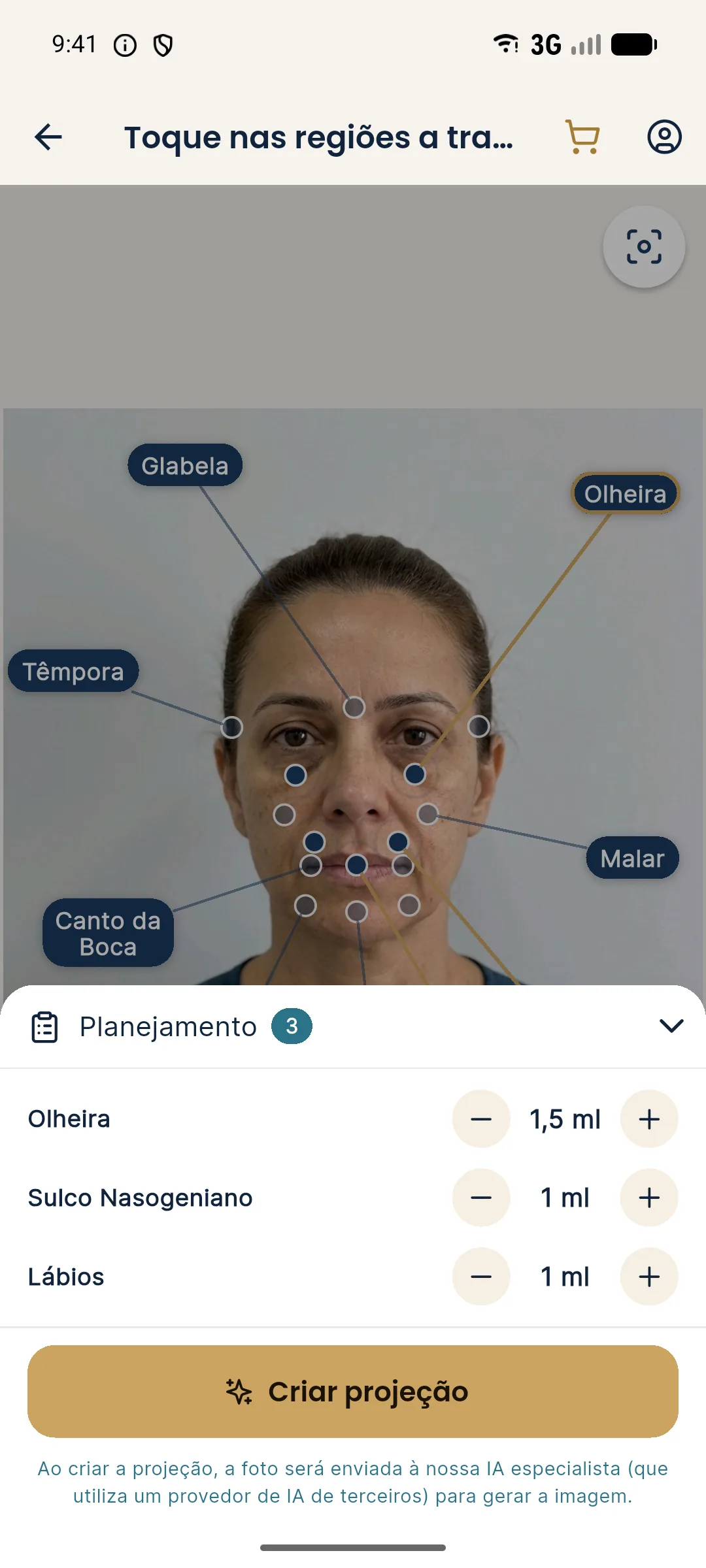
To compare two intensities on screen, see comparing intensities in the simulation.
How to run the follow-up?
At the follow-up, compare the standardized starting photo with the current one and with the simulation, and ask what the patient notices. Only then decide about the touch-up. Avoid injecting more product on the day of the follow-up without assessing.
What to do when the patient asks for a touch-up out of impatience?
It happens: the patient sees the swelling in the first few days and wants "more". Explain that the face is still settling and that assessing before two weeks tends to be misleading. If they insist, record that the request came early and that the advice was to wait. See aligning expectations about timing.
What questions to expect?
What to record?
Record in the patient record and in the consent form that the touch-up was explained, the agreed policy, the follow-up timeframe and the planned date. Keep the standardized photos from the start and from the follow-up. If there is a charge, it must appear in the quote.
When the touch-up is announced as part of the plan, it stops being a delicate subject and becomes just the next page of the conversation.
Frequently asked questions
What is a touch-up in facial harmonization?
It is a targeted adjustment, made after the result settles, to refine volume or contour. It may be part of the plan or arise after the assessment.
Does a touch-up mean something went wrong?
Not necessarily. In many plans, the two-stage approach is deliberate, to reach a natural result more safely. Explain this beforehand.
When should the touch-up be done?
Generally after the swelling goes down and the product settles, which usually takes about two weeks. The professional defines the exact timing after assessment.
Is the touch-up charged?
That depends on each professional's policy. What matters is to agree on it and put it in writing, before starting, whether there is a charge and under what conditions.
Harmy images are illustrative simulations generated by AI from the patient's photo to support the conversation between practitioner and patient. They are not a promise of results. Indication, technique, product and volume are solely the decision of the licensed practitioner. This content is for information only and does not replace a clinical assessment.