
Livedo after filler: a net-like pattern on the skin
Quick facts
- Definition
- Violet or bluish discoloration of the skin in a net or lace pattern.
- In HOF
- After filler, it is a sign of ischemia from vascular occlusion until proven otherwise.
- When it appears
- Usually minutes to hours after the occlusion, often after a phase of pallor.
- Distribution
- Follows the territory of the affected vessel and may be far from the injection point.
- Difference from ecchymosis
- Ecchymosis is a flat, continuous patch at the puncture point; livedo is net-like and follows a territory.
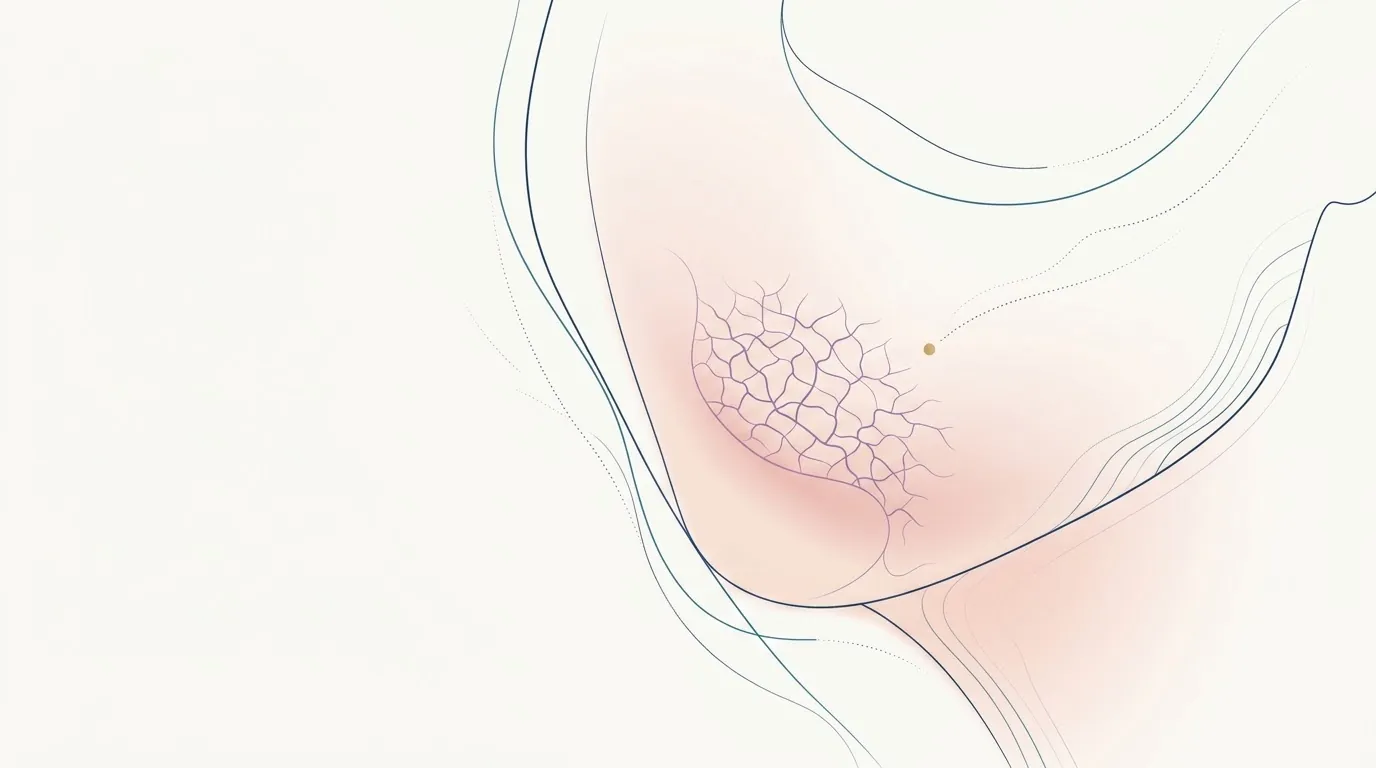
Livedo is a violet or bluish discoloration of the skin in a net pattern, with lighter areas in the center of the meshes, resembling lace. In dermatology, the term describes several patterns linked to changes in blood flow in the small vessels of the skin. After filler, livedo has a specific and serious meaning: it is a sign of ischemia from vascular occlusion until proven otherwise.
Why does livedo appear in an occlusion?
When an artery is blocked by the product or compressed, the area it supplies receives less blood. The blood that remains stays stagnant in the small veins of the skin, loses oxygen and darkens, and the pattern of those veins becomes visible as a net. That is why livedo usually appears after a phase of pallor, skin blanching, and follows the territory of the affected vessel, and it may show up far from where the product was injected.
How do you tell livedo from other discolorations?
| Sign | Appearance | What it usually indicates |
|---|---|---|
| Livedo after filler | Irregular violet net that spreads; may come with pain, coldness and slow return of color | Ischemia from vascular occlusion |
| Ecchymosis | Flat, continuous patch at the puncture point or just below it; changes color over the days | Extravasated blood, benign |
| Bruise (hematoma) | Patch with palpable volume at the injection point | Collection of blood, benign in most cases |
| Physiological livedo | Regular, diffuse net on the limbs and trunk that appears in the cold and goes away when warmed | Normal response of the vessels to cold |
| Tyndall effect | Stable bluish tone, no net pattern | Hyaluronic acid in a superficial plane |
When in doubt between ecchymosis and livedo, the safe approach is to treat it as a warning sign and assess it right away. Slow return of color when pressing the area, compared with the neighboring skin, strengthens the suspicion of ischemia.
What happens if it is not treated?
Livedo indicates that the tissue lacks the oxygen it needs. If blood flow is not restored, the area can progress over the following days to pustules, blisters, dark crusting and tissue loss, known as necrosis. The time window in which it can still be reversed is covered in therapeutic window.
Where is the risk greater?
Livedo can appear in any treated area, but it is discussed most in areas with important arteries and little alternative circulation: glabella, nose, nasolabial fold and lips. The pictures by area are in lip vascular occlusion and nasal vascular occlusion.
How should you advise the patient?
Because livedo can appear hours later, when the patient is already home, the aftercare instructions should explain what to watch for and whom to notify. Photographing the area at the time of the complaint helps document and follow the evolution.
Also called: livedo reticularis, post-filler livedo, lacy skin, mottling.
Frequently asked questions
Is net-like skin after filler normal?
No. A net-like pattern, violet or bluish, that appears after filler is a sign of vascular compromise until proven otherwise. The professional must be notified immediately to assess and start care.
Does livedo go away on its own?
Physiological livedo, which appears in the cold, goes away when the skin warms up. Livedo after filler is different: it indicates a lack of blood in the tissue and needs care, because it can progress to necrosis if blood flow is not restored.