
Blurred Vision After Filler: An Emergency

- Artery
- Highlighted area
Quick facts
- Question
- What to do if vision becomes blurred after filler
- Severity
- Ophthalmic and vascular emergency, measured in minutes
- Immediate action
- Stop, alert, activate the emergency response, and refer to a service with ophthalmology
- Who decides
- The professional on site and the emergency service
This text is different from the others. Blurred vision after filler is not an aftercare question, it is an emergency. The complication is rare but serious, and time makes all the difference. This page exists so that you, the professional, and your patients recognize the problem quickly and act without hesitation. It does not replace training, clinic protocol, or specialized care.
What is happening?
In rare cases, during or shortly after injection in certain areas, the product can enter a facial vessel and travel through connections that reach the circulation of the eye, such as the ophthalmic artery and the central retinal artery. Obstruction of these arteries reduces the blood supply to the retina and optic nerve, and can cause partial or total loss of vision, known as amaurosis. It is a type of vascular occlusion with ocular consequences.
The areas most associated in the literature are those with vascular communication to the orbit: glabella, nose, nasolabial fold, forehead, and temples. This does not mean other areas are free of risk. The overview is in visual complication after filler.
Which symptoms to look for
| Symptom | How the patient describes it |
|---|---|
| Vision loss in one eye | "I can't see on one side" |
| Sudden blurring | "Everything looks foggy" |
| Scotoma or visual field loss | "There is a dark spot in the middle" |
| Double vision (diplopia) | "I'm seeing double" |
| Severe eye or periocular pain | "It hurts a lot behind my eye" |
| Drooping eyelid, difficulty moving the eye | "I can't open or move my eye" |
| Severe headache, nausea, dizziness | May indicate neurological involvement |
| Pale skin, net-like patches, local pain | Signs of skin ischemia that accompany the picture |
Symptoms can appear during the injection, in the following minutes, or even hours later. That is why the patient should leave the office knowing exactly what a visual change means and where to go.
What to do right away
This is an outline of principles. The detailed protocol should be set by the service, with team training, according to the professional's qualifications and the rules of their professional board.
Note these points: the specific management of hyaluronidase doses and routes is not on this page, because it is a decision for the trained professional and the literature evolves. What matters here is the speed of recognition and transfer. See hospital transfer of the patient and the office emergency checklist.
What the patient needs to know before leaving
Written instructions are part of aftercare. Include a direct sentence and a phone number.
Agree on the contact channel and confirm that the patient knows the address of the nearest emergency service, especially if they live far away or are about to travel. With every minute without care, the chances of recovery decrease.
How to reduce the chance of it happening
No technique brings the risk to zero, and the subject belongs to whoever injects. General points the literature discusses: knowledge of facial vascular anatomy, planning of volume and area, emergency preparedness, and a well-equipped setting. Conservative planning and careful choice of the higher-risk areas are part of prevention.
Clear consent also helps: the patient must know that visual complication exists, even if rare, and that the professional is prepared. See informed consent in harmonization.
What about Harmy?
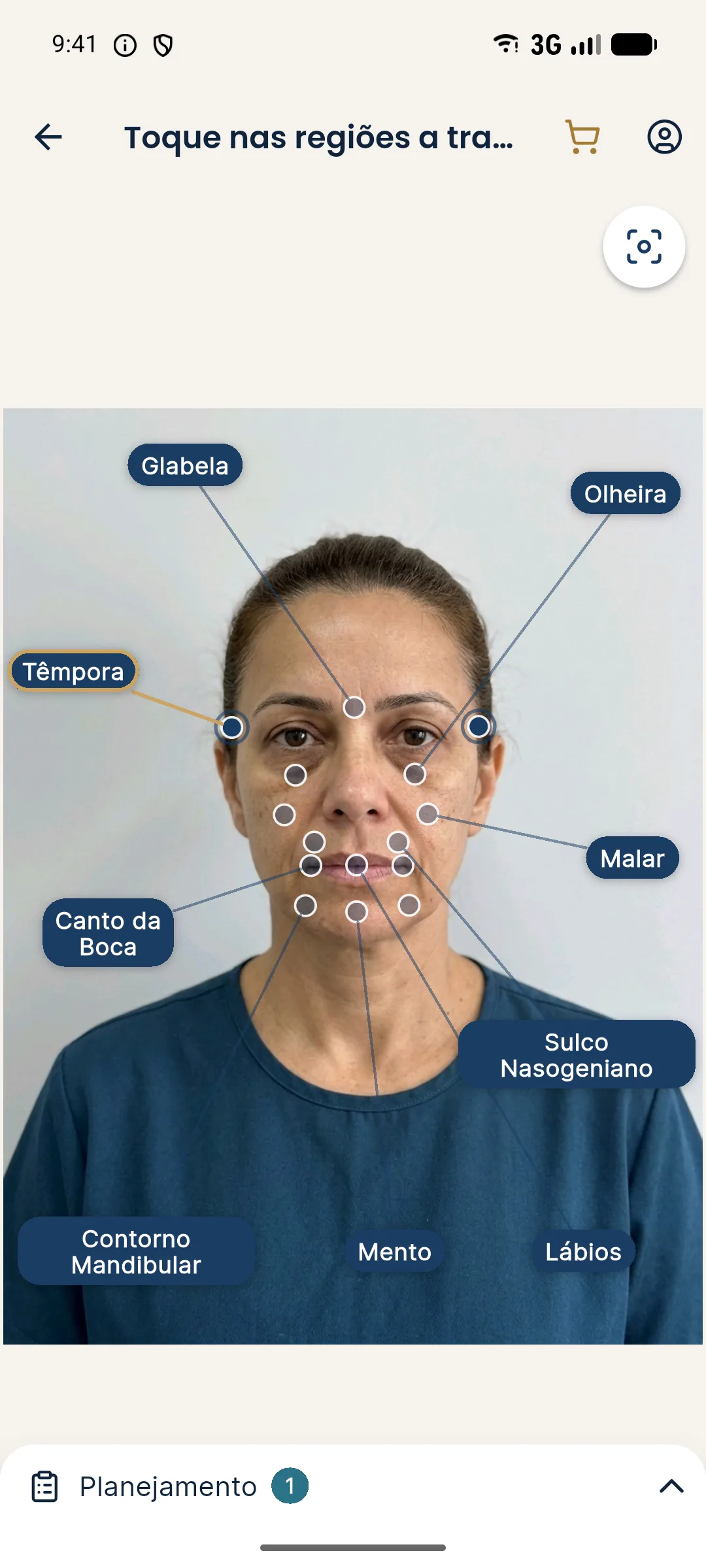
Harmy does not assess vessels or prevent complications. It helps you plan conservatively: by marking the areas, setting the volume in ml, and showing the projection, the professional and the patient talk about the minimum necessary. The projection is an illustrative simulation, not a promise of results, and the technical and safety decision always belongs to the professional.
Frequently asked questions
Is blurred vision after filler normal?
No. Any visual change during or after facial filler, such as blurring, loss of visual field, double vision, or eye pain, must be treated as an emergency.
What should the patient do if their vision changes?
Tell the professional immediately, if present, or go without delay to an emergency service with ophthalmology, stating that they had facial filler.
Why can filler affect vision?
Because, in rare cases, the product can enter facial vessels that connect with the ophthalmic artery, leading to occlusion of retinal vessels. It is a rare and serious complication.
Does hyaluronidase fix the vision loss?
It may be part of the response when the product is hyaluronic acid, but the visual prognosis is guarded and depends on time. Immediate referral is essential.
Harmy images are illustrative simulations generated by AI from the patient's photo to support the conversation between practitioner and patient. They are not a promise of results. Indication, technique, product and volume are solely the decision of the licensed practitioner. This content is for information only and does not replace a clinical assessment.