
How many ml of lip filler do I need?

 BeforeSimulation
Quick facts
- Question
- How many ml of lip filler
- Usual range
- Small volumes, generally about 0.5 to 2 ml, at the professional's discretion
- What defines it
- Anatomy, balance between the lips, wishes and tolerance for swelling
- Who decides
- The licensed professional, after assessment
The lip is the area where the question of volume weighs most, because any excess is visible from across the room. The patient asks "how many ml?" the way someone asks a sandal size, and the answer depends on more variables than it seems. Lip filler works with small volumes, and that is exactly why every fraction of a milliliter makes a difference.
This page explains how anatomy and proportion set the volume, presents usual ranges and helps you talk about the subject with the patient. Volume and technique are decisions for the licensed professional, according to the rules of their professional council (in Brazil).
Usual range, not a rule
Volumes tend to be small: generally, from a few fractions of a milliliter to a few milliliters in total. Many first-time patients do well with conservative volumes, and those who repeat can adjust over the sessions. The range is a reference and does not replace assessment. For the 1 ml range specifically, see lip filler with 1 ml.
| Profile | How the volume tends to be planned |
|---|---|
| First time, thin lips | Conservative, in stages |
| Lips already full | Small volume or contour only |
| Maintenance | Smaller amount, to replace what was absorbed |
| Asymmetry | Uneven distribution between sides, not necessarily more volume |
| Request for a dramatic effect | Conversation about proportion and the risk of an artificial look |
What proportion has to do with ml
Volume is not just a number, it is the relationship between the parts of the lip. The upper lip is usually a little smaller than the lower; the Cupid's bow defines the shape of the top; the vermilion has its own thickness; the philtrum links the nose to the lip. Injecting a lot of volume while ignoring these relationships can flatten the philtrum, over-project the lip and look artificial.
The most useful question is: "what proportion do we want?". After that, ml is the tool. When the patient arrives with a reference photo, see patient who wants to look like someone else. And on natural aesthetics, natural lip filler.
Why the immediate result is misleading
Right after the injection, the lip has swelling and looks bigger than the final result. The patient gets scared or, on the contrary, delighted, and both judgments are premature. Assessment of the final volume should wait about two weeks. To understand the progression, see swelling after lip filler.
How to use the simulation to decide the ml
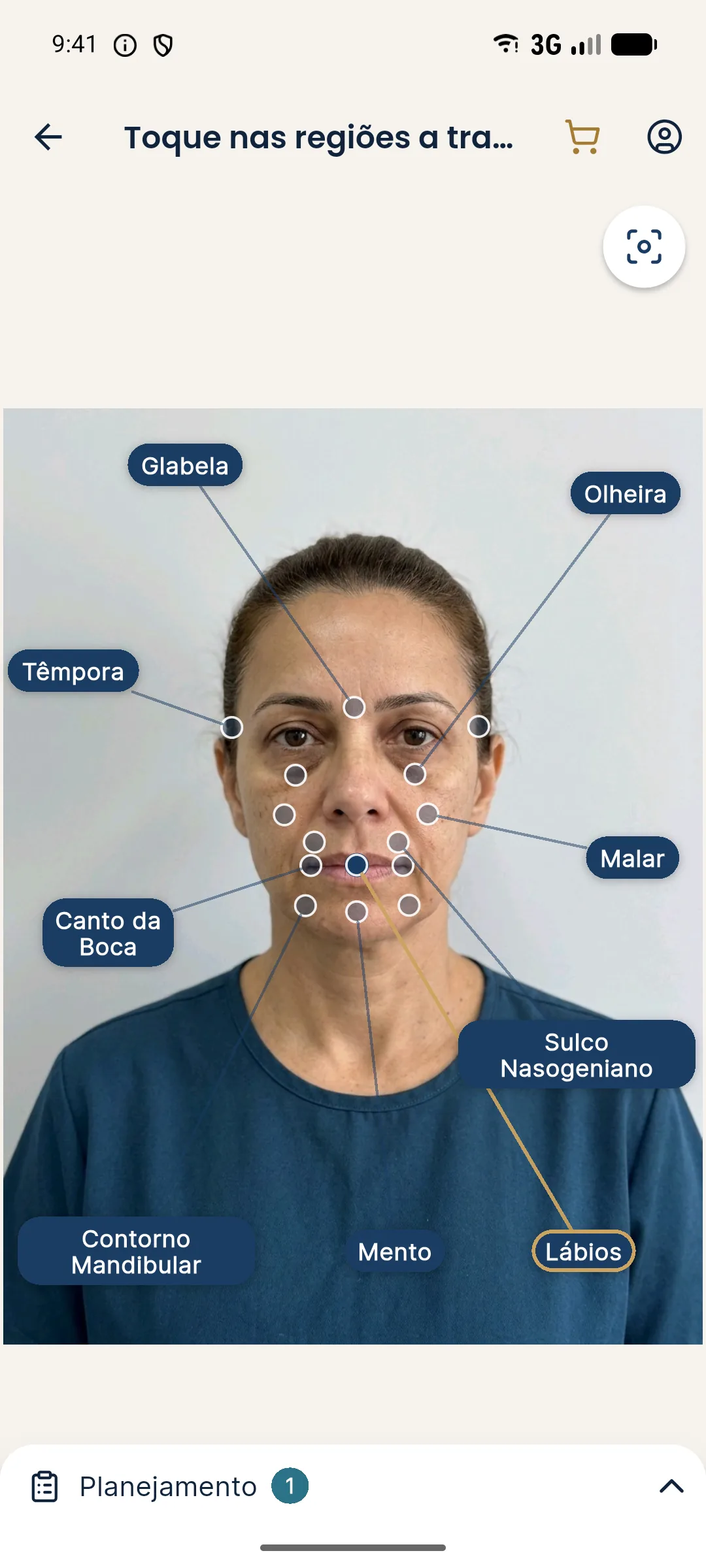
Volume is abstract for the patient, and the simulation makes it concrete. In Harmy, you mark the Lips point, choose the ml (from 0.5 to 5 ml, in steps of 0.5) and the intensity (Subtle, Moderate or Pronounced) and generate an illustrative projection. The "First time" shortcut brings lips at 1 ml in Moderate intensity, and the "Maintenance" shortcut brings 0.5 ml in Subtle intensity. When comparing two versions side by side, the patient often prefers an in-between one to the one they had in mind.
Questions to define the volume
When the request comes as "just a little more"
It is common for the patient to ask for more at the follow-up. Before agreeing, check whether the swelling has gone down, compare the photos and ask what bothers them. Often the problem is proportion, not volume. The reasoning is in lip filler that went wrong and in asymmetry after lip filler.
Summary
There is no "right" ml for the lip, there is the volume that respects proportion and the patient's wishes. Starting conservatively, waiting out the swelling and reviewing with photos is usually the lowest-risk path.
Frequently asked questions
How many ml of hyaluronic acid are used in the lips?
Usually small volumes, in the range of about 0.5 to 2 ml, varying with anatomy and goal. The amount is set by the professional after assessment.
Is 1 ml a lot or a little for the lips?
For many patients, 1 ml already changes the proportions noticeably. Whether it is a lot or a little depends on the starting point and the wish.
Does more ml make the lip look better?
Not necessarily. Too much volume throws off the balance, affects the philtrum and the Cupid's bow, and tends to look artificial.
Do I need to do it all at once?
Many professionals prefer to start conservatively and adjust at a follow-up, to avoid overfilling.
Harmy images are illustrative simulations generated by AI from the patient's photo to support the conversation between practitioner and patient. They are not a promise of results. Indication, technique, product and volume are solely the decision of the licensed practitioner. This content is for information only and does not replace a clinical assessment.