
Double Chin in Profile: Fat, Skin or Recessed Chin

 BeforeSimulation
- Nerve
- Highlighted area
Quick facts
- Concern
- Fold or fullness under the chin that shows in profile, even in thin people
- Key reading
- It may be fat, skin, platysma or simply a recessed chin that "pushes" tissue downward
- Supporting measure
- Profile photo in the horizontal plane and cervicomental angle
- Limit
- Projecting the chin can improve the look, but excess fat calls for a different approach
"I have a double chin" is one of the most photographed and least explained concerns. Patients usually look at themselves in profile and see a fold under the chin. The intuitive fix is to "remove the fat", but the cause may be something else. In many thin patients, what looks like fat is a poorly projected chin that leaves the tissue under the jaw without support.
The point here is to teach how to tell these causes apart in the profile photo. If the patient's topic is the submental fullness itself, see double chin: assessment and double chin even when thin. For descent of the chin tissue, read witch's chin, and for combining areas, double chin with a small chin.
What are the four causes of an apparent double chin?
The look of a fold under the chin depends on the sum of several structures. In practice four causes stand out, and more than one may be present:
| Cause | What happens | How to suspect it |
|---|---|---|
| Submental fat | Buildup of fatty tissue under the chin | Palpable, soft fold, persists in profile and from the front |
| Loose skin | Loss of elasticity, "excess" skin | Fold that improves when the skin is stretched with the fingers |
| Platysma and bands | Slack neck muscle, with bands | Vertical bands when talking or contracting |
| Recessed chin | Poorly projected pogonion, open angle | Smaller fold when the chin is projected by hand |
These elements relate to the cervicomental angle, the angle between the chin and the neck. When it is very open, the transition is poorly defined, and skin and fat "fall" into that space. Subplatysmal fat and the platysma take part in the architecture of the area.
How to take the profile photo
The profile photo requires standardization. Ask the patient to hold the head in the Frankfurt horizontal plane (lower edge of the eye socket aligned with the upper point of the ear canal), with the mouth at rest and the teeth lightly touching. A photo with the chin down or raised completely changes the cervicomental angle and misleads the assessment.
Photograph both sides, at rest and with the patient swallowing, which helps show the platysma. Also consider a photo with the head slightly extended, which shows excess skin. The method is in profile facial analysis (checklist) and in retrognathic profile: assessment.
When is a recessed chin the cause?
Retrogenia is a frequent finding in thin people with a double chin. The chin bone sits behind the ideal line, the soft tissue is left unsupported and the transition to the neck sags. In these patients, chin projection reduces the fold and improves definition without touching the fat. Reading the profile uses the facial convexity angle and the position of the pogonion, and the technical term is retrogenia.
This changes the conversation. The patient who came wanting to "remove fat" discovers the problem is projection. That understanding prevents the wrong treatments, such as lipolysis in someone with no excess fat, and points toward chin filler.
And when the cause is fat or skin?
If the projection test does not change much and the fold is palpable and soft, submental fat carries weight. Options include procedures that reduce localized fat, at the discretion of the licensed professional and within the rules of their professional council, and a liposuction assessment with a plastic surgeon for larger cases.
When skin is the culprit, with loss of elasticity, the plan may include biostimulation, threads or technologies that stimulate collagen, always with realistic expectations. See PDO threads in the neck and lower third and biostimulator in the neck. With excess skin, surgery is usually the most effective answer.
| Predominant cause | Approach discussed | Limit |
|---|---|---|
| Recessed chin | Chin projection | Excess creates an artificial profile |
| Fat | Localized fat reduction or surgery | Does not project, does not tighten skin |
| Loose skin | Collagen stimulation, threads | Moderate effect; surgery in larger cases |
| Platysma and bands | Toxin in selected cases | Requires careful assessment |
How to explain it to the patient
The conversation needs to replace "removing the fat" with "understanding what forms the fold". Show the photo, point out the angle and use the projection test. Seeing the difference with their own eyes, the patient understands why the plan starts where it starts.
For male patients, the reasoning is similar, with attention to the masculine design of the chin and jaw. See men with a double chin and ideal chin projection by sex.
What does Harmy simulate?
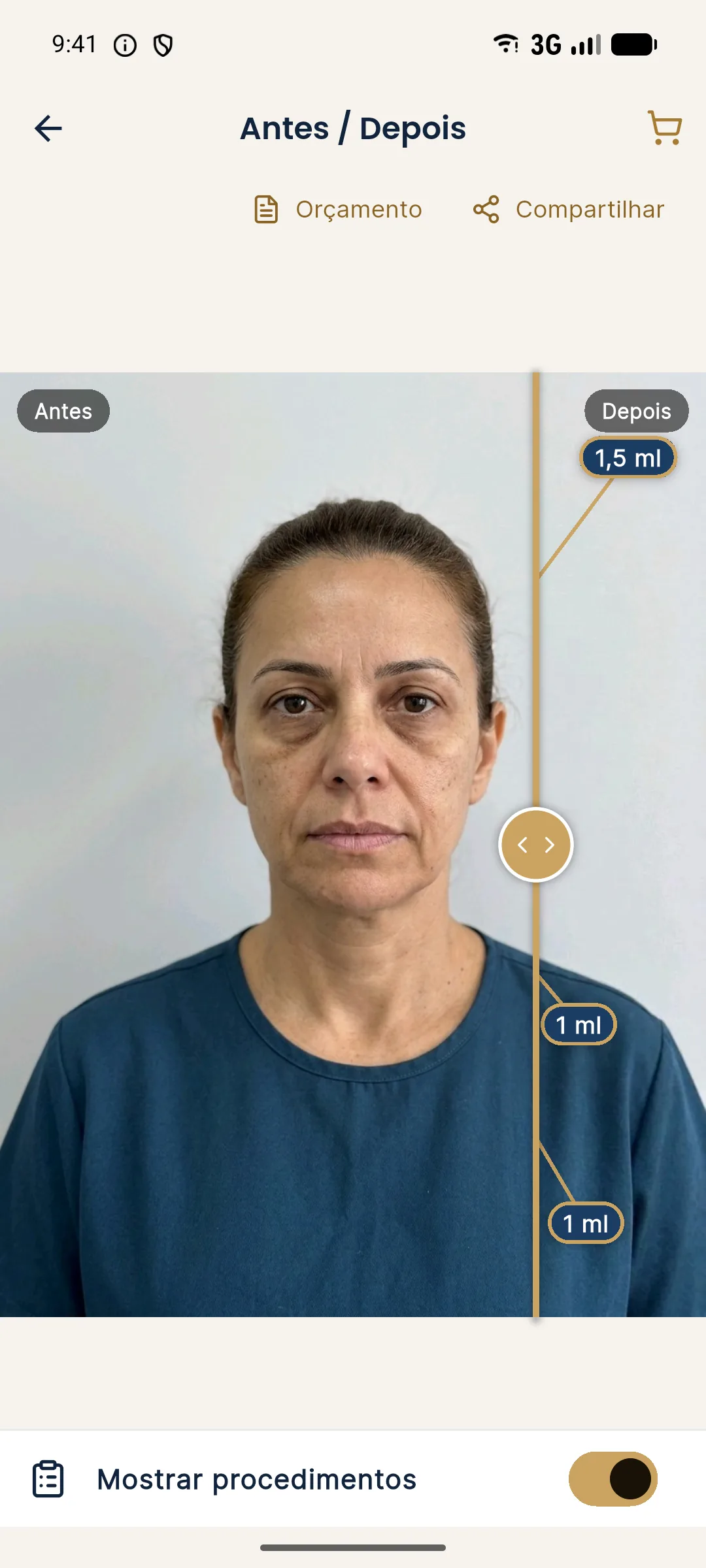
A double chin is a profile concern, and Harmy uses only the frontal photo. The projection helps discuss volume and chin contour seen from the front, but it does not show the cervicomental angle or the fold. This limit must be clear, because patients often expect to see the double chin shrink in the image.
When to refer
Refer for a plastic surgery or dermatology assessment when there is significant submental fat, very loose skin, marked bands or a desire for a result HOF does not deliver. If a thyroid problem or another condition that changes the neck is suspected, medical investigation comes first. The flow is in referring patients in HOF.
Record keeping
Save the standardized profile photos, the result of the projection test, the probable classification, the plan as a range and what was explained about limits. At follow-up, repeat the exact photo. Standardized clinical photography and chin and double chin: combining in the plan complete the method.
Frequently asked questions
Is a double chin always fat?
No. It can be submental fat, loose skin, platysmal bands or a recessed chin, which leaves the tissue unsupported and creates the look of a fold. The cause defines the approach.
Why do thin people get a double chin?
Because the look can come from the position of the chin bone, the skin and the musculature, not only fat. A recessed chin, for example, leaves the neck with an open angle.
Does filling the chin reduce a double chin?
In some cases, projecting the chin improves the definition between chin and neck and softens the look. If the problem is fat or excess skin, the effect is limited, and the decision is up to the licensed professional.
When should you look to another specialty?
When there is obvious fat accumulation, excess skin or marked bands, an assessment by a plastic surgeon or a dermatologist may help, depending on the case.
Harmy images are illustrative simulations generated by AI from the patient's photo to support the conversation between practitioner and patient. They are not a promise of results. Indication, technique, product and volume are solely the decision of the licensed practitioner. This content is for information only and does not replace a clinical assessment.