
Witch's Chin: Chin Ptosis and Treatment Options

 BeforeSimulation
- Nerve
- Highlighted area
Quick facts
- Concern
- Chin that droops and points downward, with loose skin and a "beak" look
- Key reading
- Chin ptosis combines tissue descent, loss of support and, sometimes, a recessed chin
- Supporting measure
- Profile and frontal photo, cervicomental angle and skin mobility
- Limit
- With excess skin or tissue, volume and toxin have limited effect and surgery enters the conversation
The term is informal and unkind, but it is what patients type: "witch's chin". Behind it is chin ptosis, in which the chin tissue descends with age, forming a tip that curls downward and inward, sometimes with a crease beside it and with loose skin over the neck. Many postmenopausal patients report this concern, but it also appears in people who lost a lot of weight.
Management requires care, because the instinct to "add volume" can worsen the look. Read on to recognize the picture, separate what is descent from what is recession, and choose what fits within HOF. The sister page double chin in profile covers the accumulation under the chin, and wrinkled chin skin covers texture.
What happens to the chin over the years?
The chin is formed by the pogonion (the tip of the bone), by soft tissue and by muscle insertions. With age, three changes add up: the bone of the jaw and chin partially resorbs, fat and skin lose support, and the mentalis muscle keeps pulling the skin upward. Together these make the tissue slide downward and give the chin a pointed, drooping look.
The neck takes part. The platysma weakens, the bands become visible, and the cervicomental angle becomes more open. The line between chin and neck loses definition, and laxity enters the picture. The whole resembles the descent of the lower third elsewhere, such as the jowl.
How to recognize the picture
The most frequent signs of chin ptosis are:
- Chin tip pointing downward, with the skin forming a curve over the bone.
- Horizontal crease above the chin, the deep mentolabial fold.
- "Wrinkled" chin when talking and smiling, from mentalis action.
- Profile with a short chin, over which the tissue seems to "hang".
- Poor transition between chin and neck, with an open cervicomental angle.
- Thin, loose-looking skin over the area.
Tell it apart from similar pictures. In a recessed chin (retrogenia), the bone is set back and the tissue may be well positioned. In a double chin, the accumulation is under the chin. In witch's chin, the problem is the descent of the chin tissue itself. All three can coexist, and it is the profile assessment that separates them (see retrognathic profile: assessment).
| Condition | Main finding | Where to look | Most discussed approaches |
|---|---|---|---|
| Witch's chin | Drooping chin tip | Profile and pogonion position | Conservative projection, toxin, skin |
| Recessed chin | Bone with little projection | Profile and convexity angle | Projection volume, orthodontics |
| Double chin | Accumulation under the chin | Submental region | Assess fat, skin and platysma |
| Wrinkled chin skin | Texture with movement | Frontal in motion | Mentalis toxin, skin care |
What can harmonization do?
The plan is about balance, not major correction. Depending on what predominates, the licensed professional may consider:
- Conservative chin projection, to support the tissue and improve the relationship with the lower lip, avoiding lengthening. See chin filler.
- Mentalis toxin, when the mentalis muscle accentuates the tip and the texture. See mentalis toxin.
- Jawline support, when jowl descent contributes. See laxity along the face contour.
- Biostimulator or threads, in cases of moderate laxity, at the professional's discretion. See biostimulator in the chin.
- Skin care as part of the long-term plan.
In the chin area, the risks include swelling, bruising, asymmetry, nodules and, rarely, vascular complications. With hyaluronic acid, hyaluronidase must be at hand. The patient must be told that the correction is partial, and the decision to inject or not is up to the professional after an assessment. For the general risks, see safety and complications.
When do you hit the limit?
In some cases the excess tissue is greater than any volume or stimulus can offset. If the skin is very loose, if submental fat is significant or if the platysma has prominent bands, HOF works as part of a plan that may include plastic surgery. Saying this clearly to the patient avoids frustration.
The limit also shows up when the patient asks for an injectable "lift". The comparison has to be honest: volume and stimulation improve support and quality, but they do not remove tissue or do the surgical repositioning. For how to frame the conversation, see explaining the chin to the patient and concerns that HOF does not solve.
How to present the plan to the patient
Start by acknowledging the concern without using the informal term. Show the profile photo, explain what is happening with the tissue and present the plan as balance, not complete correction. Then define what is possible in HOF and what depends on another specialty.
The concern also varies with sex and age. In women going through menopause, the hormonal context weighs in, as in menopause and the face. For people who lost weight quickly, see double chin after weight loss.
What does Harmy show?
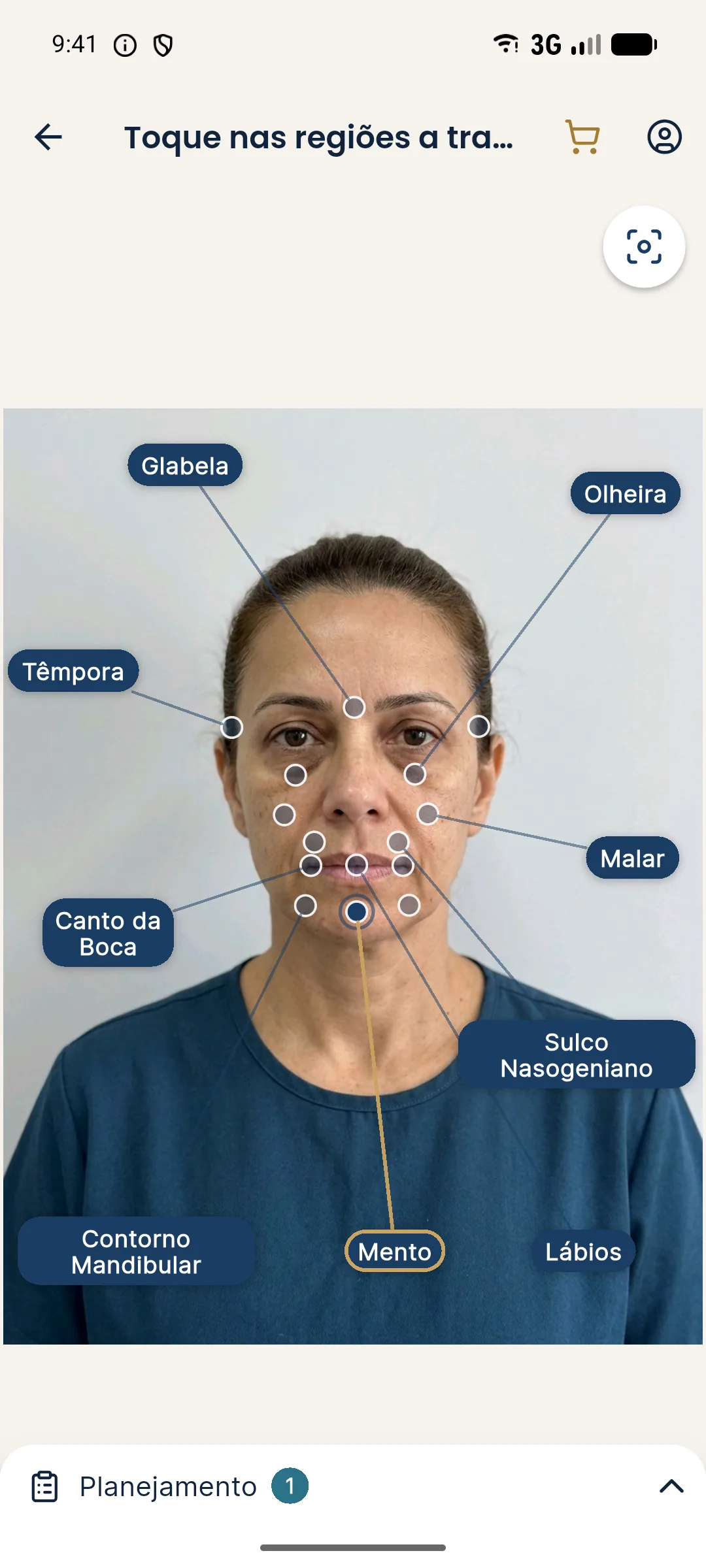
Harmy does not simulate the profile, which is where witch's chin is most visible. The projection uses only the frontal photo and shows a small change in the chin. Use it to discuss proportion and contour seen from the front, but make clear that chin ptosis is a profile concern and that the app does not show the effect on the chin tip.
Record keeping
Record the profile and frontal photos, the skin and platysma findings, the plan as a range and what was explained about limits. At follow-up, always compare in profile, at the same angle. Standardized clinical photography describes the method, and the long-term plan can be organized with chin and double chin: combining in the plan.
Frequently asked questions
What is witch's chin?
It is chin ptosis: the soft tissue of the chin drops, the tip points downward and the chin contour curls over the neck area. It usually comes with side creases and laxity in the lower third.
What is the difference between witch's chin and double chin?
In witch's chin, descent of the chin tissue is the main finding. In double chin, the focus is an accumulation of fat or skin under the chin. The two can coexist.
Does filler make witch's chin worse?
It can if it is placed in a way that lengthens the chin even more. Volume should be planned to project and balance, not to add to the droop. The decision is up to the professional after an assessment.
Does toxin in the chin help with chin ptosis?
It can relax the mentalis muscle, which sometimes accentuates the look, but it does not reposition the tissue. Its role is complementary, and the indication requires an assessment.
Harmy images are illustrative simulations generated by AI from the patient's photo to support the conversation between practitioner and patient. They are not a promise of results. Indication, technique, product and volume are solely the decision of the licensed practitioner. This content is for information only and does not replace a clinical assessment.