
Menopause and the face: what changes in the assessment

Quick facts
- Concern
- Rapid change in the skin and the contour of the face during menopause
- Method
- Assess skin, volume, bone and contour and listen to the concern without assuming a single cause
- Structures
- Skin, collagen, fat, facial bone and ligaments
- Caution
- Hormonal health is medical follow-up, and aesthetics neither replaces nor decides it
Menopause is a period of change that does not always show up in the mirror all at once. Some patients report that, within a few years, the face "lost its firmness," the skin became thinner and drier and the contour softened. Others notice little. For the professional, the task is to welcome the concern, assess with method and avoid two traps: promising to reverse age and treating hormones as if they were an aesthetics matter.
This page organizes the assessment. It connects with lax skin on the face, laxity after 40 and harmonization plan in menopause.
What usually changes in the face?
The drop in female hormones is associated, in many people, with changes in skin quality and in the supporting structure. The observations below are of a general clinical nature, and the intensity depends on genetics, habits, sun, smoking and other factors.
| Layer | Observed change | Effect on appearance |
|---|---|---|
| Skin | Thinner, drier, less elastic | Fine lines, altered texture |
| Collagen | Lower production over time | Loss of firmness |
| Fat | Redistribution and loss in areas | Flatter midface, jowl |
| Bone | Gradual resorption | Less support, softer contour |
| Ligaments | Loosening | Descent of tissues |
The midface and the lower third concentrate the concerns: flatter cheekbones, deeper nasolabial folds, a less defined jawline and thinner lips. Static wrinkles appear or deepen.
How to organize the assessment
What the plan can consider
At the discretion of the licensed professional, after assessment and with consent, the plan is usually gradual:
- Skin quality and collagen stimulation, with collagen biostimulator in selected cases.
- Support of the midface, with restrained volumes. See cheekbone filler.
- Contour, when there is loss of definition. See jawline filler.
- Lips, respecting proportion. See lip filler.
- Skin care and sun protection, as part of the plan.
A golden rule for this period is to prioritize structure and quality before detail, and to spread the work over stages, because the face keeps changing. Over-ambitious plans in a short period can age poorly.
Risks and precautions
Thinner skin favors bruising, persistent swelling and the Tyndall effect. Patients who take anticoagulants, antiplatelet drugs or supplements that affect clotting need specific assessment. The usual risks of the procedures include swelling, asymmetry, nodules and irregularities, and vascular complications are rare and serious: hyaluronidase should be available when hyaluronic acid is used. Biostimulators carry a risk of nodules and require their own consent.
How to show it in Harmy
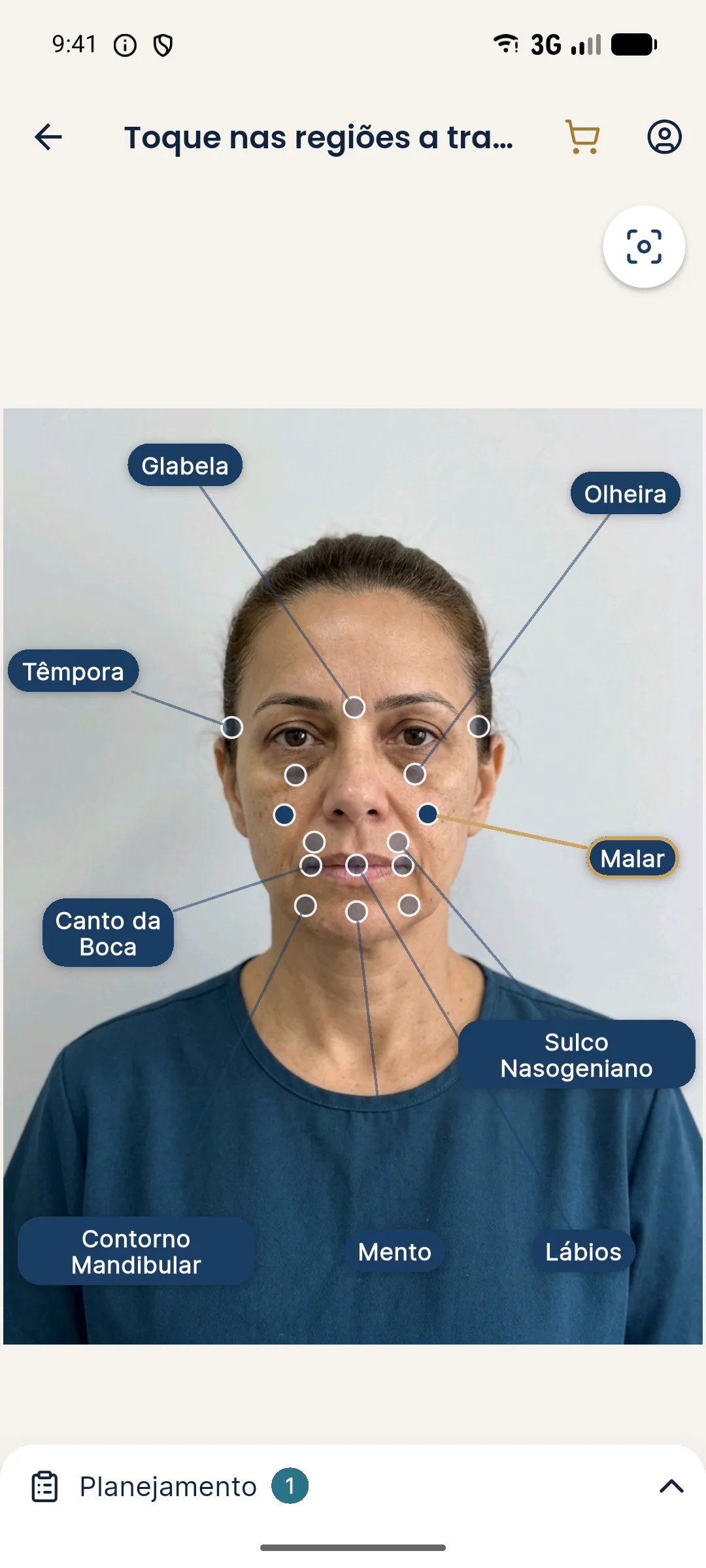
Harmy projects a possible volume effect in the marked areas from a front photo. It does not simulate skin quality or biostimulation, because the projection does not retouch the skin. For the patient in menopause, the app is useful for talking about support of the cheekbone, lips and contour, at Subtle intensity and with a focus on identity. The "Maintenance" shortcut (lips 0.5 ml, line 1 ml and cheekbone 1 ml, all Subtle) is a conversation starter, not a prescription.
Common mistakes with the menopausal patient
The first mistake is promising that harmonization reverses the hormonal effect. Aesthetics supports quality and structure but does not replace medical follow-up, and the patient should hear that. The second mistake is applying too much volume in very thin skin: the product shows, the swelling lasts and the Tyndall risk rises.
Another mistake is ignoring the emotional moment. Menopause comes with changes in mood, sleep and body, and the aesthetic concern may be the tip of a larger discomfort. Listening closely and, when indicated, suggesting medical or psychological support is part of care. It is also a mistake to overlook medications and supplements, such as anticoagulants or herbal products that affect clotting, which change the risk of bruising.
Finally, avoid the "everything at once" plan. In a phase of transformation, the face changes, and the plan needs reassessments.
Practical guidance
Agree on a plan of one to two years, in stages, with regular reviews. Prioritize skin quality and sun protection, and use volume where the loss is most evident. Record the relevant clinical history, the medications mentioned, the standardized photos and the conversations about limits. If the patient is under hormonal follow-up, ask for permission to exchange information with the physician, when it makes sense. Emphasize that each face responds differently and that there is no guarantee of results. The trust built in this period usually extends over many years of follow-up, and the patient values a professional who does not promise miracles.
Patient profiles and stages of the transition
The perimenopause phase tends to bring rapid and confusing changes; postmenopause tends to be more stable, with clearer patterns of loss. In each phase, the plan changes pace.
Women on hormone therapy may have a different skin response, and a conversation with the physician helps in understanding the context. Women with a history of breast cancer or other conditions need specific assessment and clearance before any procedure.
In every case, a warm welcome counts. Many patients arrive insecure about their appearance and their body, and the consultation is an opportunity to give honest guidance, without pressure for procedures, and to build a relationship of trust for the long term.
Wrap-up
Record the photos, the relevant history, the staged plan and the conversation about limits. For related concerns, see face at 60: loss of volume and thin skin at 60. Volumes and techniques are at the discretion of the licensed professional, in accordance with the rules of their professional council in Brazil.
Frequently asked questions
Does menopause change the face?
Many patients notice thinner, drier skin, loss of firmness and volume and a less defined contour during this period. The intensity varies widely between people.
Is a biostimulator indicated in menopause?
It may be considered in selected cases, at the discretion of the licensed professional, for skin quality and support, gradually. The response varies and there is no guarantee of results.
Do I need medical clearance for facial harmonization in menopause?
It depends on the clinical history. If there is hormone therapy, associated conditions or use of medications, a conversation with the patient's physician is part of the assessment.
Can the facial changes of menopause be prevented?
Aesthetics can help maintain quality and support, but it cannot stop the changes. Health care, sun protection and habits are part of the whole.
Harmy images are illustrative simulations generated by AI from the patient's photo to support the conversation between practitioner and patient. They are not a promise of results. Indication, technique, product and volume are solely the decision of the licensed practitioner. This content is for information only and does not replace a clinical assessment.