
Facial sagging after 40: where it starts and how to map it

 BeforeSimulation
- Nerve
- Highlighted area
Quick facts
- Concern
- Skin and soft tissue starting to descend, with loss of contour definition
- Key reading
- Separate volume loss, ptosis (descent) and skin quality
- Where it usually starts
- Middle third and the transition to the lower third, with folds and jowls appearing later
- Limit
- Injectables support and improve quality; they do not do the job of a facelift
After 40, many people come into the office with the same sentence: "my face has started to sag". The concern is real, but not very specific. What is sagging? Volume, fat, skin, bone? For whoever is planning, the question matters more than a quick answer, because each component calls for a different approach and has a different limit.
This page organizes the map of where sagging begins, shows what usually comes first and helps prioritize without promising what injectables do not deliver. For a loose jawline in particular, see sagging facial contour. For the patient's view, face at 40 and loose facial skin.
What happens to the face after 40?
Facial aging is not a single drop. It is a set of changes in layers, advancing at different paces. It can be described on four fronts:
| Component | What changes | How it shows |
|---|---|---|
| Bone | Gradual resorption of the orbits, maxilla and mandible | Loss of support, deeper-set eyes, less defined chin and jaw |
| Deep fat | Reduction and redistribution of the compartments | Hollow cheek, more marked folds |
| Ligaments and fascia | Loosening of the anchoring points | Tissue descent, jowls and nasolabial fold |
| Skin | Less collagen and elastin, less thickness | Static wrinkles, thin and dull look |
This layered reasoning is in facial aging by layers and in retaining ligaments and sagging. Understanding that the problem is rarely just the skin avoids the mistake of treating the surface when the cause is the base.
Where does sagging usually start?
There is no fixed order, but some patterns are common:
- Middle third: the cheek loses projection and the tissue descends, which accentuates the nasolabial fold and the under-eye area. See middle third ptosis and drooping cheeks.
- Lower contour: the jowl appears at the transition between cheek and chin, and the jawline loses definition. See drooping jawline.
- Perioral area: loose skin around the mouth and marionette lines accentuate a tired look. See loose skin around the mouth.
- Neck: bands and loss of definition between chin and neck. See face with no separation between chin and neck.
- Eyes: the brow and eyelid descend and under-eye hollows appear. See tired face.
In women, the menopause period can accelerate the loss of skin quality and the thinning of tissue. See menopause and the face and the facial harmonization plan in menopause.
Volume loss, ptosis or skin: which is yours?
The deciding question is which component dominates. A practical line of reasoning, which helps in talking with the patient:
When volume loss predominates, careful replacement can restore support. See cheekbone filler and nasolabial fold filler.
When thin skin predominates, biostimulation and quality treatments enter the reasoning. See biostimulators: overview and biostimulator at 40.
When ptosis predominates, injectables have a limit. Threads and other strategies are discussed, always with realism. See ptosis or volume loss: which to treat.
How do you prioritize the plan?
Prioritizing is the hardest part. A path that usually works:
- Structure before detail. Middle third and support first, folds and lines later. See structure before detail.
- Conservative volume in the first session. Reassess in weeks. See conservative volume in the first session.
- Skin quality in parallel, not afterward.
- Respect the limit: if the concern requires structural correction, say so.
- Combine areas with judgment. See domino effect between facial areas.
For a broader view, see the facial analysis at 40 and the conversation about the plan in facial harmonization at 40.
How do you show the plan to the patient?
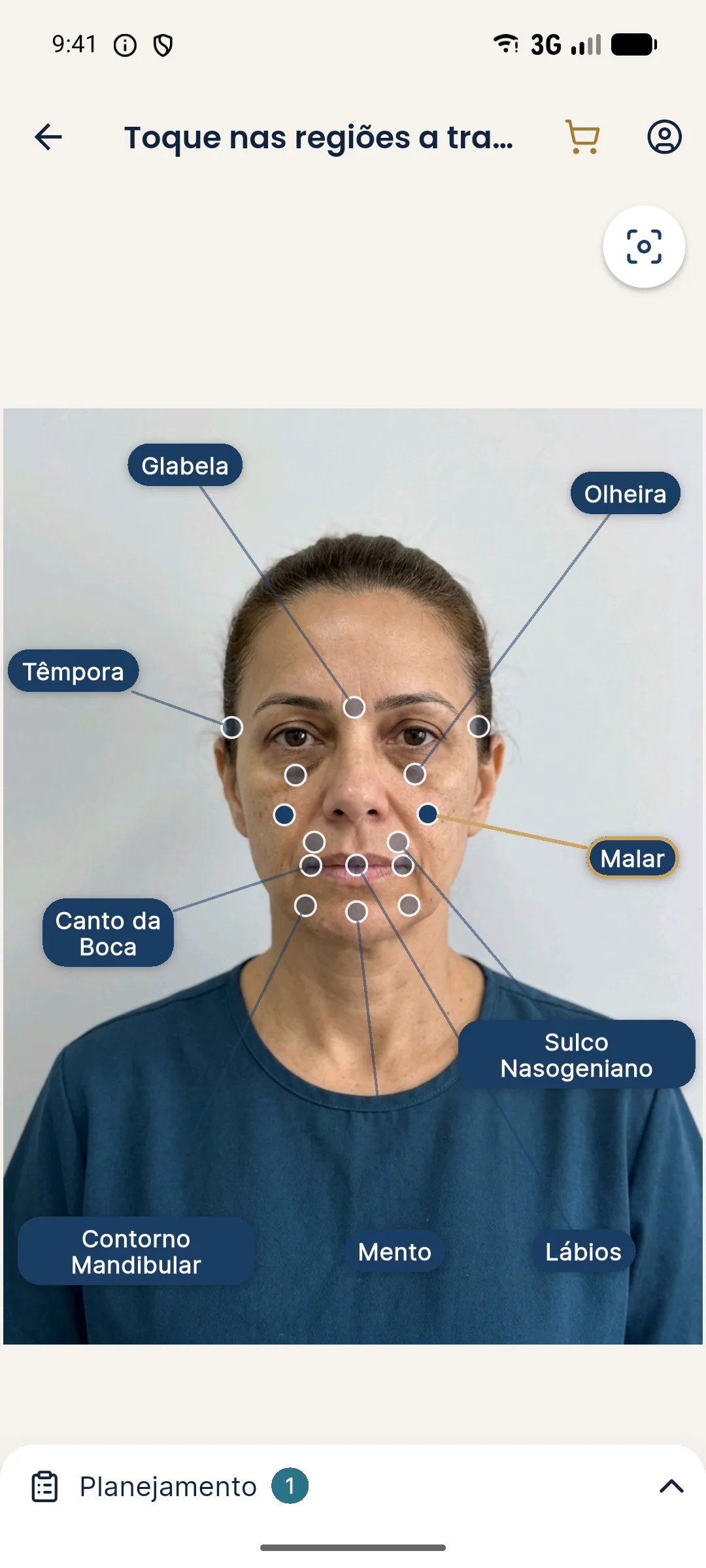
In Harmy, the support area of the middle third is the Cheekbone point. The simulation on the front photo shows the effect of a discreet volume on cheek projection and fold shadow, and is useful for the patient to understand that what changes is subtle. The app does not simulate ptosis or the effect of threads, and it does not retouch skin, so explain what the slider shows and what it does not.
Record keeping and follow-up
Photograph with the same standardization at each review, record the hierarchy of concerns and what was agreed. Aging continues after the procedure, which justifies follow-up. The long-term reasoning is in aging of the facial harmonization result and the history per patient in Harmy keeps everything organized for comparisons.
Frequently asked questions
Why does the face start to sag after 40?
From a combination of deep fat volume loss, gradual bone resorption, loosening of ligaments and loss of skin quality. The pace varies a lot from person to person.
Which area usually shows the first signs?
In many patients, the middle third (cheek and nasolabial fold) and the transition to the jawline. Order and intensity vary with genetics, habits and body type.
Filler or biostimulator for sagging?
It depends on the picture. Volume loss calls for replacement; loss of skin quality may benefit from biostimulation; significant ptosis has limits with injectables. The decision belongs to the licensed professional, after assessment.
Can sagging after 40 be prevented?
Sun protection, not smoking, sleep and weight control help the skin. Procedures at an early age are not an obligation, and each plan should respect the patient's real need.
Harmy images are illustrative simulations generated by AI from the patient's photo to support the conversation between practitioner and patient. They are not a promise of results. Indication, technique, product and volume are solely the decision of the licensed practitioner. This content is for information only and does not replace a clinical assessment.