
Sagging jawline: fat, skin or ligament

 BeforeSimulation
- Nerve
- Highlighted area
Quick facts
- Concern
- The face contour lost its straight line and dropped, with jowls
- Method
- Separate excess fat, loss of support, skin laxity and ligament
- Structures
- Jowl, mandibular ligament, platysma, skin and jaw bone
- Caution
- Volume over sagging tissue can weigh the contour down instead of defining it
The jawline is one of the first impressions of a young face, and one of the lines that most calls for careful assessment. When it "drops," the patient describes it in words like "I lost my contour," "it feels heavy at the bottom" or "my face slid down." The temptation is to fill the jaw. A good assessment starts earlier, by asking which layer is failing.
This page organizes that reasoning. It connects with sagging cheek over the jaw, laxity along the face contour and weak jaw.
What supports the jawline?
The jawline is defined by bone, ligaments, fat and skin. The mandibular ligament anchors the skin at the chin and separates the jowl fat from the chin compartment. With aging, bone resorbs, fat descends and skin loses elasticity, and the jowl forms a fold that interrupts the contour.
| Layer | Change over time | Impact on the contour |
|---|---|---|
| Bone | Resorption of the body and angle | Loses support, shorter contour |
| Fat | Descent and buildup in the jowl | Fold below the mouth |
| Ligaments | Loosening | Skin descends, pre-jowl sulcus |
| Skin and platysma | Laxity and bands | Blurred contour |
| Chin | Relative retrusion | Chin disappears into the line |
The pre-jowl sulcus is the gap between the chin and the jowl, and is usually the spot the patient points to. The clinical care is to understand whether it is caused by lack of bone support or by excess sagging fat, because the approach changes.
How to assess the predominant layer
Assess with the patient seated in a neutral position, then lying down and, if possible, with the head slightly raised. A contour that improves when lying down indicates a gravity and laxity component.
What harmonization can consider
At the discretion of the licensed professional, the plan may include one or more approaches:
- Bone and angle support: volume replacement along the contour to restore the line, in restrained amounts. See jawline filler.
- Chin: when the chin is recessed, projecting it can improve the line. See chin filler.
- Skin quality and support: collagen biostimulator and thread lift in selected cases.
- Non-injectable technologies, which are outside the scope of this page but come up in the conversation.
- Surgical referral when laxity is severe and the expected result goes beyond what an injectable does.
Risks
The jaw area contains the marginal mandibular branch of the facial nerve, the facial artery and vessels that cross the contour. Risks include swelling, bruising, asymmetry, nodules and irregularities; vascular complications are rare and serious. Having hyaluronidase available is mandatory when hyaluronic acid is used. Biostimulators carry a risk of nodules and threads can cause irregularities, and the choice requires specific consent.
How to show it in Harmy
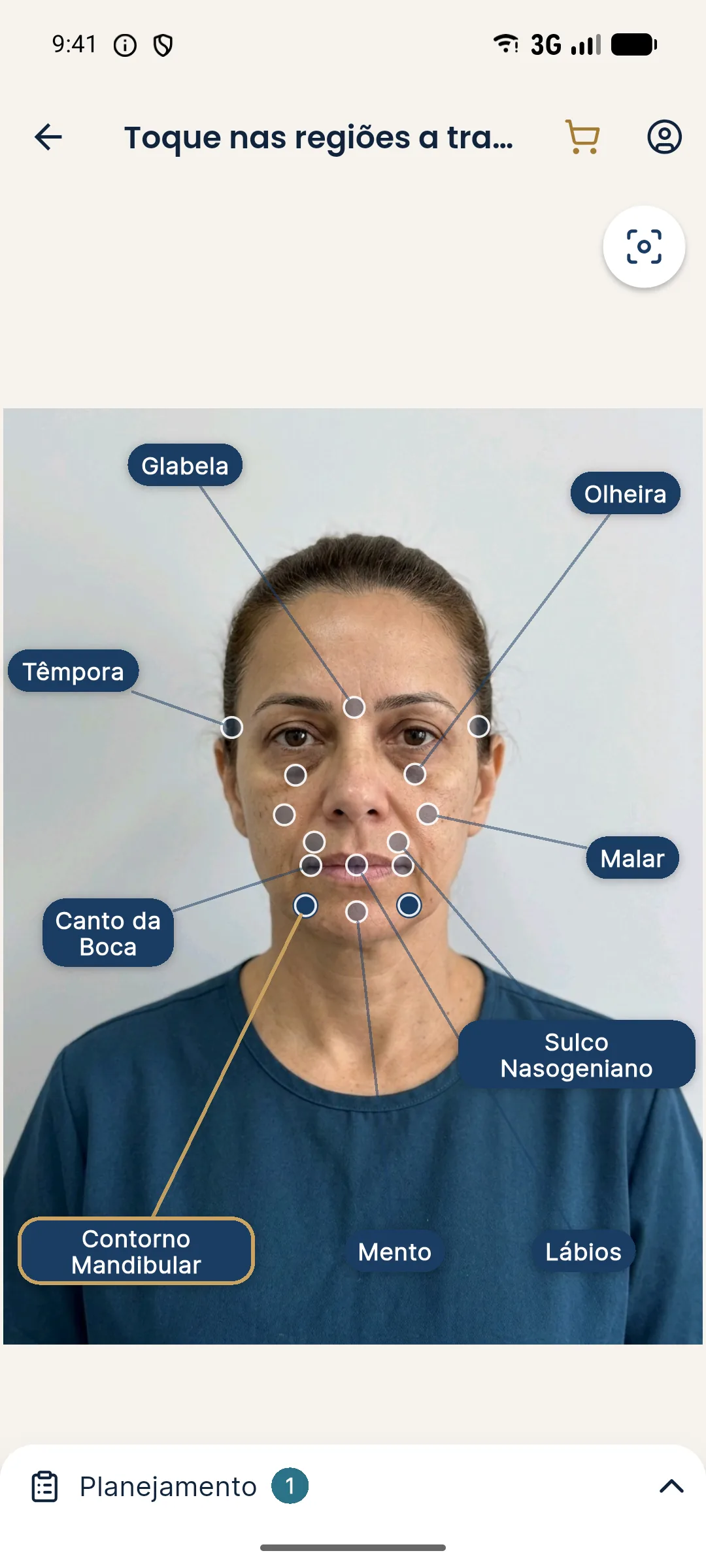
The Jawline point in Harmy simulates contour support on the frontal photo. The frontal photo shows the jowl fold poorly, since it is better seen at three-quarter view, and the app does not make that reading: it simulates volume in the marked area. The "Full harmonization" shortcut suggests jaw at 2 ml with Moderate intensity and chin at 1.5 ml, which can be a starting point for conversation, never a dose.
Common mistakes with the sagging contour
The main mistake is filling the contour of someone with significant laxity. The volume descends along with the tissue and adds weight to the lower third. The second is ignoring the chin: a recessed chin makes the contour look worse, and projecting it first can change the reading without touching the jaw.
Another mistake is promising a facelift effect. Injectables and threads can improve support in selected cases, but they do not reproduce the effect of surgery, and a patient who expects that effect will be disappointed. It is also a mistake to assess only from the front: the jowl shows more at three-quarter view, and the neck completes the reading of the angle.
Finally, do not plan without asking about weight. Recent weight loss changes the contour over the following months, and a plan made in the middle of that variation can end up unsuitable.
Staged plan and records
Define the order of work with the patient: chin, then angle support, then skin quality, and only then refinements. Record photos at three angles, the predominant layer, what was proposed and what was declined. At follow-up, assess the contour seated and lying down, with the same lighting, and note the difference. If laxity is the dominant factor, talk about surgical alternatives without pressure, and document the conversation. A well-informed patient decides better and tends to value a discreet, honest result more.
Patient profiles and expectations
Patients in their 40s and 50s are usually at the start of the descent and benefit from support and skin quality plans. Older patients have more established laxity, and the conversation about limits and alternatives should come before any injection.
Men and women want different contours. In general, the male contour tolerates straighter, more angular lines, while the female contour calls for softer transitions, but individual preference rules. Ask, and show references the patient finds acceptable.
Those who have lost a lot of weight or take weight-loss medications deserve special attention: the jowl may have appeared from loss of facial fat, and the support plan is designed differently.
Wrap-up
Record photos at three angles, the predominant layer, the staged plan and the limits stated to the patient. For other lower-third cases, see double chin even when thin and double chin in profile. Volumes and techniques are at the discretion of the licensed professional, in line with the rules of their professional council in Brazil.
Frequently asked questions
What makes the jawline sag?
A combination of loss of bone support, descent of fat, loosening of ligaments and skin laxity. The relative weight of each factor varies from person to person.
Does filler fix a sagging jaw?
It can help with definition when the problem is lack of support, at the discretion of the licensed professional. With significant laxity, filler alone tends to be insufficient or to weigh the contour down.
What is a jowl?
It is the descent of fat and skin along the contour, creating a fold below the mouth and interrupting the jawline. It is also called a sagging cheek over the jaw.
Do threads and biostimulators belong in the plan?
They can be considered in selected cases, at the discretion of the licensed professional, alongside other approaches. The choice depends on the predominant layer and the patient's expectations.
Harmy images are illustrative simulations generated by AI from the patient's photo to support the conversation between practitioner and patient. They are not a promise of results. Indication, technique, product and volume are solely the decision of the licensed practitioner. This content is for information only and does not replace a clinical assessment.