
How to explain the jawline plan to the patient

 BeforeSimulation
- Nerve
- Highlighted area
Quick facts
- Core message
- The technique depends on what is missing or in excess in the contour
- Tools mentioned
- Filler, biostimulator, toxin in the masseter and threads
- Limit
- No technique replaces surgery when there is excess skin
- Risk to mention
- Asymmetry, nodules, swelling, bruising and vascular complication
Whoever asks for a "defined jaw" is almost never talking about the same thing. For one patient, the problem is a lack of angle. For another, it is the double chin. For a third, the jaw is too wide. The honest answer involves asking, assessing and explaining that the jawline results from several structures and that each technique acts on one of them. This page shows how to explain that.
What should you ask before explaining the plan?
Ask what they want to see and where. Asking them to point it out on the photo or in the mirror prevents misunderstandings. Useful questions:
- "What bothers you: the angle, the side line or the area under the chin?"
- "Do you want more definition or less width?"
- "How long has this bothered you?"
The answer shows whether the plan will be one of addition (volume), reduction (relaxing muscle), support, or a combination. That distinction is the basis of the explanation to the patient.
What should you explain about the anatomy?
In plain language, the contour depends on:
| Element | What it influences |
|---|---|
| Bone | Angle and base width, which do not change with injectables |
| Masseter muscle | When large, it widens the lateral contour |
| Fat and skin | When they accumulate or lose firmness, they form jowls and a double chin |
| Volume of the mandibular angle | Can be accentuated or softened by different techniques |
The table helps the patient see that the jaw is not one single thing, and that treating what is not the problem does not help.
Which techniques should you present and which limits should you state?
Present the options without naming brands, and state the limit of each one.
| Technique | When it is usually considered | Limit to explain |
|---|---|---|
| Filler | Lack of definition or lateral volume | Does not reduce a double chin or excess skin |
| Biostimulator | Loss of tissue quality and support | Gradual effect, no immediate volume |
| Toxin in the masseter | Bulky muscle widening the contour | Reduces muscle volume, does not define the angle |
| Threads | Mild laxity of the lower third | Do not replace surgery |
Each row should be explained as a possibility, at the professional's discretion after assessment. For laxity, see lower third laxity: assessment and hydroxyapatite in the jawline.
How do you show the plan with Harmy?
Harmy marks the Jawline on the front-facing photo and simulates the volume in ml. The point is useful for the patient to visualize subtle lateral definition. The projection uses only the front-facing photo, so it does not show the profile line or the double chin.
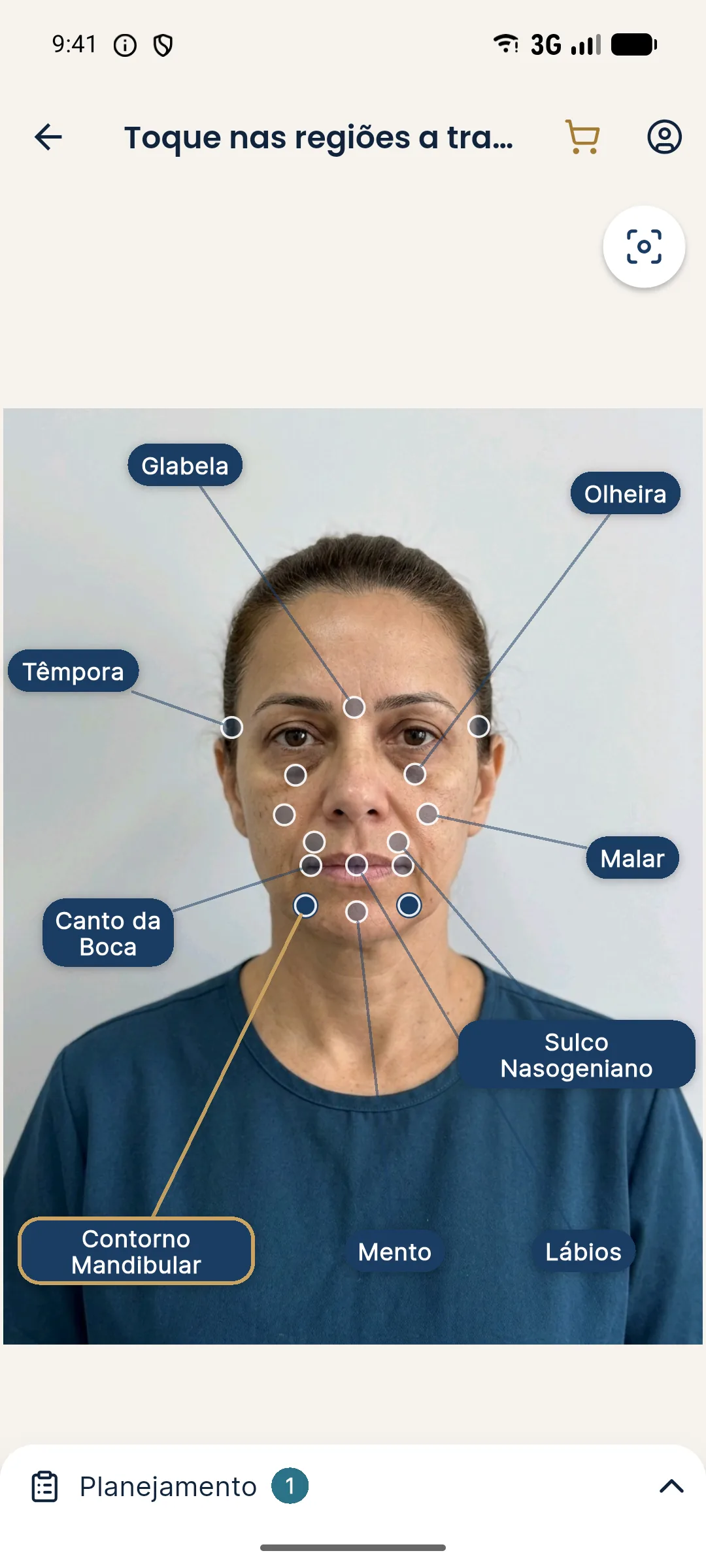
Explain to the patient: "The image shows the lateral definition, seen from the front. What happens under the chin or in profile, the simulation does not show." This keeps the tool honest. For the presentation, see presenting the projection in the consultation.
Which risks should you explain?
The jaw area has structures that demand care: the facial artery runs close by, the marginal mandibular branch of the facial nerve can be affected by inadequate technique, and the angle is a place where swelling is obvious. In patient language, mention:
- swelling and bruising, which usually pass;
- asymmetry, from volume or movement;
- nodules or irregularities;
- more rarely, a vascular complication.
When hyaluronic acid is used, hyaluronidase should be available. On the topic of risk, see safety and complications, overview.
How do you handle expectations of masculinization or feminization?
Some patients seek a more marked contour, others a softer one. Adjust the conversation to the patient's goal and identity, without imposing a standard. For male patients, see male orofacial harmonization. For any patient, ask what "defined" means and use the simulation as a reference.
Which questions should you expect?
What should you record?
Note the concern, the assessment by structure, the proposed technique, the limits explained and the risks mentioned. Record front and profile photos in the patient record, even though Harmy uses only the front-facing one. The informed consent should cite the area and the risks.
A well-explained jaw plan starts by understanding which structure is at play, and ends with a patient who knows what each technique can and cannot deliver.
Frequently asked questions
How do I explain to the patient what defines the jawline?
Say it depends on bone, volume, muscle, fat and skin. That is why the technique varies: sometimes volume is missing, sometimes there is excess tissue, and each case calls for its own path.
Does jaw filler fix a double chin?
Generally not. A double chin has its own causes, such as fat and laxity, and jaw filler works on lateral definition. Explain the difference and avoid promising a fix.
Can the patient expect a defined contour right after the procedure?
The volume may show right away, but swelling can change the perception in the first days. Assess the settled result and schedule the follow-up before adjusting.
Which risks should I mention in the jaw area?
Asymmetry, nodules, swelling, bruising and, more rarely, vascular complication. Structures such as the facial artery and the marginal mandibular branch require anatomical knowledge.
Harmy images are illustrative simulations generated by AI from the patient's photo to support the conversation between practitioner and patient. They are not a promise of results. Indication, technique, product and volume are solely the decision of the licensed practitioner. This content is for information only and does not replace a clinical assessment.