
Patient did not like the simulation: how to handle it
You open the slider, expect a smile and get silence or a "that's not what I imagined." Many professionals see a negative reaction as a failed sale. It is the opposite: the simulation did its job by bringing out a mismatch in expectations before any injection. Hearing "I don't like it" in the consultation is far better than hearing it after the procedure. This page offers a script for investigating, adjusting and, when appropriate, not going ahead.
What can "I didn't like it" mean?
The same sentence hides different causes. Before adjusting, understand.
- Change too small: the patient expected more.
- Change too big: it frightened them, it looked artificial.
- Wrong area: their focus was elsewhere.
- Feeling strange about themselves: seeing the altered face can cause discomfort, even when it is subtle.
- Image quality: lighting, angle, expression. See patient wants a result identical to the simulation.
- Unrealistic expectation: no realistic image would please them. See patient with unrealistic expectations.
- Doubt about the procedure itself, which the image merely revealed.
How do you investigate in five steps?
One question helps unlock things: "If you could change one thing in this image, what would it be?" The answer is usually more specific than "I didn't like it."
How do you react to each type of rejection?
| The patient says | Likely cause | Path |
|---|---|---|
| "It changed little." | Expected more, or is comparing with a filter | Talk about proportion and naturalness; see patient asks for more in the simulation |
| "It's too much." | High intensity or apprehension | Reduce; see patient asks for less in the simulation |
| "It doesn't look like me." | Feeling strange, or the face changed more than expected | Compare a more subtle version; explain that the image is illustrative |
| "That wasn't the point." | Wrong area | Go back to the concern and redo the plan; see documenting concerns in the patient's own words |
| "It looks artificial." | Illustration, or volume too high for the face | Reduce volume; revisit the priority |
| "I don't know, I just don't like it." | Insecurity about the decision | Pause, do not generate a new image, return to the conversation |
When should you adjust the plan and when should you hold it?
Adjusting is reasonable when the objection is clinical or about proportion, and the new plan remains safe and indicated. Holding is right when the objection is the very idea of changing, or when the requested adjustment goes against your clinical judgment. When in doubt, return to informed consent: the patient decides based on what they understood, and you decide what to offer based on what is safe.
If the rejection is of the change itself, going ahead would be forcing it. It is a legitimate decision to say: "We can choose not to do it. I want you to be at ease with whatever is chosen." See how to tell the patient they do not need a procedure.
What does the tool help you do?
In a scenario like this, the value of the simulation lies in the conversation it opens. Three features help.
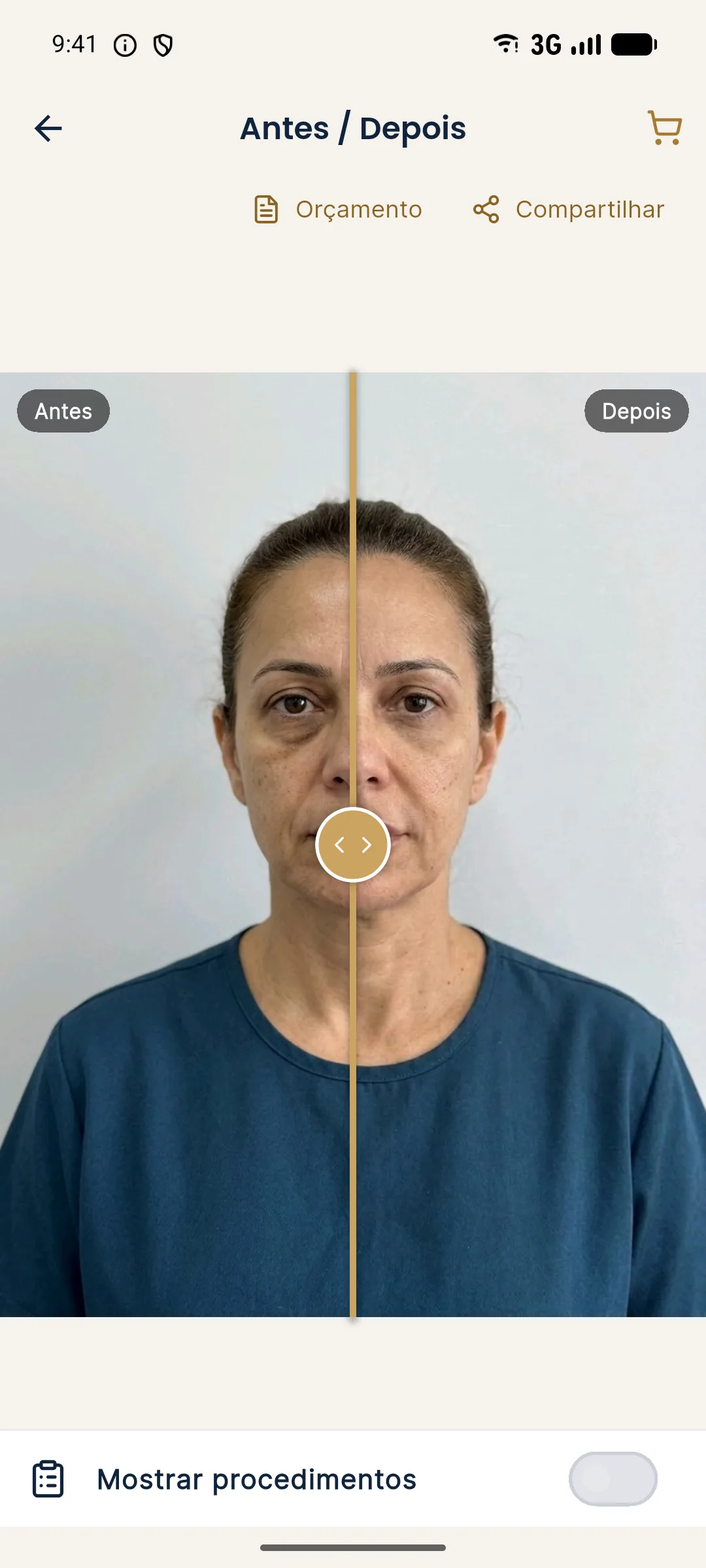
Two versions side by side, one subtle and one more pronounced, are usually more useful than several similar variations. See comparing intensities in the simulation and explaining the Subtle, Moderate and Pronounced intensity.
What if the patient is shaken?
For some, the image is confronting. If the patient becomes emotional, reacts with sadness or criticizes their own face, stop showing it and offer support. See patient cries in the consultation. If there is a pattern of dissatisfaction with their own image that does not ease, see patient with suspected dysmorphia and when not to show the simulation.
How do you save the consultation?
Saving the consultation is not saving the sale. It is preserving the relationship and the quality of the decision.
- Thank them for being frank. The feedback is valuable.
- Sum up what you understood. "You prefer something more discreet and want to avoid such-and-such effect."
- Propose the next step. Adjustment, a new conversation, a smaller stage or a pause.
- Do not pressure. Give time to think.
- Document. The objection, the adjustment and the decision.
What should you document?
Write down what the patient said in their own words, what you classified as the cause, what was adjusted, what was decided and why. If the procedure was postponed or cancelled, document the reason without judgment. This record shows that the simulation was treated as a conversation tool, which is exactly what it should be.
Frequently asked questions
What should I do when the patient does not like the simulation?
Do not defend the image. Ask what bothered them, separate taste from unrealistic expectation, adjust the plan if it makes sense and remind them the image is an illustration.
If they did not like it, does that mean I should not do the procedure?
Not necessarily. It may be an adjustment of intensity or area. But if they reject the change itself, it is best not to go ahead.
Can I generate another simulation with adjustments?
Yes, when there is a clinical reason to adjust the plan. Be careful not to turn the conversation into an endless search for an image that pleases.
Does a negative reaction to the simulation point to a problem?
It means the expectation conversation needs to be redone. It is valuable information, better received in the consultation than after the procedure.
Harmy images are illustrative simulations generated by AI from the patient's photo to support the conversation between practitioner and patient. They are not a promise of results. Indication, technique, product and volume are solely the decision of the licensed practitioner. This content is for information only and does not replace a clinical assessment.