
Patient with unrealistic expectations: how to lead the talk

"I want to look just like her." "I want the face I had five years ago." "I want it to look like I did nothing, but I want to look like someone else." Unrealistic expectation is the root of a good share of the difficult cases in orofacial harmonization (HOF). The patient is not lying or being capricious: they imagine an outcome that no product delivers. The professional's job is to recalibrate without humiliating. This page shows how to use the patient's own face as a yardstick.
What makes an expectation unrealistic?
A few families of requests come up often:
- Copying another face: a photo of a celebrity, an influencer or a filter. See patient brings a filter photo and patient who wants to look like someone else.
- An effect the procedure does not produce: expecting filler to do the work of surgery, or one session to fix everything.
- Symmetrical perfection: every face has natural asymmetry. See explaining natural asymmetry to the patient.
- Total change of identity: see patient who wants to change their whole face.
- Impossible timeline: immediate results, no swelling, by tomorrow.
The expectation is not always entirely unrealistic. Usually there is a realistic core ("I want to look rested") wrapped in an exaggerated request. Look for that core.
How do you use the patient's face as a yardstick?
Instead of arguing about the reference photo, go back to the face in front of you. The reasoning is: what this face has, what can safely change and what will not change.
- Ask them to point in the mirror. "Show me what bothers you." This moves the conversation from "I want to be like her" to "I want to change this." See how to use the mirror in the consultation.
- Talk in proportions, not adjectives. Show size, distance and the relationship between areas.
- Use their before, not other people's after. The patient's frontal photo is the starting point. See how to use the frontal photo in the conversation.
- Make clear what does not change. Bone, baseline symmetry, eye position and soft tissue have limits.
- Propose stages and stopping criteria. "We will do X; if you like it, we will assess Y."
Does the simulation help or hurt?
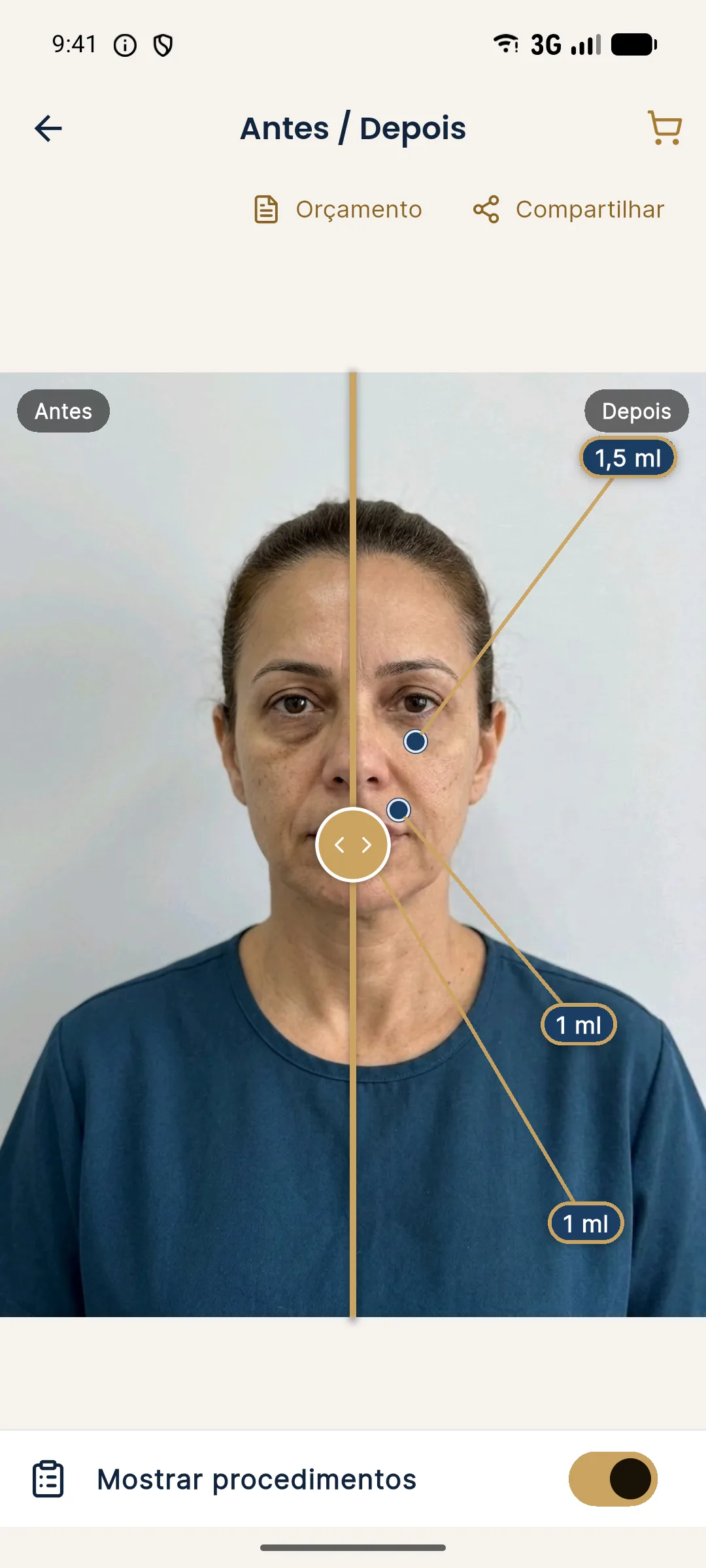
It depends on how it is used. Presented as a promise, it hurts. Presented as an illustration, it helps recalibrate, because it shows the size of the possible change instead of leaving it loose in the imagination. Two ideas work well:
- Show two versions side by side: one restrained and one more pronounced. The patient often realizes that "more" does not change as much as they imagined, or that it changes more than they wanted. See comparing intensities in the simulation.
- Show what stays the same: the illustrative simulation shows the same face with changes limited to the marked areas. This makes it visible that identity remains.
How do you know the expectation has improved?
Ask the question back, in different words: "With what we have seen, what do you expect to see in the mirror afterward?" If the answer still describes another person or a result the plan does not deliver, the conversation is not over. If it describes a concrete, proportionate change, that is a good sign. To document the expectation, see aligning expectations in writing and defining a good result with the patient.
What if the expectation does not change?
Some patients' expectations do not yield to any argument, and then the path is the hardest one: not to treat. If the plan does not deliver what the patient wants, saying so is the most honest service. See saying no to the patient in HOF and declining a request for excessive volume. If their discomfort with their appearance seems out of proportion to what you see, read patient with suspected dysmorphia.
Checklist for the consultation
What should you document?
Write down the request in the patient's own words, what was explained as possible and impossible, what they answered and the agreed plan. If the decision was to postpone or decline, document the clinical reason. The record of the alignment is often the best defense if the expectation resurfaces at follow-up.
Frequently asked questions
How can I tell if a patient's expectation is unrealistic?
When the request depends on something the product or the anatomy cannot deliver, or when the patient expects a result identical to a photo, another person or a filter. Asking what they expect to see in the mirror helps measure it.
Can I turn away a patient with unrealistic expectations?
Yes. If, after explaining and recalibrating, the expectation is still incompatible with what is safe and possible, declining is a legitimate clinical decision. Document it.
Does the simulation help correct the expectation?
It can, as long as it is presented as an illustration. Showing a restrained version next to a more pronounced one helps discuss proportion instead of promises.
Should I scale back the plan to please the patient?
Not to please them. Adjust according to clinical judgment and what the patient can safely accept. If the plan does not address their concern, say so clearly.
Harmy images are illustrative simulations generated by AI from the patient's photo to support the conversation between practitioner and patient. They are not a promise of results. Indication, technique, product and volume are solely the decision of the licensed practitioner. This content is for information only and does not replace a clinical assessment.