
Botulinum toxin in the temporalis muscle: indication and care
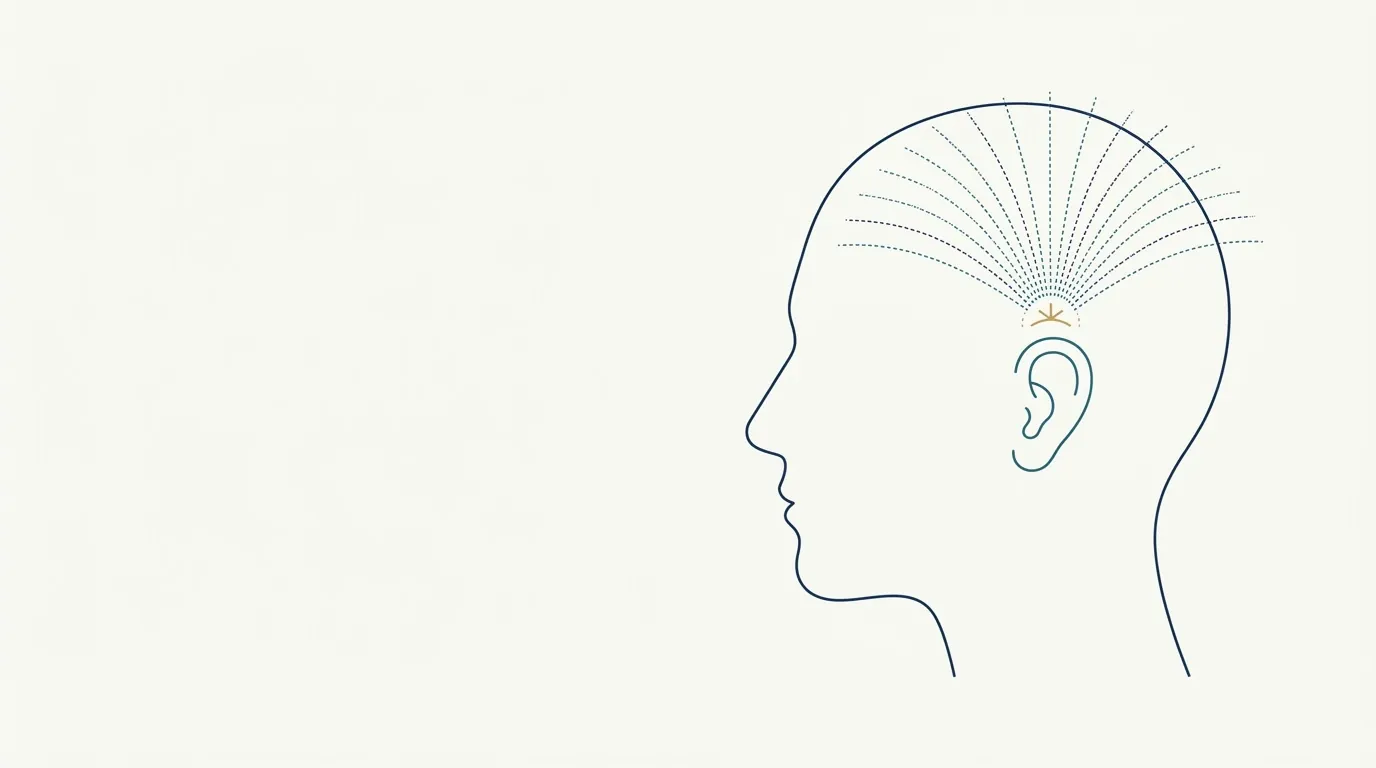
- Muscle
- Nerve
- Highlighted area
Quick facts
- Topic
- Toxin in the temporalis muscle, a chewing muscle
- Indications discussed
- Bruxism, tension headache and hypertrophy, at the professional's discretion
- Central risk
- Loss of bite strength, atrophy and hollowing of the temple
- Main precaution
- Assess chewing function and temple contour before treating
The temple is usually remembered for filler, when the patient complains of hollowing. But under the skin and fat of the temple lies the temporalis muscle, one of the large chewing muscles, and it enters the botulinum toxin conversation for three reasons: bruxism, tension headache and contour. Each brings a different line of reasoning, and together they demand great care, because toxin in a chewing muscle affects function.
This page gathers, at a review level, the anatomy, the indications discussed, the risks and the pitfalls. There is no dose, point or injection technique. Management is the decision of the qualified professional, following the product label and the rules of their professional council in Brazil.
Functional anatomy of the temporalis
The temporalis muscle is a wide, fan-shaped muscle that fills the temporal fossa. Its fibers converge on a tendon that passes under the zygomatic arch and inserts on the coronoid process of the mandible. Contraction lifts the mandible and pulls it back, contributing to closing and biting.
Some useful features:
- Covering: the muscle is covered by the temporal fascia and the temporal fat pad, which influences contour.
- Relationship with the masseter: both lift the mandible and often work together in bruxism. See botulinum toxin in the masseter.
- Vascular neighborhood: superficial, middle and deep temporal arteries and veins of the area, described in temporal anatomy for injectables and vascular danger zones of the face.
- Nerves: branches of the facial nerve (temporal) and of the trigeminal nerve, relevant for function and sensation.
| Structure | Role | Why it matters |
|---|---|---|
| Temporalis muscle | Lifts and retracts the mandible | Target of the toxin and of hypertrophy |
| Temporal fascia | Covers the muscle | Reference plane |
| Temporal fat pad | Fills and rounds the temple | Its loss creates hollowing |
| Temporal arteries | Blood supply | Vascular risk with filler |
| Zygomatic arch | Passage of the tendon | Contour landmark |
Why toxin enters the conversation
Bruxism and clenching
In patients with bruxism, hyperactivity of the chewing muscles is common, and the temporalis often takes part together with the masseter. Toxin is considered, in selected cases, as an option to reduce the intensity of contraction, together with the dentist who follows the patient. The general topic is in botulinum toxin for bruxism.
Tension headache or headache associated with clenching
Pain in the temporal area is a frequent concern in patients who clench their teeth. In some, toxin is considered as part of management, always with a clear diagnosis and follow-up. It is worth remembering that headaches have many causes and that the diagnosis is medical. There are also reports of headache after toxin is applied in other areas, as in headache after botulinum toxin.
Hypertrophy and contour
In some patients, a bulky temporalis contributes to a full temple or to a lateral width of the upper skull that the patient wants to reduce. The decision to treat is complex and involves assessing what is muscle, what is fat and what is bone, and weighing the risk of hollowing.
Specific risks
- Reduced bite strength and fatigue when chewing, usually temporary.
- Muscle atrophy with repeated use, discussed in muscle atrophy from toxin.
- Temple hollowing, especially in those who already have fat or volume loss. See aging of the temples and temporal fat pad.
- Asymmetry, if the response is uneven.
- Headache after the application, reported by some patients.
- Bruising, from the superficial vessels of the area.
- Diffusion to neighboring muscles, with an effect on the brow or eyelid, as in toxin diffusion.
- Changes in the temporomandibular joint, in patients with prior TMD, who need follow-up.
Clinical assessment
An organized assessment includes:
- History: pain, clenching, grinding, headache, TMD, night guard use.
- Palpation: temporalis and masseter, at rest and in contraction, with and without pain.
- Observation of contour: flat, convex or hollow temple, at rest and in contraction.
- Mouth opening and lateral movement, with attention to deviations and noises.
- Occlusion and tooth wear, with the dentist's support.
- Function: type of diet, chewing habits and professions that demand a strong bite.
- Photography and video at rest and in contraction.
| Finding | Possible reading | Caution |
|---|---|---|
| Hollow temple at rest | Fat or volume loss | Toxin may accentuate it, consider other approaches |
| Hypertrophic temporalis on palpation | Muscle hyperactivity | Consider, with caution, together with the masseter |
| Pain on palpation and limited opening | TMD picture | Refer for diagnosis |
| Evident tooth wear | Bruxism | Align with the dentist |
| Frequent temporal headache | Varied origin | Medical workup |
Hollow temple and toxin: a conflict
Many patients come to HOF precisely because of a hollow temple, as the face ages. In these cases, weakening the temporalis can worsen the hollow look, and the conversation needs to anticipate that. In patients whose temple is already flat or concave, toxin in the temporalis is a decision that weighs against the expected gain.
On the other hand, in someone with a bulky temporalis, the reasoning may be different. The point is that temple contour is the result of bone, muscle, fat and skin, and no single decision should ignore the other components. Filler in the area is another conversation, with its own risks, described in biostimulator in the temples and in temple filler.
How to talk to the patient
The consent form should record the functional and aesthetic risks, as well as the temporary nature of the effect. See the items in informed consent by procedure.
Where Harmy fits in
Harmy has the Temple area, which simulates volume with hyaluronic acid. The app does not simulate toxin in the temporalis, muscle atrophy or changes in the bite. For the patient who is worried about a hollow temple, the volume simulation can show the effect of a filler approach, while the conversation about the muscle continues separately.
Timeline
Quick review
The temporalis shows how toxin in HOF is not always only aesthetic: it touches function. Those who assess the muscle, the temple and the occlusion before deciding, and talk to the dentist when the picture is bruxism, treat more safely and avoid surprises in contour and bite.
Frequently asked questions
What is the function of the temporalis muscle?
It is a chewing muscle that lifts the mandible and takes part in closing the mouth. It sits in the temporal fossa, covered by fascia, and its contraction shows up as volume in the temple when biting.
Does toxin in the temporalis help with bruxism?
It may be considered in selected cases, usually together with the masseter, with follow-up by the dentist. The decision depends on the diagnosis, the concern and the risk-benefit balance.
Can toxin in the temporalis make the temple concave?
Muscle volume may be reduced, which, in someone who already has little fat or volume loss in the area, can accentuate a hollow look. This is a point of attention in planning.
Is there a risk of weakening chewing?
Yes, toxin in chewing muscles can reduce bite strength and cause fatigue when chewing, usually temporarily. That is why a prior functional assessment is important.
Harmy images are illustrative simulations generated by AI from the patient's photo to support the conversation between practitioner and patient. They are not a promise of results. Indication, technique, product and volume are solely the decision of the licensed practitioner. This content is for information only and does not replace a clinical assessment.