
Neutral Expression in Clinical Photos: How to Ask the Patient
Quick facts
- Goal
- Record the face at rest, with no muscle contraction, so the photo is comparable.
- Signs of success
- Lips just touching, smooth forehead, gaze on the horizon and a loose jaw.
- Typical mistake
- Asking for a normal face: the patient poses and the expression changes with every shot.
- Where it matters
- Glabella, nasolabial fold, lips, chin and any asymmetry assessment.
Almost every bad before and after photo has the same origin: the patient did not have the same face in both. A slight smile in the before, a pressed lip in the after, a higher eyebrow because they got anxious. The difference the eye perceives becomes one of expression, not of treatment. Getting a neutral expression is a coaching skill, and it can be trained like any other step of your routine.
This page gives a script to say, the signs to check on the screen and the mistakes that show up most.
What is a neutral expression and why does it decide the comparison?
It is the face at rest: loose muscles, no smile, no frown, no pressed lips. The goal is not to look serious or pretty, but to be reproducible. If the same condition is achieved at every visit, what changes between two photos is the patient, not the pose.
This matters more in some areas:
- Glabella and forehead: any contraction of the corrugator or frontalis creates lines that do not exist at rest. See also photo of the glabella in contraction for the case where the contraction is the goal.
- Nasolabial fold and lips: a slight smile deepens the fold and changes the position of the upper lip.
- Chin and jawline: a pressed mouth wrinkles the chin and hides projection.
- Asymmetry: one side of the face usually contracts more than the other, and a photo with a forced expression exaggerates the natural difference, as explained in natural facial asymmetry.
How do you ask for a neutral expression, step by step?
The command "make a normal face" fails because everyone has a different idea of normal. It works better to give physical instructions, one at a time, from top to bottom.
A short script you can adapt:
- Gaze: "Look at the marked point on the wall, at eye level." See gaze on the horizon in clinical photos.
- Forehead and eyebrows: "Relax your forehead, as if you weren't thinking about anything."
- Mouth: "Lips just touching, without pressing. Your teeth should not clench together."
- Jaw and tongue: "Let your tongue rest behind your lower teeth and loosen your jaw."
- Breathing: "Breathe in, let the air out slowly and stay still."
Take the photo right after the breath goes out. The expression tends to be more relaxed at that moment.
What signs show the expression is not neutral?
Check on the screen before accepting the photo:
| Sign | What it indicates | What to ask |
|---|---|---|
| Lines between the eyebrows | Active corrugator | "Relax your forehead and open your eyes slightly." |
| Forehead with folds | Frontalis raising the eyebrow | "Let your eyebrows drop." |
| Stretched skin under the eyes | Slight smile | "Relax your cheeks." |
| Wrinkled chin | Contracted mentalis | "Loosen your chin, lips only touching." |
| Open nostrils | Forced breathing | "Breathe normally." |
| Tense neck | Contracted platysma | "Relax your shoulders and neck." |
What common mistakes ruin the photo?
- Talking during the shot. Conversation keeps the mouth and cheeks moving. Ask for silence for a few seconds.
- Asking them to "smile less." The patient ends up with a restrained smile, which is also an expression.
- Warning too late. Saying "one, two, three" creates anticipation and contraction. It is better to give a calm heads-up and shoot without a countdown.
- Shooting right after an emotional conversation. A few seconds of pause already help.
- Accepting the first photo. Take three to five and pick the most relaxed one.
If the patient's anxiety shows on their face, a short pause solves more than insisting. Give them a minute, talk about something else and repeat.
How do you standardize the expression across visits?
A neutral expression only counts if it is repeated. A few simple measures:
- Always use the same script, until it becomes automatic.
- Mark the gaze point on the wall and keep the height, as in marking floor position for clinical photos.
- Note in the medical record if the photo came out with any limitation (for example, a patient with a tic or paralysis).
- Take the resting photos before the dynamic expression ones, so the muscle does not tire. The sequence is in photo of the face at rest and in motion.
And in Harmy?
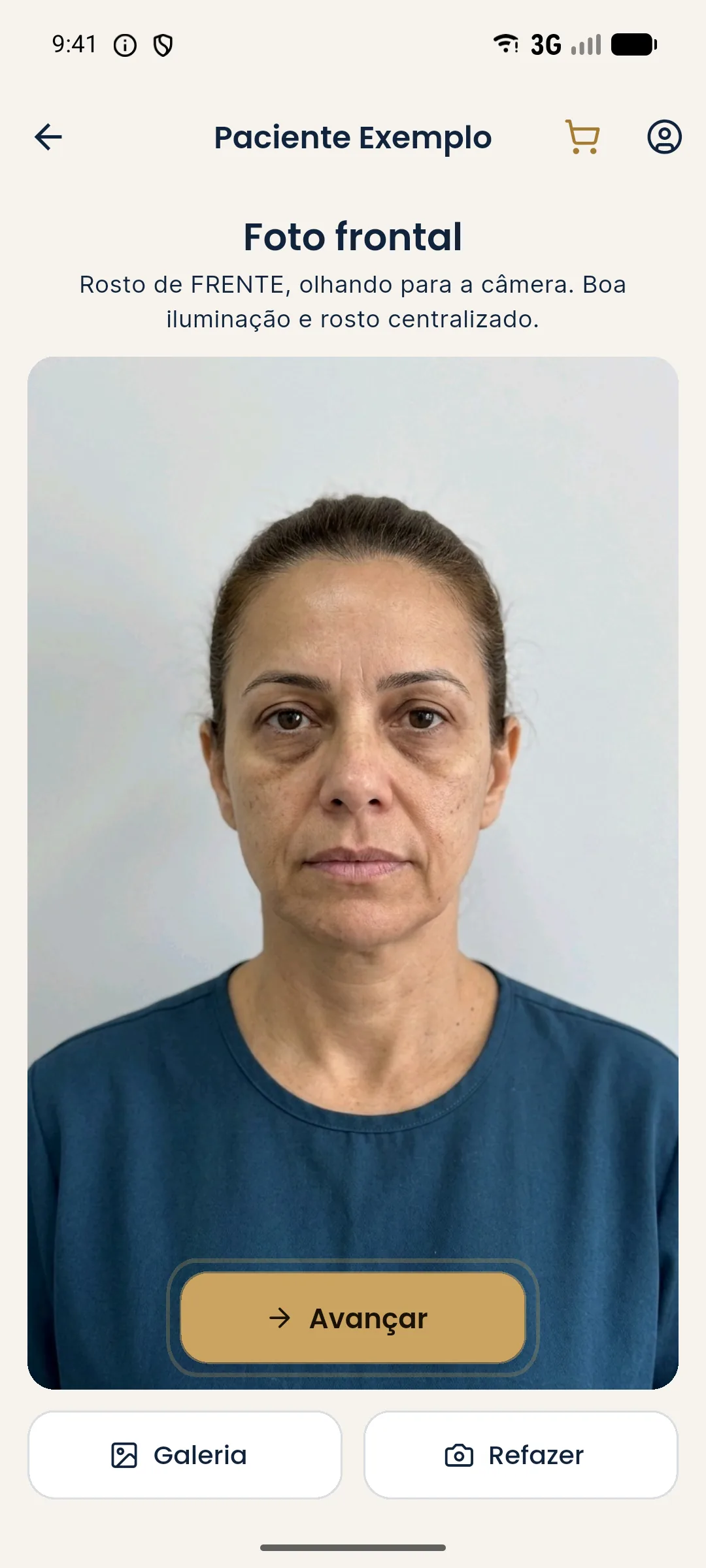
The app works with one frontal photo per session, and the projection preserves the patient's expression from the original image: the prompt does not allow changing the expression. That is why the starting photo needs to be neutral; otherwise the After shows the same contraction, and the slider ends up comparing one pose with another. To review the full framing, see frontal photo framing and bad photo for AI projection.
Summary
Give short, physical commands, take more than one photo, check the signs of contraction and use the same script at every visit. A neutral expression is not an aesthetic detail: it is what makes the comparison between before and after honest.
Frequently asked questions
What is a neutral expression in a clinical photo?
It is the face at rest, with no smile, no frown and no pressed lips, with the gaze fixed on a point straight ahead. It is the baseline for comparing the patient across different visits.
How do I ask the patient to relax their face?
Use short, physical commands, such as loosening the jaw, letting the lips just touch and looking at a point at eye level. Avoid asking for a normal face, because everyone understands something different.
Can I take several photos until the right expression comes out?
You can and should. Take a short sequence, discard the ones showing contraction and keep the one most faithful to rest, noting the criterion you used.
Does a neutral expression change the projection result in Harmy?
The projection keeps the expression from the original photo. If the patient is frowning or smiling, that shows up in the after image too, and the comparison loses value.
Harmy images are illustrative simulations generated by AI from the patient's photo to support the conversation between practitioner and patient. They are not a promise of results. Indication, technique, product and volume are solely the decision of the licensed practitioner. This content is for information only and does not replace a clinical assessment.