
Phone Flash in Clinical Photos: Why to Avoid It

Quick facts
- Problem
- Strong frontal light very close to the lens erases shadows and creates shine on the skin.
- Clinical effect
- Hides folds, volume, tear troughs and swelling, and changes skin color.
- Alternative
- Soft, diffuse light coming from the front and slightly above, with no harsh shadows.
- Rule of thumb
- Flash off in every documentation photo, always.
In an office with little light, the first fix that comes to mind is turning on the flash. It solves the exposure and destroys what matters. The face ends up bright, flat and full of shine, and the relief you need to document disappears. A clinical photo is, above all, a reading of shadow and volume, and the phone flash works against that.
This page explains what happens to the face under flash, what is lost in documentation and how to solve a lack of light without it.
What does flash do to the face?
The phone flash sits almost on the same axis as the lens and fires a short, strong, hard light. This causes four problems:
- Flattened relief: without lateral shadow, the face looks like a flat surface. Folds, depressions and projections become less visible.
- Shine: oily or damp skin reflects the light and creates white spots on the forehead, nose and cheekbones.
- Altered color: cold, intense light changes skin tone and brightens the image, on top of the automatic white balance adjustment.
- Eyes and pupils: red-eye, glare in the eye and a squinting gaze, which changes the expression.
In documentation terms, flash produces a photo that is too "clean," useless for assessing what the treatment changed.
What is lost in the clinical reading?
Some areas suffer more:
| Area | What flash hides |
|---|---|
| Tear troughs and under-eye hollow | The shadow of the depression, which is the sign itself. See photo of the tear troughs in documentation. |
| Cheekbone and midface | Volume and the transition between the cheek and the fold |
| Nasolabial fold | The depth of the fold, which looks softer |
| Forehead and glabella | Fine expression lines |
| Bruise and swelling | The color contrast and relief of the swollen area |
What light should you use instead of flash?
The ideal is soft, diffuse, stable light coming from the front and slightly above eye level. A few ways to get there:
- Window with a sheer curtain: diffuse natural light, good for most offices. Details in window as a light source for clinical photos.
- LED light with a diffuser: one or two frontal side sources with a softbox or tracing paper.
- Ring light, with care: it eliminates shadows and creates a circular reflection in the eyes; see ring light in clinical photos.
- Stronger office lighting: replace bulbs with a single, uniform color temperature. See lighting for facial clinical photos.
What about a complication photo, in a hurry?
In urgent situations, the priority is care, not the photo. Once the patient is stable, record with the best light available, noting in the medical record that the record was made under limited conditions. For this kind of case, see complication photo: how to document safely. Flash may be tolerated to prove the presence of a sign, never as a comparison standard.
How do you turn the flash off for good?
Many phones have the flash on automatic and fire without asking when the light drops. To avoid surprises:
- Set the flash to off (not automatic) in the camera settings.
- If there is a preserve settings option, turn it on so the camera does not go back to automatic.
- Check the lightning bolt icon before every session.
- Test with the device in the assistant's hands, since they are usually the one operating it.
What do you tell the patient?
Some patients notice the absence of flash and assume the photo will come out dark. A short explanation is enough.
Shine on the skin: how to handle it?
Even without flash, skin can shine under direct light. Blot the forehead and nose with a tissue before the photo, with no powder or makeup, and move the light source away from the lens axis. Makeup alters the skin, and the subject is covered in makeup in clinical photos.
And in Harmy?
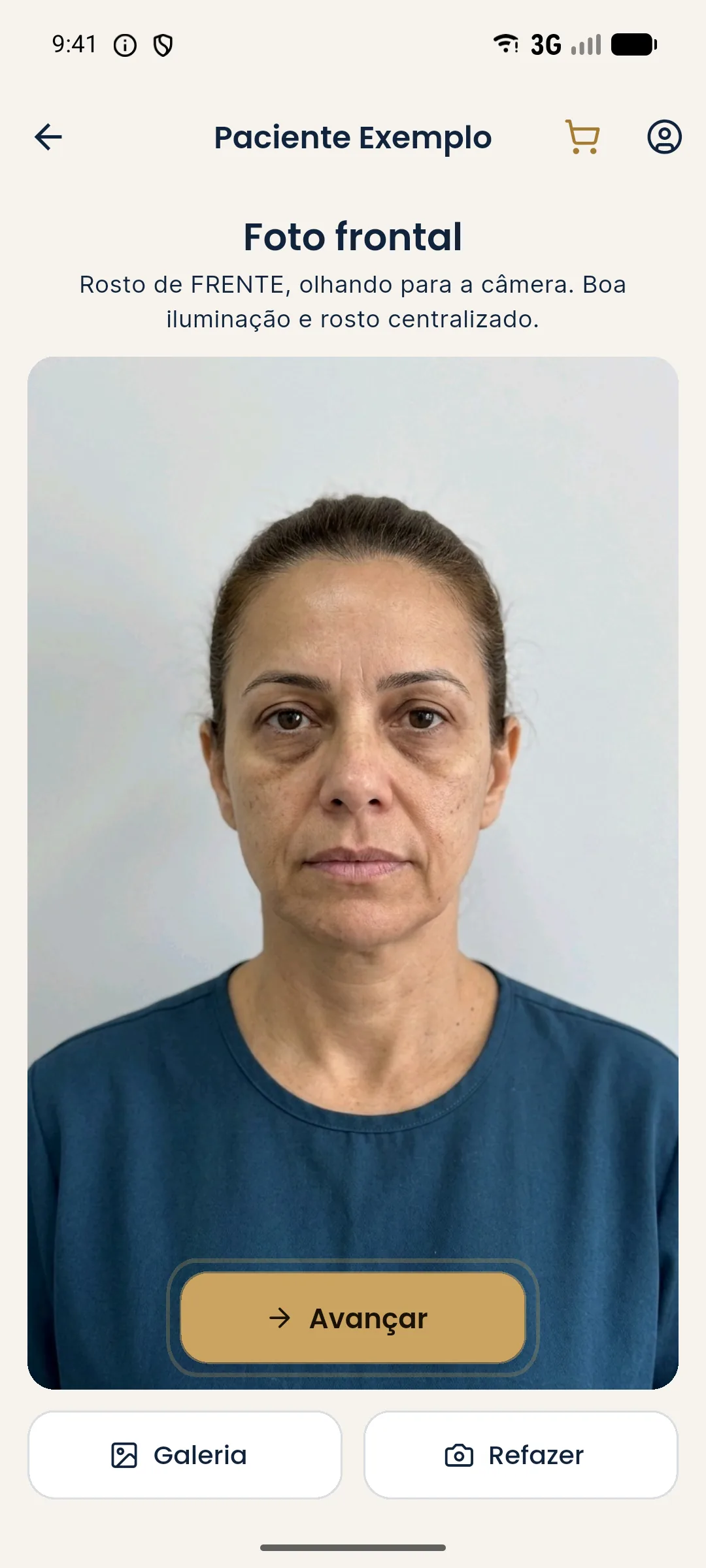
Harmy's projection preserves the lighting of the original photo: the prompt does not allow changing the light. A photo with flash enters the app with flattened relief and shine, and the After inherits those flaws. Reading the marked areas depends on visible shadow, so a photo with diffuse light produces a more informative illustrative simulation. More on what gets in the way in bad photo for AI projection.
Summary
Turn the flash off, permanently. Use diffuse light from the front and slightly above, keep the same light across visits and explain the reason to the patient. The no-flash photo looks less "shiny," and that is exactly why it works.
Frequently asked questions
Can I use the phone flash in a clinical photo?
Generally no. Flash flattens relief, creates shine on the skin and alters color, which hurts the reading of volume, folds and tear troughs. Prefer diffuse, stable light in the room.
Why does flash hide tear troughs and folds?
Because the light comes from almost the same axis as the lens and eliminates the shadows that outline relief. Without shadow, folds and depressions look smaller than they are.
Does flash make the face lighter?
It usually does, and it also alters skin tone, which makes it harder to compare photos from different visits. The effect varies with distance and device.
What if the office is dark?
It is better to increase the room light with a diffuse source than to turn on the flash. An LED light with a diffuser or a window with a sheer curtain solves most cases.
Harmy images are illustrative simulations generated by AI from the patient's photo to support the conversation between practitioner and patient. They are not a promise of results. Indication, technique, product and volume are solely the decision of the licensed practitioner. This content is for information only and does not replace a clinical assessment.