
Does Jawline Filler Hurt? Area and Pain

 BeforeSimulation
Quick facts
- Question
- Does jawline filler hurt
- Usual range
- Mild to moderate discomfort, varying from person to person
- What helps
- Topical anesthetic, a product with anesthetic and the technique chosen by the professional
- Who decides
- The qualified professional, after assessment
For the patient, "does it hurt?" usually comes before "how much does it cost?" and "how long does it last?" In jawline contour filler the worry is well founded: it is a firm area, with bone nearby, nerves and muscles that move all the time. Even so, the discomfort is usually manageable, and you can anticipate what the patient will feel, instead of just repeating "it's fine."
This page organizes the answer by area and by moment, without promising the absence of pain. The anesthetic approach and the chosen instrument follow the decision of the qualified professional.
Why does the jaw feel different from one area to another?
The jawline is not a uniform area. The angle of the jaw sits over bone and near the masseter muscle. The jaw line is a long path, with relatively thin skin. The chin and the transition toward it have a lot of sensory innervation. That is why the same session can be nearly painless in one stretch and more uncomfortable in another.
| Area | What the patient usually reports | Note |
|---|---|---|
| Angle of the jaw | Deep pressure, a "squeezing" feeling | Near the muscle and bone; swelling when chewing |
| Body of the jaw | Mild stinging, small prick | Longest stretch; usually the best tolerated |
| Transition to the chin | More sensitivity, an urge to pull away | Highly sensitive area, worth checking the anesthesia |
| Submental line | A pulling sensation | In people with a double chin, the tissue is looser |
Reports vary: this table does not measure pain, it only helps the patient prepare.
What reduces discomfort?
Several measures come into play, always at the discretion of whoever is injecting: topical anesthetic before the procedure, a product that already contains anesthetic in its formulation, slow injection speed, ice before starting and calm conversation throughout. None of them eliminates the sensation, and promising otherwise burns trust.
The choice between a cannula and a needle also matters: a cannula usually reduces the number of entry points, and some patients report fewer pricks. There are situations in which the needle is preferred, for precision or because of the area. The topic is detailed in explaining cannula injection to the patient.
And after the injection, does it hurt?
In the first days, tenderness to the touch, a feeling of heaviness and discomfort when opening the mouth wide or chewing hard foods are common. This is due to swelling and, sometimes, bruising. It usually improves gradually and follows the course of the swelling.
When pain is not normal
Expected pain has a pattern: it is greatest in the first 48 hours and then decreases. Pain that worsens over time, that is out of proportion to the procedure, accompanied by pale skin, a purplish net-like pattern, warmth to the touch, blisters, or visual or sensory changes, calls for immediate contact with whoever performed the procedure. This picture may indicate vascular occlusion or infection, and prompt care changes the outcome. For full guidance, see intense pain after filler.
How to prepare the patient for the session
Also avoid promising that "you won't feel anything." A patient who expects little and feels what was expected goes home calmer than one misled by a promise. To broaden the conversation, see jawline filler: how many ml, because volume also affects session length and, with it, discomfort.
Where Harmy comes in
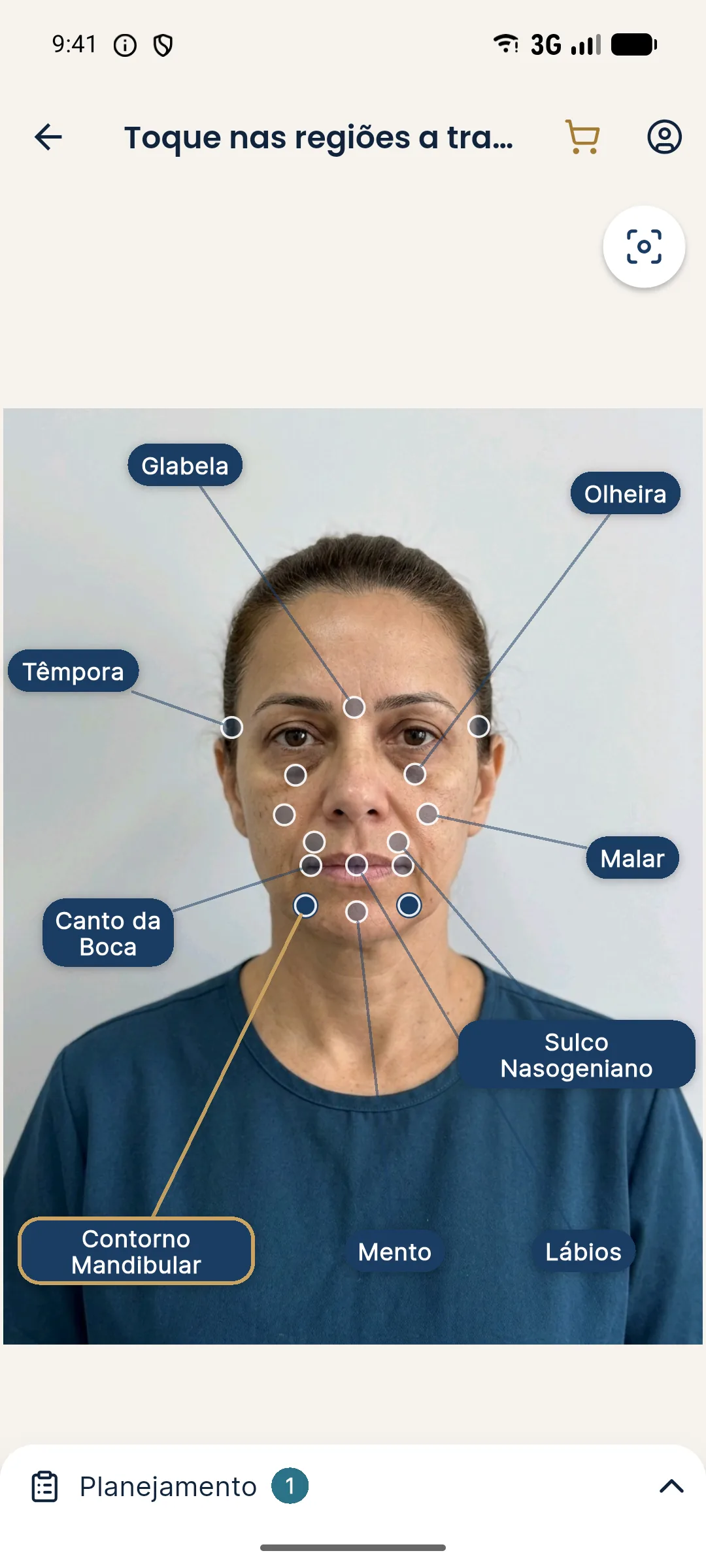
When the patient arrives anxious, showing what will be done lowers the tension. In Harmy, the Jawline point generates an illustrative simulation of the "after" from the front-facing photo, with the chosen ml. This helps explain the extent of the work and discuss whether one or more sessions are worthwhile. The projection does not measure pain or the final result and does not replace the in-person assessment.
Summing up for the consultation
Pain exists, it is generally tolerable and it varies by area. Promising no pain is a mistake; describing what the patient will feel, what you do to reduce it and when they should call is what builds trust.
Frequently asked questions
Does jawline filler hurt a lot?
Most people describe tolerable discomfort, with occasional pressure and stinging. Intensity varies with each person's sensitivity, the area and the technique, and very strong pain during or afterward should be reported.
Which part of jawline filler hurts the most?
In general, the areas near the angle and the chin are cited as more sensitive, but perception varies. The professional can adapt the anesthesia to each area.
Does it hurt after jawline filler?
Tenderness, heaviness and swelling for a few days are common, especially when chewing and touching the area. Intense pain that only gets worse, or pale or purplish skin, calls for immediate contact.
Does a cannula hurt less than a needle on the jaw?
Many patients report fewer pricks with the cannula, but the choice of instrument depends on the area, the product and the professional's approach.
Harmy images are illustrative simulations generated by AI from the patient's photo to support the conversation between practitioner and patient. They are not a promise of results. Indication, technique, product and volume are solely the decision of the licensed practitioner. This content is for information only and does not replace a clinical assessment.