
Malar Filler or PDO Threads: Which Lifts More

 BeforeSimulation
Quick facts
- Question
- Which of the two "lifts" the midface more
- Filler
- Restores and projects volume in the malar area
- PDO threads
- Aim at support and stimulation, with a limited pulling effect
- Who decides
- The qualified professional, after assessment
The patient who asks "which one lifts more" almost never wants to compare products. They want to know how to get rid of that look of a face "sliding" down from the midface. The technical answer begins with another question: what is missing, volume or support? Malar filler works on the first, and thread lifts try the second, each with limits worth stating out loud.
This page is for building the explanation without promising a lift that neither option delivers on its own. Indication, product, quantity and technique always belong to the qualified professional, in line with the rules of their professional council.
What does each one do in the midface?
Hyaluronic acid placed in the malar area restores the volume that bone and deep fat have lost over time. By giving projection back to the cheekbone, it holds up the tissues above by support, and the eye reads the whole as "firmer." There is no pulling: the tissue is pushed and supported, not pulled.
PDO threads are absorbable filaments inserted under the skin. Smooth ones work more as collagen stimulation; those with barbs or cones are proposed to give some mechanical support. The lifting effect is usually discreet and depends on the degree of laxity, the thickness of the skin and the area. On duration, see PDO threads: how long do they last.
| Criterion | Malar filler | PDO threads |
|---|---|---|
| Main target | Volume and projection of the cheekbone | Support and collagen stimulation |
| How it shows up | Visible result right after, with swelling adjustment | Gradual, with marks and swelling in the first days |
| Reversal | Hyaluronic acid can be broken down by hyaluronidase | No enzyme reversal; removal is surgical when possible |
| Best when | There is loss of volume and projection | There is mild to moderate laxity, with little volume lost |
| Limit | Excess can round the face and flatten the gaze | Limited pull; marked laxity calls for another indication |
When does filler tend to be the choice?
When the concern is a "deflated" face, with a flattened cheekbone and a deeper cheek groove. Also when the patient has low bone projection from birth, without laxity, and wants more definition. In these cases, what is missing is volume, and pulling the tissue would not solve it.
A frequent mistake is treating a sagging cheek with more and more acid, because the patient asks to "lift." The gel accumulates, the face widens and asymmetry appears. To understand how far volume helps, see does malar filler slim the face? and how many ml of malar filler.
When do threads enter the conversation?
When volume is relatively preserved and what has changed is the position of the tissue, as in faces with still-good skin that are starting to lose contour definition. Even so, the pulling effect is limited, and marked laxity generally calls for another approach. The specific risks of threads, such as irregularities, extrusion and pain weeks later, are in PDO threads: risks and in are PDO threads visible?.
Can the two be combined?
In faces with loss of both volume and support, the combination is a discussed option, with filler for projection and threads or a biostimulator for tissue quality. The order and the interval are the professional's decision. What matters for the patient is understanding that each thing has a function and that the sum is not a guarantee. For the comparison with collagen stimulation, see biostimulator or PDO threads.
How to show the difference before deciding
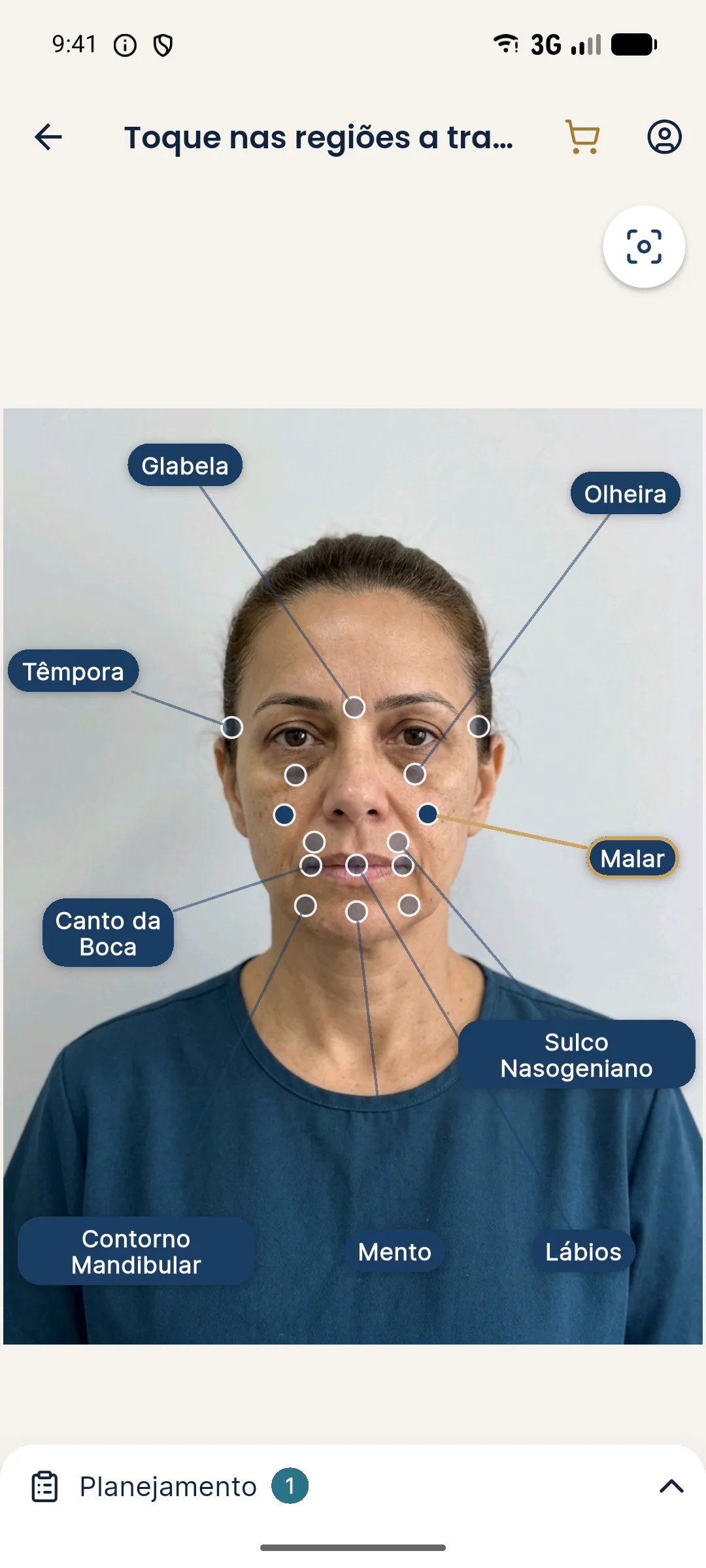
In Harmy, the Cheekbone point lets you mark the volume in ml and generate the "after" projection from a front-facing photo. It helps discuss the amount of projection the patient expects and shows that raising the ml changes the appearance gradually. It shows volume, not the effect of threads or collagen stimulation, so it does not replace the assessment.
How to close the decision
Record in the patient file what the patient asked for, what the assessment showed and what was agreed, with standardized photos. Review with them the time frame for judging the result and what can happen afterward, such as swelling and bruising. If the choice involves both procedures, make clear in the consent that one does not replace the other.
Frequently asked questions
Does malar filler lift the face?
It can give the impression of lift by restoring the volume that used to support the midface, but it does not pull tissue. The effect is one of projection and support, and it depends on the assessment.
Do PDO threads lift more than filler?
There is no single answer. Threads act on support and stimulation, with a generally discreet pulling effect, and filler acts on volume. The choice depends on what that patient's face is missing.
Can malar filler and threads be combined?
Yes, the combination is discussed when there is volume loss and laxity at the same time. The order, the interval and the feasibility are at the professional's discretion.
Which lasts longer, malar filler or threads?
Both durations are ranges and vary with the product, the area and the patient. The most useful approach is to agree on a reassessment with photos, rather than promise a number.
Harmy images are illustrative simulations generated by AI from the patient's photo to support the conversation between practitioner and patient. They are not a promise of results. Indication, technique, product and volume are solely the decision of the licensed practitioner. This content is for information only and does not replace a clinical assessment.