
Malar Filler or Cheek Implant: What Is the Difference

 BeforeSimulation
Quick facts
- Question
- What is the difference between filling and placing an implant in the cheekbone
- Filler
- Absorbable gel, reversible, no surgery
- Implant
- Solid material placed surgically, permanent in nature
- Who indicates it
- Qualified professional, in line with the rules of their professional council
"I prefer the implant, because it lasts forever." This sentence comes up often when the patient has already done their research, and it deserves an unhurried conversation. Malar filler and a cheek implant aim for the same visual effect, more projection in the cheekbone, by paths that look nothing alike: one is an injection of absorbable gel, the other is surgery with solid material. This page helps you explain that difference without taking the place of whoever makes the surgical indication.
Whoever indicates and performs each procedure follows the rules of their professional council. Here the goal is to prepare the conversation and be clear about reversibility, recovery and limits.
What each one is, in patient language
Filler uses hyaluronic acid injected into the malar area to restore or create projection. It is done in the office, with topical anesthetic, and the patient generally returns to routine the same day, with possible swelling and bruising.
An implant is a solid prosthesis placed surgically over the zygomatic bone. It requires an operating room, appropriate anesthesia and a longer recovery. A patient who looks for this path should be referred to someone with surgical training, and the orofacial harmonization (HOF) professional who does not operate can take part in the assessment and conversation stage.
| Aspect | Malar filler | Cheek implant |
|---|---|---|
| Material | Absorbable gel | Solid prosthesis, permanent in nature |
| Procedure | Injection, no cuts | Surgery with an incision |
| Reversal | Can be broken down with hyaluronidase | Requires another surgery to remove or replace |
| Fine adjustment | Gradual, in sessions | Limited to the size and position of the implant |
| Recovery | Days, with possible swelling and bruising | Longer, with postoperative care |
| Duration | Months, with maintenance | Long, but the face keeps aging around it |
In what situations is each one considered?
A discreet lack of projection, or age-related volume loss, is usually treated with gel. It is a path the patient can adjust from time to time and that respects the natural change of the face. For volume design, see how many ml of malar filler.
When the deficiency is bony and marked, the gel needs large volumes to compensate, which can widen the face and give an artificial look. In that scenario, the conversation about surgery makes sense, with a surgical professional. The final decision belongs to the well-informed patient and to the professional who indicates it.
How filler can help with the decision
Some patients use the gel as a projection "trial": it shows how the face responds to more volume in the cheekbone, without giving up reversal. This does not guarantee that an implant will give the same result, because the materials occupy different spaces. Even so, it helps find out whether the patient likes the new proportion.
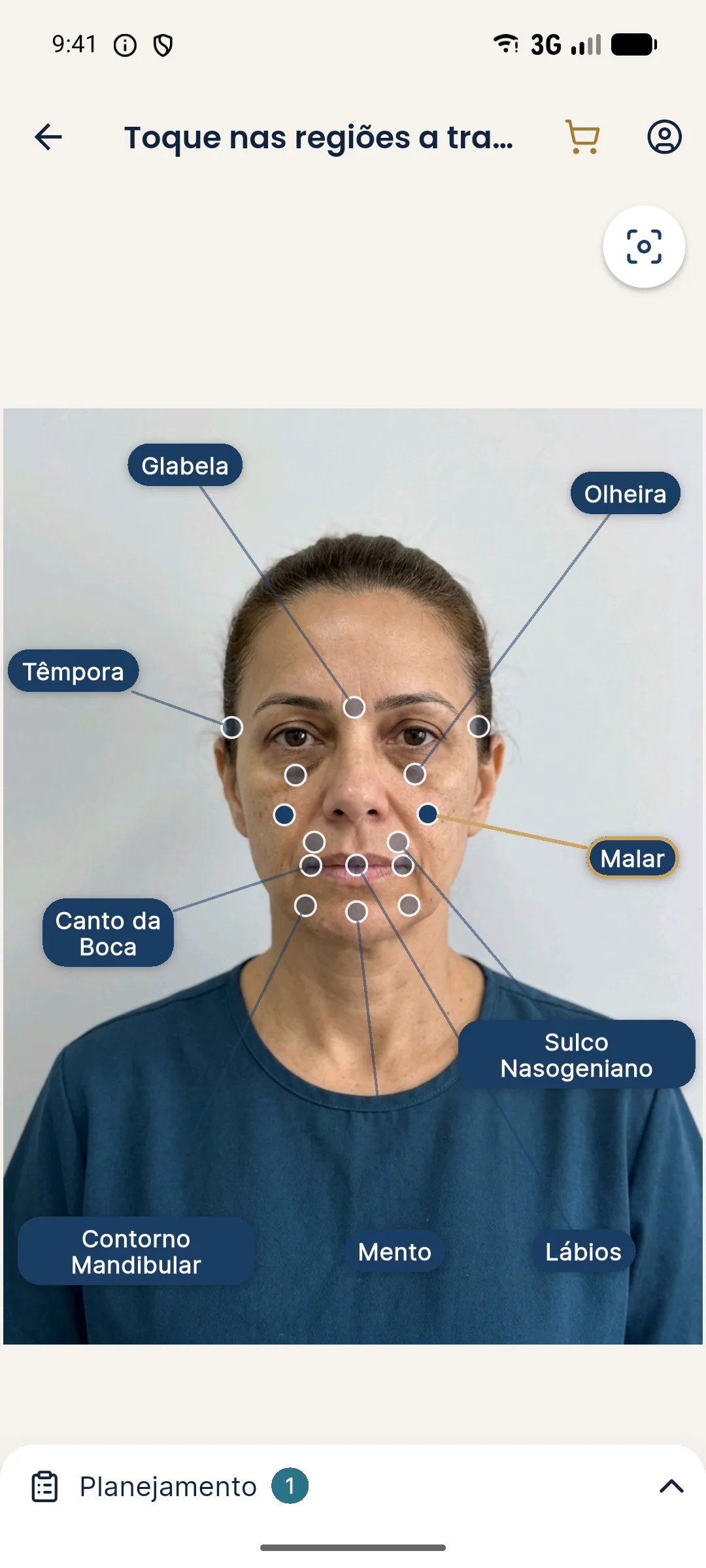
In Harmy, the Cheekbone point lets you simulate the volume in ml on the patient's front-facing photo. The simulation shows an illustrative projection of volume and serves to align expectations, but it does not represent the result of a surgical prosthesis.
Risks that need to be part of the conversation
Risks change a lot between the two paths. With gel, the focus is on vascular occlusion, asymmetry, lumps and swelling, with hyaluronidase available. With surgery, infection, implant displacement, asymmetry and the possibility of reoperation come in. The page asymmetry after malar filler helps on the gel side.
Questions to ask the patient before deciding
To close
The question "what is the difference" often hides another: "which is safest for my face?" There is no universal answer. Gel is the more gradual and reversible path; surgery is permanent and more invasive. Document the conversation, offer the alternative and let the decision mature.
Frequently asked questions
What is the difference between malar filler and a malar implant?
Filler uses an absorbable gel applied by injection. An implant is a solid material placed surgically, generally permanent. Invasiveness, reversal and risk profile all change.
Does a malar implant give a more natural result?
There is no fixed answer. An implant can give stable projection, but filler allows gradual adjustments and reversal. Naturalness depends on the indication and the proportions of the face.
Can I test the result before deciding on an implant?
Some professionals use filler as a projection trial, and a photo simulation also helps the conversation. Neither guarantees the surgical result.
Does malar filler replace an implant?
In some cases of mild to moderate lack of projection, yes. When the bone deficiency is significant, the gel may need large volumes and the result is limited.
Harmy images are illustrative simulations generated by AI from the patient's photo to support the conversation between practitioner and patient. They are not a promise of results. Indication, technique, product and volume are solely the decision of the licensed practitioner. This content is for information only and does not replace a clinical assessment.