
Testosterone Use and Facial Harmonization

Quick facts
- Question
- Can people who use testosterone have facial harmonization
- Central point
- The hormone changes skin, oiliness, fat and muscle, and that goes into the plan
- Attention
- Active acne, increased oiliness and changes in the face over time
- Who decides
- The professional, with complete information and, if needed, the prescribing doctor
Whether in prescribed replacement therapy, for gender transition or in other situations, patients who use testosterone show up more and more in harmonization clinics. Many hesitate to say so, fearing judgment or refusal. This page guides you, the professional, on what the hormone changes in the face and skin, what to ask and how to plan without moralizing and without improvising.
What does testosterone change in the face?
Testosterone and its derivatives act on the skin, sebaceous glands, hair, fat and muscle. In general terms, and with great variation between people, use may be associated with:
- Increased oiliness and larger sebaceous glands, with more visible pores.
- Acne, especially in the first months of use or at high doses. See acne vulgaris and sebaceous gland.
- Changes in facial fat distribution, which tends to decrease in some areas and reorganize over time.
- Increased facial hair and skin thickness.
- Greater muscle mass, with an impact on the masseter and other muscles in some cases.
These effects vary with dose, route of administration, length of use, genetics and underlying condition. The face may be in transformation, and that matters for planning. Gender differences and the assessment of facial type should be considered without stereotypes.
What to ask in the medical history?
The medical history should naturally include a question about hormones and supplements. For someone using testosterone, some useful points:
| Question | Why it matters |
|---|---|
| How long and in what form | Stability of the situation and phase of change |
| Who prescribes and monitors | Possibility of contacting the doctor, if needed |
| Active acne, oiliness or inflammatory lesions | May contraindicate or postpone treatment in the area |
| Other medications | Interactions and bleeding risk |
| What is the aesthetic goal | Aligns the plan with the person's wishes |
| Expectation of future changes in the face | The face may still change, and the plan should allow for it |
It is also important to know whether anabolic steroids are being used in non-prescribed doses, in which case the health assessment has other layers. The page on anabolic steroids and aesthetic procedures covers that situation.
Acne, oiliness and the right time to treat
Injectables in skin with active inflammatory acne are usually postponed, because puncturing an infected or inflamed area increases the risk of infection and of spreading the condition. If the acne is under control, the professional assesses the area to treat. The approach is individual; see active acne: can I have filler?.
Oilier, thicker skin may also respond differently to some treatments, and the choice of what to do at each phase belongs to the professional. Talking to the prescribing doctor, with the person's consent, helps understand whether the dose is stable and whether changes are planned.
Botox and filler: anything specific?
There is no universal contraindication to botulinum toxin or hyaluronic acid solely because of testosterone use. What changes is the context: the skin may be oilier, the muscles stronger and the face may be changing. In areas such as the chin, jawline and glabella, the assessment of volume and muscle strength must be individual.
For those seeking to masculinize the face, the most common requests usually involve the jawline and chin contour, and that conversation is in gender transition and facial harmonization and in respectful care for trans patients. For planning with hormones, see hormone therapy and facial planning.
Beware of assumptions
Two common mistakes in the clinic: treating the information as an obstacle, refusing automatically, and treating it as a detail, ignoring what changes. The middle path is to ask, assess and plan. If you decline for safety reasons, explain why and offer a reassessment. The refusal form, when needed, is in refusal form template.
Harmy's role
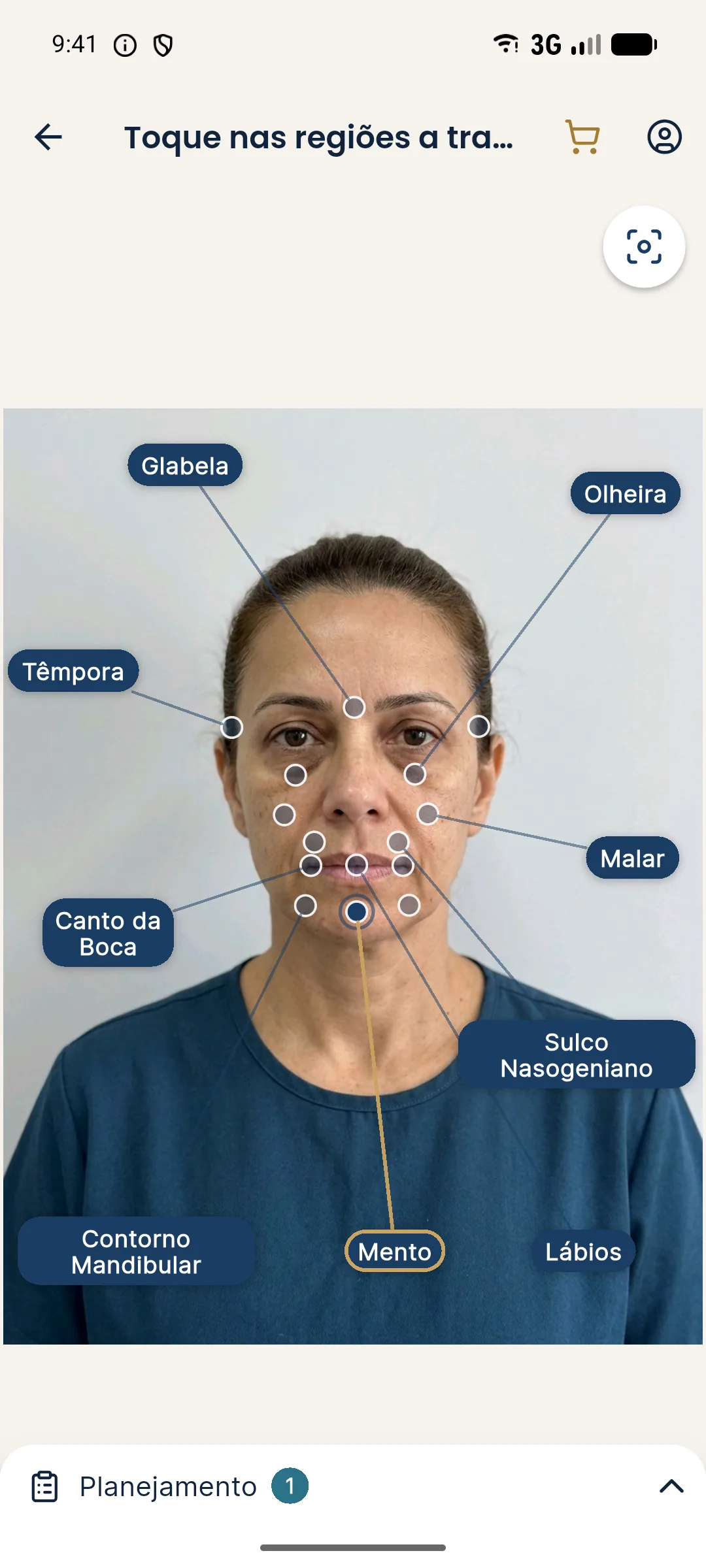
Harmy helps visualize the planning: mark the Chin or the Jawline, set the volume in ml and generate the projection. Because the app uses the frontal photo and shows a change in volume, it serves to talk about expectations without pressure. Remind the patient that the face may change during hormone use, and that the projection is an illustrative simulation, not a promise of results.
Frequently asked questions
Can people who use testosterone have botox and filler?
Generally there is no specific contraindication in itself, but hormone use needs to be in the medical history because it changes the skin, oiliness and the face, and that changes the plan. The decision is the professional's.
Does testosterone cause acne that gets in the way of treatment?
It can cause or worsen acne and oiliness. With active inflammatory acne in the area, the professional usually postpones injectables until the condition is controlled.
Does the face change during testosterone use?
Yes, over time there can be changes in fat distribution, skin and muscle, which is why many professionals wait for stabilization before planning procedures.
Do I need to tell the professional that I use testosterone?
Yes. As with any medication or hormone, the information is part of the medical history and helps the professional plan safely.
Harmy images are illustrative simulations generated by AI from the patient's photo to support the conversation between practitioner and patient. They are not a promise of results. Indication, technique, product and volume are solely the decision of the licensed practitioner. This content is for information only and does not replace a clinical assessment.