
Gender transition and facial harmonization

Quick facts
- Question
- What facial harmonization offers in gender transition
- Scope
- An aesthetic complement to medical care, done in stages
- Principle
- Plan with the person, respecting their pace and expectations
- Who decides
- The qualified professional, in dialogue with the person being treated
For many trans and nonbinary people, the face is a central part of identity, and facial harmonization can be an important complement to transition. For the professional, treating this person takes two skills at once: technique and respect. This page brings together what usually goes into planning, what injectables can and cannot do, and how to lead the conversation.
What is the role of harmonization in transition?
The role is complementary. Medical care, hormone therapy (when the person chooses it), and, when indicated, surgeries have a different function and a different level of change. Injectables work on volume, contour, and muscle dynamics, in a reversible or temporary way in many cases, and can bring the face closer to what the person wants.
It is worth being clear: injectables do not change bone structure. The brow, forehead, jaw, and chin may have limits that only surgery changes. Saying so from the start avoids frustration and protects the relationship.
How is planning usually approached?
| Stated goal | Areas that usually come up | Point of attention |
|---|---|---|
| Soften and feminize | Cheekbone, lips, softening of angles | Avoid excess, which distorts the face |
| Define and masculinize | Chin and jawline | Respect proportions and bone anatomy |
| Reduce expression lines | Botulinum toxin in chosen areas | May change expression, which is part of identity |
| Adjust asymmetries | A combination of areas | Reassess after stabilization |
| Balance the lower third | Chin and jaw | Consider profile and proportion |
The logic is proportion and identity, not a template. assessment by facial thirds helps organize the reasoning, and the facial biotype is one of the elements, but it does not decide.
Hormone therapy and timing
People on hormones, whether estrogens, antiandrogens, or testosterone, may see the face change over months and years: fat that redistributes, skin that changes texture, muscles that change. For that reason, many professionals prefer to plan in stages and wait for relative stabilization before larger volumes, or to start with more conservative procedures.
This is not a rule, and some people want to act soon. The conversation should explain that the face may still change, that a volume placed now could end up out of proportion later, and that adjustment is possible. For testosterone use in particular, see testosterone and facial harmonization. For the professional's view, hormone therapy and facial planning.
Respectful care: what changes in practice
Care goes beyond the procedure. A few practical points:
- Name and pronoun: use the chosen name and the pronoun the person indicates, on the form, in conversation, and in documents.
- Intake form: have fields that do not force the person to expose themselves, and that record what is needed for safety.
- Ask, without interrogating: what matters for the plan is what the person wants and what medications they use.
- Privacy: identity and health data are sensitive; handle them carefully under the LGPD (Brazil's data protection law).
- A prepared team: reception and assistants should receive guidance on respect and discretion.
The full guide is in respectful care for trans patients in HOF.
Risks and expectations
The risks of injectables are the same as for any patient: swelling, bruising, asymmetry, nodules, and, more rarely, vascular complications. The informed consent should cover all of them, with attention to higher-risk areas. In addition, expectations carry more emotional weight: a "nearly there" result can affect self-esteem more than in other consultations.
Also avoid pressure for a big change in one session. Small, progressive changes tend to look more natural and let the person get used to the new face.
Harmy in planning
Harmy can be a communication bridge. Mark the desired areas (Cheekbone, Lips, Chin, Jawline), set the volume in ml and the intensity (Subtle, Moderate, or Pronounced), and show the projection. The person sees the effect of the volume on their own photo, which helps calibrate expectations and decide in stages. The projection is an illustrative simulation, not a promise of results, based on a frontal photo.
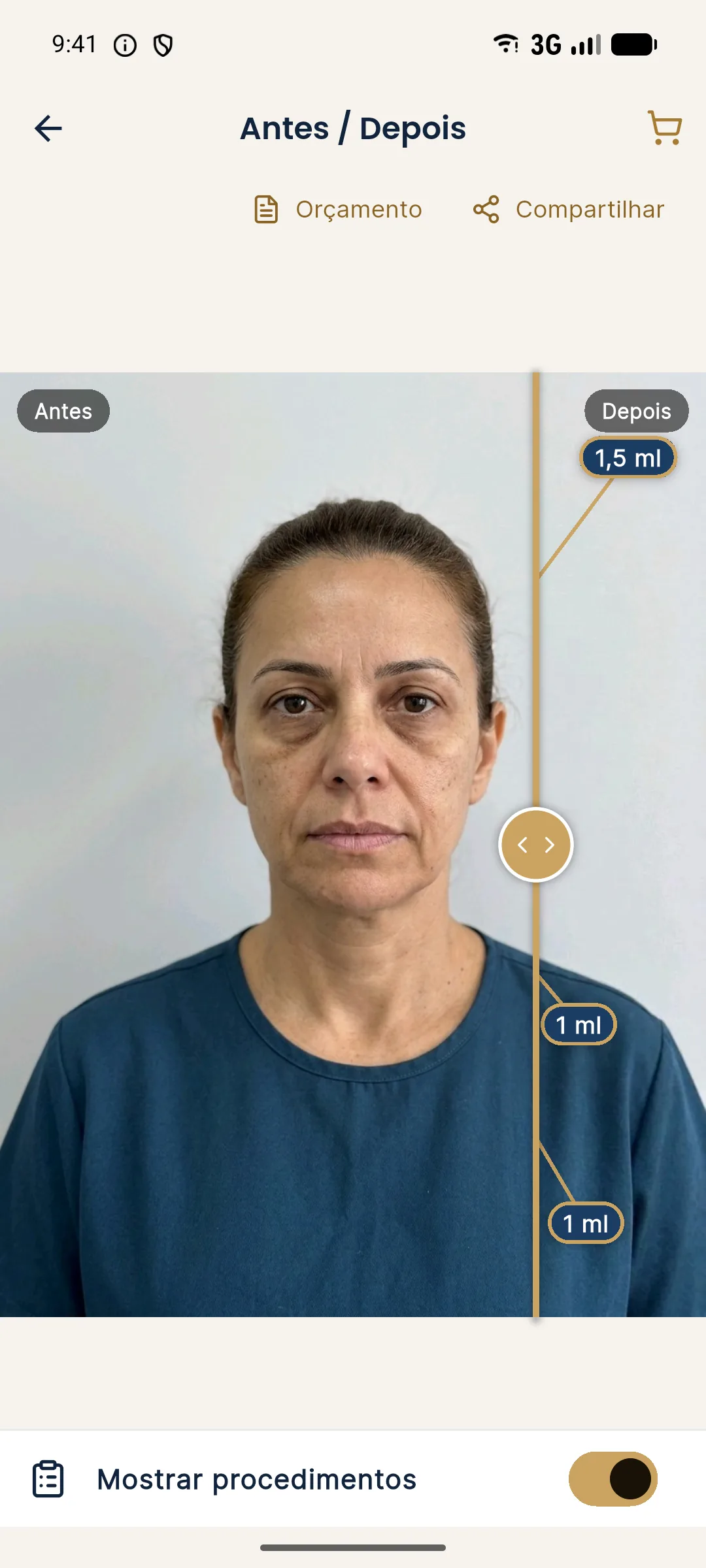
The photo is sent to a third-party AI with the professional's consent in the app, and it is important to tell the person about it. Never use a person's photo in promotion without specific authorization.
Frequently asked questions
Is facial harmonization part of gender transition?
For some people, yes, as an aesthetic complement; for others, no. It is an individual choice, and the procedure does not replace medical care or surgery, when those are indicated.
What can injectables change in facial feminization?
They can adjust volumes, such as cheeks and lips, and soften angles, at the professional's discretion. They do not change bone structure the way surgery does.
What can injectables change in facial masculinization?
They are often used to define the chin and jawline and to reduce the softness of certain areas. The result depends on anatomy and the individual plan.
Do you need to wait for hormone therapy to take effect before harmonizing?
Many professionals prefer to wait for stabilization, because hormones change fat and skin. The decision is shared with the person and, if needed, with the treating physician.
Harmy images are illustrative simulations generated by AI from the patient's photo to support the conversation between practitioner and patient. They are not a promise of results. Indication, technique, product and volume are solely the decision of the licensed practitioner. This content is for information only and does not replace a clinical assessment.