
Dark spots on the face: what harmonization does not treat

Quick facts
- Concern
- Dark or uneven spots on the facial skin that the patient associates with aging
- Method
- Separate changes in color and texture from changes in volume and structure
- Structures
- Epidermis and dermis, melanocytes, superficial vessels and skin barrier
- Caution
- Injectables do not treat spots, and a suspicious spot goes to dermatology
Every day a patient arrives at the clinic asking for "a younger face" and, once examined, turns out to be bothered by spots. The ethical and technical challenge is not to offer what harmonization does not deliver and, above all, not to let slip a lesion that deserves a dermatological look.
This page draws the line between pigmentation and harmonization. It connects with purple or dark under-eye circles, enlarged pores and texture and concerns that harmonization does not solve.
What is a spot and what is volume?
Color and volume are distinct dimensions of aging. A person can have perfect volume and spotted skin, or the reverse. The picture is often mixed, which confuses the patient.
| Change | Layer | Who manages it |
|---|---|---|
| Melasma, sun spots, post-inflammatory spots | Epidermis and dermis | Dermatology |
| Spider veins and rosacea | Superficial vessels | Dermatology |
| Under-eye shadow from a hollow | Volume and structure | Harmonization, at the professional's discretion |
| Under-eye darkness from pigment | Skin and vessels | Dermatology |
| Texture and pores | Skin | Dermatology |
| Loss of volume and laxity | Fat, bone, ligament | Harmonization and other approaches |
Under the eyes, the mix is common. Periorbital pigmentation and the shadow of the groove add up, and treating only the volume may not fix the color. The page on under-eye filler shows the volume side.
What to ask and observe
What harmonization can do
At the discretion of the licensed professional, there are two legitimate points of contact:
- Volume that improves the shadow: in under-eye areas with a hollow component, restoring volume can reduce the shadow, while the pigmentation remains.
- Overall skin quality: approaches such as collagen biostimulator act on support and texture, and do not replace the treatment of spots.
The rest belongs to dermatology: sunscreen, depigmenting agents, light technologies and peels. It is up to the harmonization professional to guide the patient to the specialist and to coordinate the plan so that sessions do not interfere with one another, such as when a skin procedure coincides with an injectable.
Risks of mixing approaches
Using an injectable as a solution for a spot creates unrealistic expectations and unnecessary risk. Besides the usual risks (swelling, bruising, asymmetry, nodules), thin and pigmented skin can show a bruise for longer, and the Tyndall effect under the eyes is a specific risk. The procedure should have hyaluronidase available when hyaluronic acid is used, and the patient should understand that the color of the skin does not change with the product.
How to show it in Harmy
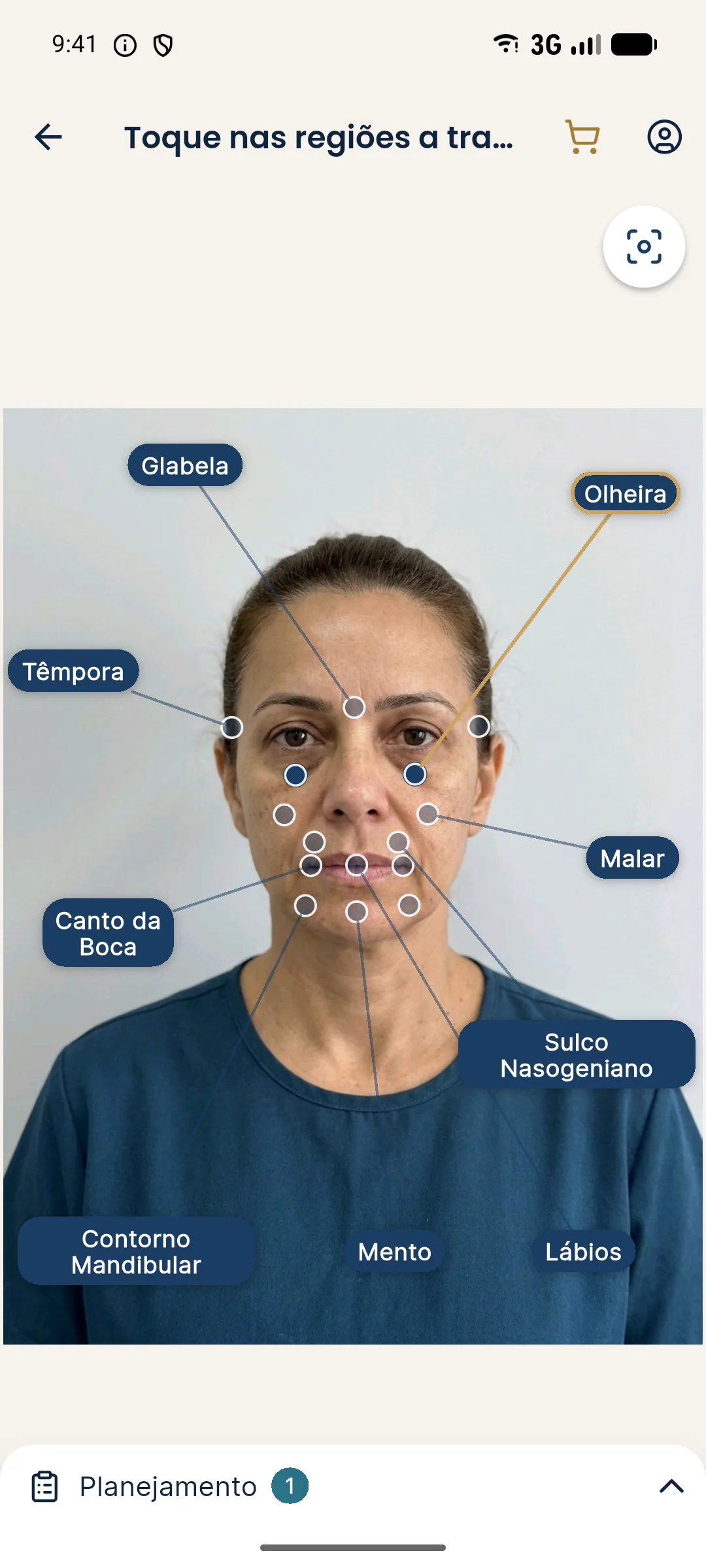
Harmy does not retouch skin or lighten spots. The projection changes only what was marked, and the app's prompt prohibits skin retouching and makeup. This is useful in the conversation: if the patient expects to see the spots disappear, show that the simulation preserves the skin as it is, and that the app handles volume in the marked areas (and toxin only in the glabella and the chin). The Tear Trough point can illustrate the effect of volume on the shadow.
How to coordinate with dermatology
Note recent or planned skin procedures, the desired interval between them and the injectable applications, and the sun-protection guidance. Agree with the colleague on what comes first. A good flow avoids overlapping inflammation and protects the patient's safety.
Common mistakes at the border with dermatology
The first mistake is offering an injectable as a solution for a spot. The patient leaves with the wrong expectation, the product does not do what they hoped and trust wears thin. The second mistake is diagnosing lesions. Saying that a spot is "just melasma" without dermatological evaluation can delay the diagnosis of something more serious.
Another mistake is combining procedures without coordination. A peel or laser right before or after an application increases inflammation and the risk of complications. It is also a mistake to downplay sun protection: without it, any skin treatment loses effect, and the spots come back.
Finally, do not use photos with makeup or filters for assessment. The spot has to be seen in natural light, without products, and the photo in the patient record should reflect reality.
Partnership with dermatology
Build a referral network. When a patient arrives with a pigmentation concern, give guidance, hand over a short summary of what you observed and suggest they come back to reassess the structural part. Agree with the colleague on the order of treatments and the interval between them. Record the referral and the guidance in the patient record. For the patient, this approach shows care: they see that the professional knows the limits of their own field. For the professional, it reduces the risk of frustrated expectations and later complaints. And, in the long run, a good network increases patient trust and the quality of results.
Patient profiles and when to postpone
Patients with active melasma, inflamed acne or dermatitis should wait for the skin to stabilize before any application. Patients in recent dermatological treatment, such as a peel or laser, need an interval defined by whoever is managing that treatment.
People with darker skin have a higher risk of post-inflammatory hyperpigmentation, and any procedure should take that risk into account. Patients with heavy sun exposure need rigorous sun-protection guidance.
When the patient wants to do everything at once, it is worth proposing an order: skin first, volume afterward, with a review. Skin in better condition also improves the reading of what really needs volume.
Wrap-up
Harmonization gains credibility when it says "that is not for me." Record the guidance, the referral and what will be left for later. For similar concerns, see acne scars on the face and thin skin under the eyes. Volumes and techniques are at the discretion of the licensed professional, in accordance with the rules of their professional council in Brazil.
Frequently asked questions
Does filler lighten dark spots?
No. Hyaluronic acid and other fillers act on volume and contour, not on pigmentation. A spot is a skin issue and is managed with dermatology.
Are dark circles a spot or a volume issue?
It can be color (pigment, vessels), shadow from volume loss, or both. The assessment separates what belongs to the skin from what belongs to the structure before any injectable.
What should I do if a spot looks suspicious?
Refer to dermatology with urgency proportional to the concern. A lesion that grows, changes color, bleeds or has irregular borders is not an aesthetics matter.
Does Harmy simulate the treatment of dark spots?
No. The app projects volume in the marked areas and does not retouch skin, so spots stay as they are in the original photo.
Harmy images are illustrative simulations generated by AI from the patient's photo to support the conversation between practitioner and patient. They are not a promise of results. Indication, technique, product and volume are solely the decision of the licensed practitioner. This content is for information only and does not replace a clinical assessment.