
I'm afraid of looking artificial: how to answer the patient
"I don't want to look artificial" is perhaps the sentence heard most often in orofacial harmonization (HOF) practices. It is a request, and also a fear. People who say it have seen faces that bothered them, on social media, on the street or in the family, and want to be sure they will not become one of them.
Answering well takes more than saying "trust me." Here is a three-step answer that combines listening, criteria and the plan's limits. The content is about communication, and conduct is left to the judgment of the qualified professional, in line with the rules of their professional board in Brazil.
What does "artificial" mean to each patient?
The word is vague, and that is the first point to clarify. For one patient, it is "duck" lips. For another, a face with no expression. For another, too much symmetry. Ask:
- "What have you seen that you didn't like?"
- "Is there anyone you think looks natural?"
- "If you could describe in one word what you want to avoid, what would it be?"
The answers become the criteria for the plan. Without them, you may be promising a "natural" that is not theirs.
Three-step answer
Step 1: listen and name it
Repeat in your own words what the patient described. That shows you listened, and gives them the chance to correct you.
Step 2: explain your criteria
Say how you usually think about the plan, without promising. Points that usually come up:
- working on proportion, not just volume;
- starting conservatively and reassessing later;
- respecting each face's anatomy and expression;
- preferring stages over one big change at once;
- declining what you do not consider appropriate.
Speak in the first person: "I usually," "my approach is." That avoids generalizing and makes clear it is your criterion.
Step 3: agree on the limit
The limit protects the patient and you. Agree on it out loud:
- what will be done now and what will be left for later;
- what you will not do, even if they ask;
- how you will assess the result together;
- that they can say "enough" or "less."
This step turns fear into an agreement. See aligning expectations about naturalness and I never want to look like I've had botox.
How does the simulation fit into this conversation?
On this topic, the simulation is a good ally, as long as it is honest. The Harmy projection changes only what was marked and does not alter skin, expression, background or lighting. That is why the changes tend to be subtle and realistic, which helps show a discreet plan.
Two precautions:
- It is not proof. The simulation is illustrative. The patient needs to know the actual result may look different.
- Start with less. Showing the discreet version first keeps them from getting used to a bigger change and then finding the subtle one "too little."
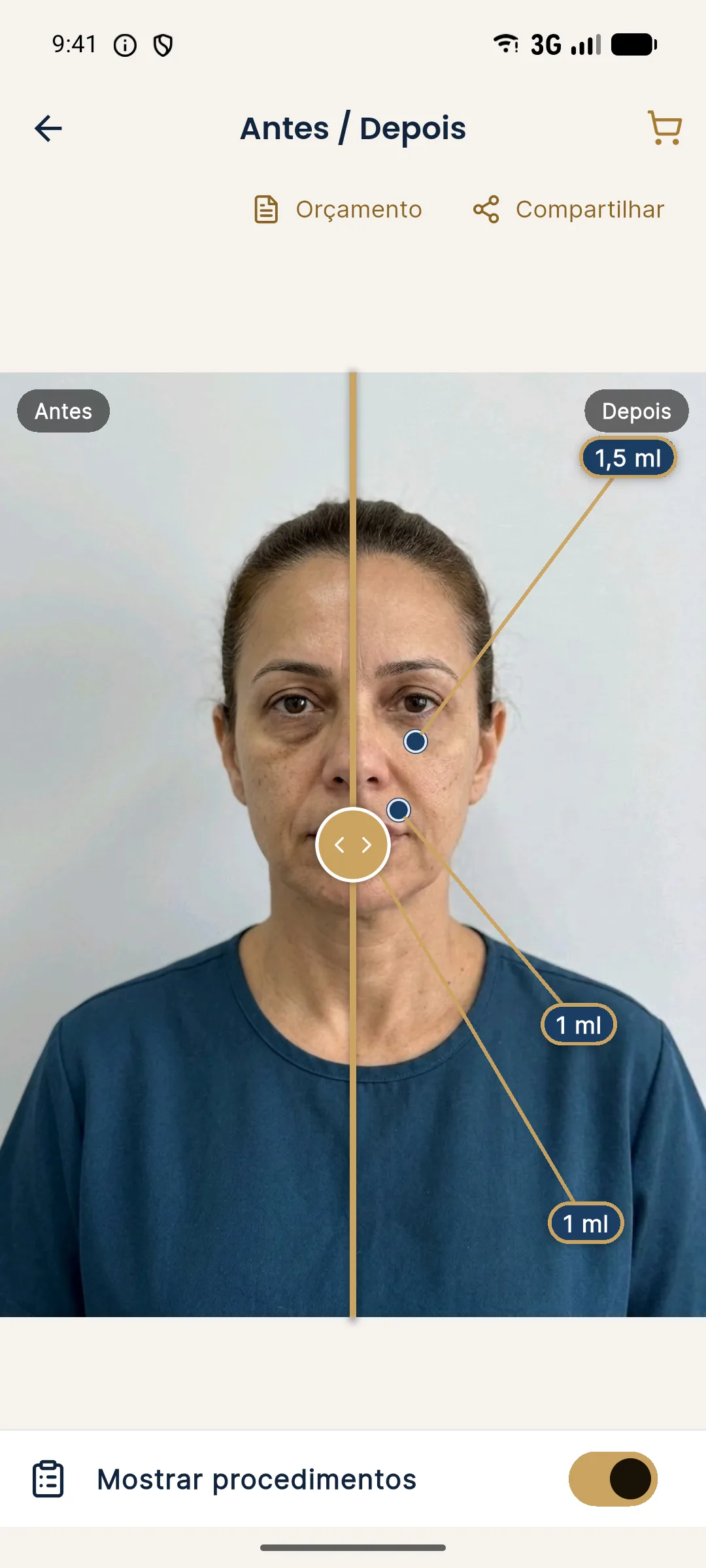
Table of signs and answers
| What the patient says | What may be behind it | Possible answer |
|---|---|---|
| "I don't want big lips" | Fear of overdoing the area | "Let's start discreetly and assess" |
| "I don't want a frozen face" | Fear of losing expression | "I can adjust to preserve movement where appropriate" |
| "I want it natural" | Vague term | "What would natural be for you?" |
| "Just like my friend" | Reference to another face | "Every face responds differently; let's think about yours" |
| "If it looks strange, can it be undone?" | Fear of irreversibility | "In some situations yes, in others no; let me explain" |
When the answer is "if it looks strange, can it be undone?", explain carefully: hyaluronic acid can be reversed with hyaluronidase in many cases, but that does not hold for every product and must be explained without promises. See explaining hyaluronidase to the patient.
What if the patient wants more than you think appropriate?
The reverse can happen: the patient says they do not want anything artificial and, on seeing the subtle simulation, asks for "a little more." That is part of the process, but it has a limit. If the request goes beyond what you consider proportionate, say so clearly and respectfully. The final decision to perform it is yours, according to your technical judgment and the rules of your professional board. Patient autonomy exists, and so does yours. See how to say no to a patient in HOF.
What to document?
- What "artificial" means to the patient, in their own words.
- The approach proposed and the limit agreed.
- That the simulation was presented as illustrative.
- That the patient can ask for less at any time.
The informed consent form should reflect this agreement. Keeping the patient's account helps compare it with what they say at the follow-up.
Frequently asked questions
How do I keep the patient from looking artificial?
There is no guaranteed formula. What helps is a conservative plan, respected proportions, intervals between sessions and listening to what the patient considers natural. The result depends on the case and is assessed by the professional.
Can I promise a natural result?
No. You can explain your approach and what you do to aim for naturalness, but natural is a subjective perception and results vary.
Does the simulation show whether it will look natural?
It shows an illustrative idea of the marked plan, with subtle changes. It does not guarantee that the actual result will be perceived as natural, but it helps the patient say whether they like it.
What if the patient wants more volume than the professional recommends?
Explain your assessment, show the limit you consider safe and proportionate and, if they persist, the professional may decline. The decision to perform it is theirs.
Harmy images are illustrative simulations generated by AI from the patient's photo to support the conversation between practitioner and patient. They are not a promise of results. Indication, technique, product and volume are solely the decision of the licensed practitioner. This content is for information only and does not replace a clinical assessment.