
When the Simulation Reveals the Patient's Asymmetry

There is a common moment in the consultation that almost nobody rehearses: you open the frontal photo, the patient sees themselves full screen and says "my eye is lower than the other" or "I never noticed my chin is crooked." They are not complaining about you. They are seeing, for the first time, something that was always there.
The simulation is a conversation tool, and an enlarged frontal photo is the most demanding image there is. This page deals with what to say and what to avoid when the image shows more than the patient expected to see. Everything here is communication guidance, at the discretion of the licensed professional, in line with their professional board's rules.
Why does asymmetry show up so much in the frontal photo?
Because the brain tends to "correct" its own face in the mirror, where the patient sees themselves in motion, with expression, and from several angles. The frontal photo freezes a single position, usually without a smile and with flatter light, and makes the differences between the sides stand out. When it appears enlarged on a phone or a screen, the effect multiplies.
There is also the fact that facial asymmetry is common and usually has varied origins: bone structure, dentition, chewing habits, sleeping position, musculature. None of this needs to be explained like a lecture, but it helps to know that the patient's question almost always has a reassuring answer: "this is common and deserves to be considered in the plan."
What do you do at the patient's first reaction?
The initial reaction sets the rest of the consultation. A few attitudes help:
- Stop touching the screen. Do not zoom, do not slide the slider, do not point with your finger.
- Acknowledge without agreeing with everything. "I understand that seeing it this way stands out" is different from "you're right, it's pretty crooked."
- Give context. Frontal photos, light, and angle exaggerate differences; most people have something similar.
- Hand back control. Ask what bothered them most, and what they would like to talk about first.
Avoid phrases like "that's normal, don't worry" said too quickly. They shut down the conversation, and the patient may feel that their concern was brushed off.
How do you separate natural asymmetry from asymmetry that deserves treatment?
Not every difference is an indication. One way to organize the conversation is to sort it into three groups:
| Type | How to approach it | Example phrase |
|---|---|---|
| Subtle difference that only shows in an enlarged photo | Explain that it is common and that the plan does not need to address it | "It's a detail almost everyone has" |
| Difference the patient notices and is bothered by | Discuss whether any approach can soften it, with a clear limit | "It may be possible to soften it, but not to even out the sides" |
| Difference with a possible structural or functional cause | Consider a complementary assessment or referral | "This may be related to your bite; an evaluation is worthwhile" |
The goal is not to make one side match the other. A perfectly symmetrical face usually looks strange, and a facial harmonization plan works with proportion, not mirroring. To go deeper into this conversation, see explaining natural asymmetry to the patient and aligning expectations about asymmetry.
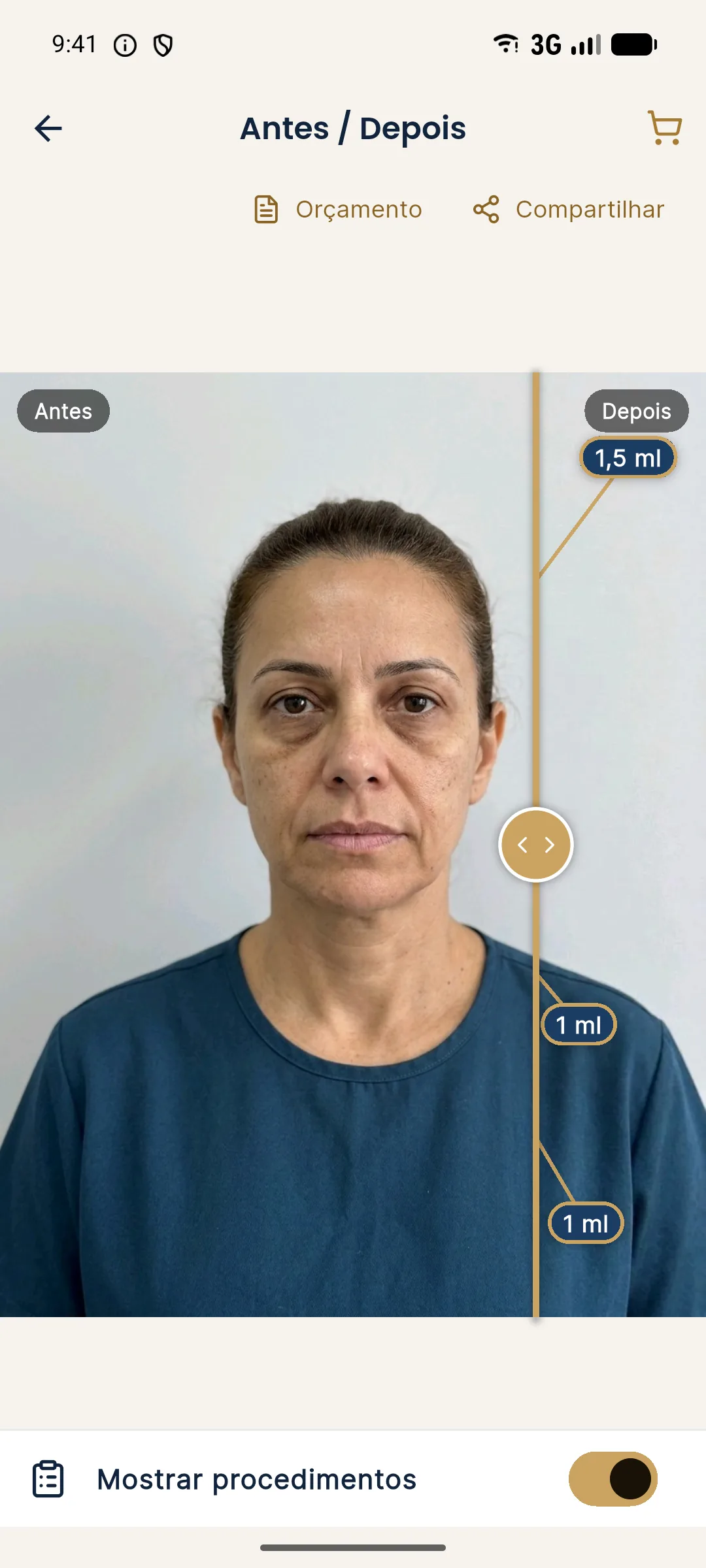
What does Harmy show and not show?
This has a practical consequence. If the patient expects to see a "balanced" face in the After image and the difference is still there, frustration appears on the spot. Before opening the slider, say what the image will and will not show. The conversation about Subtle, Moderate, or Pronounced intensity also comes in here: the more discreet the volume, the less the difference between the sides changes.
When should you postpone the simulation or change the order of the conversation?
Some situations call for the image to wait:
- The patient came with asymmetry as their main concern and is already anxious. Before showing anything, listen and sort out priorities.
- There are signs of disproportionate concern over a minimal detail. See simulation for a patient with suspected body dysmorphia.
- The patient already compares themselves with social media filters. The gap between the real face and the filtered image weighs on the reaction.
In these cases, one option is to first talk about what they want to change, then show the normal photo, and only then, if it makes sense, the simulation.
How do you keep the simulation from being used against the professional?
If the patient is shocked by the image and later attributes the discomfort to the procedure, the line between "they already had it" and "it was the treatment" gets blurry. The defense is clarity before the act:
- a standardized photo before the procedure, with consent for its use;
- a record of the differences observed, in neutral language;
- an explanation that the plan may soften but not correct, and that the simulation is illustrative;
- the informed consent signed after the conversation, not before.
The patient record is the right place for this, and the before photo becomes the reference for any future discussion.
What if the asymmetry gets worse after the procedure?
It can happen that swelling, product settling, or individual response leave the sides different for a while. Not everything is a failure, but every complaint deserves a reassessment. Compare with the before photo, record it, and talk without getting defensive. For this scenario, see communicating post-procedure asymmetry.
Frequently asked questions
Does every face have some asymmetry?
Generally, yes. Subtle differences between the sides are part of the human face, and they tend to be more noticeable in a frontal photo, under strong light, or on an enlarged screen.
Should the simulation hide the patient's asymmetry?
No. The simulation shows only what was marked, and the patient needs to understand that the plan may soften some differences but not correct them all. Hiding it creates an expectation the actual result does not meet.
What if the patient is shocked to see their own photo?
Stop the presentation, acknowledge what they felt, go back to the normal photo, and explain that the camera and angle exaggerate differences. Return to the plan only when they are comfortable.
Should I record the asymmetry in the patient record?
Yes. Record the asymmetry observed before the procedure and the guidance given to the patient, preferably with a standardized photo and consent.
Harmy images are illustrative simulations generated by AI from the patient's photo to support the conversation between practitioner and patient. They are not a promise of results. Indication, technique, product and volume are solely the decision of the licensed practitioner. This content is for information only and does not replace a clinical assessment.