
Hyaluronic Acid in the Nasal Dorsum: Limits and Risks
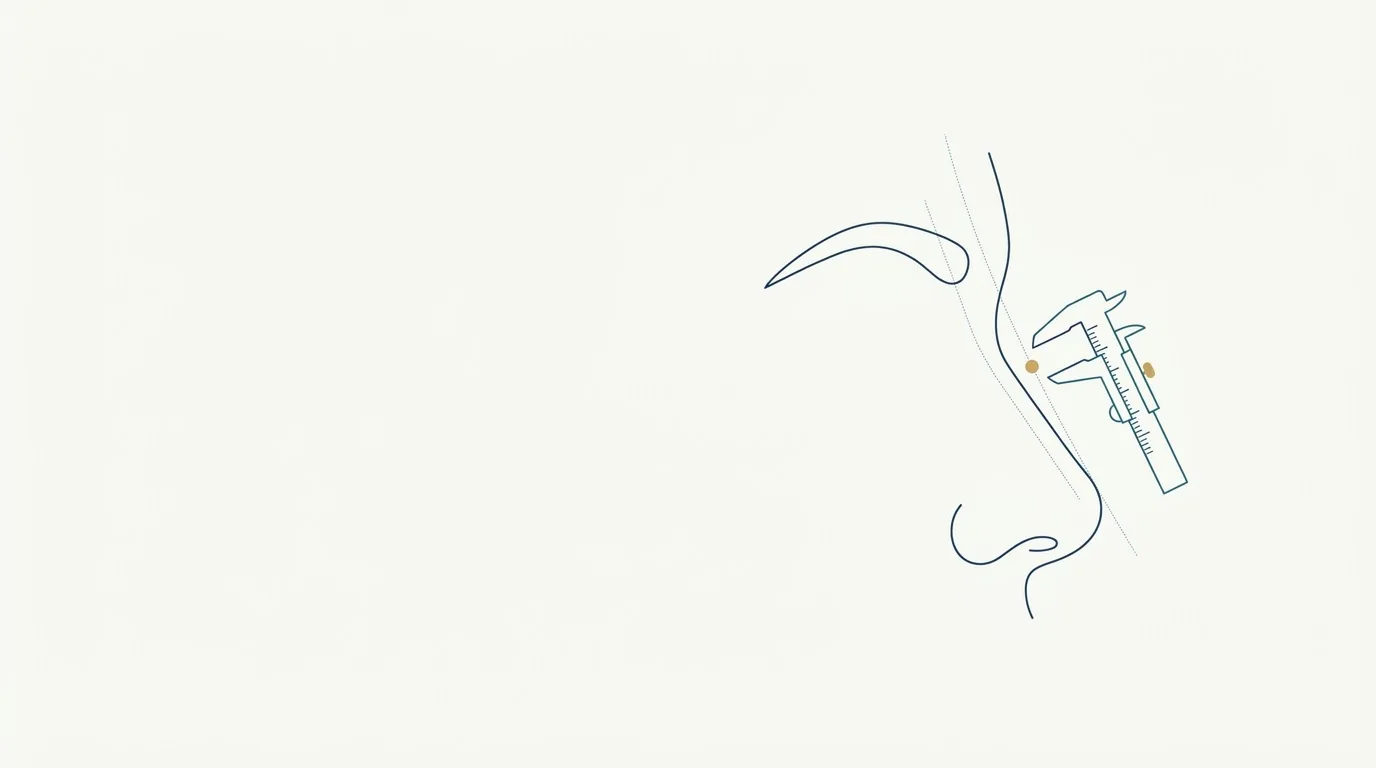
- Artery
Quick facts
- Area
- Nasal dorsum (between the nasion and the tip)
- Vascular risk
- High, with the possibility of ischemic and visual complications
- Most cited use
- Small irregularities and contour, in selected patients
- Prerequisite
- Refined anatomy knowledge and hyaluronidase available
- Alternative
- Not treating, referring or another strategy, at the professional's discretion
The nasal dorsum is one of the areas where hyaluronic acid demands the most respect. The concern that brings the patient to the office is usually simple (a slight hump, a step-off after surgery, a bridge that looks "sunken"), but the anatomy behind it does not forgive improvisation. Thin skin, little cushioning tissue and an arterial network that communicates with the orbit make the nose an area with a small margin for error.
This page is a review of indication, limits and risks, written for the orofacial harmonization (HOF) professional. It does not teach injection technique. Any decision about product, volume and approach is up to the licensed professional, after assessment, according to the rules of their professional board and the product's instructions for use.
Why does the nasal dorsum demand refined anatomy knowledge?
The nasal dorsum has a rigid base in the upper part (the nasal bone) and a flexible base lower down (the nasal cartilages). Between them and the skin there are thin layers, and the thickness of the soft-tissue cover varies from one person to another and from one part of the same nose to another. This changes how the gel spreads, how it shows under the skin and how the tissue tolerates pressure.
From a vascular standpoint, the nose receives blood from branches of the facial artery and the ophthalmic artery. The dorsal nasal artery, the lateral nasal artery and the columellar artery form a network with anastomoses, and there are individual variations. The connection with the ophthalmic artery and, through it, with the central retinal artery is why the nose always appears on lists of high-risk areas for visual complications. The general overview is in vascular danger zones of the face, and the detailed anatomy in nasal anatomy for injectables.
When is dorsum filling usually considered?
In the clinical literature and at congresses, the most cited indications are small ones, not large changes in projection. Among them:
- Subtle contour irregularities, for example after rhinoplasty, in patients who do not want to or cannot repeat the surgery.
- Smoothing a subtle step between the root and the dorsum.
- Small harmony adjustments between nose, chin and lips, assessed within the whole face.
Filler does not replace surgery when the concern is structural. If the patient's expectation is a big change, the honest path is usually to say the procedure has limits and, when appropriate, to refer. For the big picture, see facial assessment by thirds and retrognathic profile: assessment.
What are the limits of the indication?
There are situations in which the best judgment is not to treat or to postpone. The table summarizes usual criteria for caution, without replacing the clinical assessment.
| Situation | Why it calls for caution |
|---|---|
| Very thin skin or vascularized scar | Lower tissue tolerance and higher risk of circulatory compromise |
| Previous nasal surgery (rhinoplasty) | Altered vascular anatomy, unpredictable courses |
| Previous filler in the nose or area | Residual volume, fibrosis, unknown product |
| Unrealistic expectations | Dissatisfaction likely even without complications |
| Active infection, lesion or cold sore in the area | Risk of infectious complication |
| No hyaluronidase or emergency preparedness | No minimum safety conditions |
For the history of previous interventions, the page patient with unknown prior filler helps organize the conversation and the record.
What are the main risks?
The risks of the nasal dorsum are not exclusive to this area, but here they carry more weight:
- Vascular occlusion, which can progress to ischemia and skin necrosis on the dorsum, tip or alae of the nose.
- Visual complication, rare but serious, through retrograde embolization. See visual complication after filler.
- Irregularities and nodules, more visible on a thin-skinned nose.
- Tyndall effect, with a bluish tone when the gel is superficial. Details in Tyndall effect.
- Excess volume, which widens the dorsum and disrupts facial proportions.
- Infection and biofilm, the topic of infection and biofilm after filler.
Recognition specific to this area is in nasal vascular occlusion, and office preparation is in emergency kit for the HOF office and hyaluronidase in the office.
What do you need before accepting the case?
The consent must mention the complications specific to the nose, including vascular and visual ones, in language the patient understands. Informed consent is not just a signature: it is the conversation that comes before it.
How do product and instrument choice come into the conversation?
Product and instrument are the professional's decisions. For review purposes, it is worth remembering that the discussion about cannula or needle has no single answer, and that neither eliminates vascular risk. What reduces risk is the whole set: anatomical knowledge, small and conservative volume, attention to signs, a calm pace and preparation for an emergency.
It is also prudent to remember that, in thin-skinned areas, very hydrophilic products or those with high projection capacity can increase the risk of irregularity and swelling. Reading the product's instructions for use is part of safety. To understand the logic of choosing by area, see hyaluronic acid by area.
What if the result is not as expected?
The fact that hyaluronic acid can be dissolved with hyaluronidase is one of the reasons it is the usual choice in delicate areas. This, however, should not become a justification for careless injection: dissolving also has risks, such as local reaction, and not every complication resolves completely. The criteria are in dissolving filler: criteria for indication.
When there are signs of circulatory compromise, time is the main factor. Training the team, keeping the supplies within reach and rehearsing the sequence make a real difference at that moment.
How to follow up with the patient afterward?
Agree on a direct channel, tell the patient which signs require immediate contact and schedule a review. Written instructions are in post-procedure instructions, and the follow-up script is in clinical follow-up after HOF. Record product, lot, volume and complications in the patient record (see traceability of injectables).
Where does Harmy come into this conversation?
Harmy does not replace the assessment of the nose: the app works with a front-facing photo and marks areas of the face such as Glabella, Cheekbone, Lips and Chin, with no specific point for the nasal dorsum. For overall planning, the projection can help show the patient how neighboring areas interact with the nose, always as an illustrative simulation, not a promise of results. A well-assessed nose also benefits from decisions about the chin and lips; see nose area for the overview.
In summary
The nasal dorsum with hyaluronic acid is a procedure with a narrow indication and high risk. The most useful question before injecting is whether the patient really needs it and whether you are able to manage a complication, here and now. When the answer to either is uncertain, not injecting is a legitimate clinical decision.
Frequently asked questions
Can the nasal dorsum be filled with hyaluronic acid?
It is done in clinical practice, in selected cases, but it is a high vascular risk area. The indication, technique and product are the decision of the licensed professional, according to the rules of their professional board.
Why is the nose considered a risk area?
Because the skin is thin, the space is small and the arteries of the nose connect with the circulation of the orbit. A vascular occlusion can cause skin necrosis and, more rarely, vision loss.
Is nose filler permanent?
Hyaluronic acid is reabsorbed over time, and the duration varies with the product, the area and the patient. It is not a permanent procedure, and the gel can be dissolved with hyaluronidase when indicated.
What should be done if pallor or intense pain appears in the nose after the injection?
Stop the injection, follow the office's vascular occlusion protocol and use hyaluronidase according to the professional's approach. Visual symptoms call for immediate referral.
Harmy images are illustrative simulations generated by AI from the patient's photo to support the conversation between practitioner and patient. They are not a promise of results. Indication, technique, product and volume are solely the decision of the licensed practitioner. This content is for information only and does not replace a clinical assessment.