
Mouth corner with hyaluronic acid: when and risks

 BeforeSimulation
- Muscle
- Highlighted area
Quick facts
- Area
- The angle of the mouth, where the lips meet, with the modiolus just lateral to it.
- Common concern
- Downturned mouth corner, a sad or tired look, a crease that collects saliva.
- Central risk
- Irregularity, gel migration with movement, persistent swelling and vascular compromise.
- Before treating
- Separate muscular cause, volume loss, excess skin and the habit of drooling.
The mouth corner is the point where the upper lip meets the lower. When it turns downward, patients tend to describe a face that looks sad or tired, and they often ask for "a little filler in the corner of the mouth". The request seems simple, but this area is among those that demand the most anatomical reading before any indication with hyaluronic acid.
This text is not an injection protocol. It organizes the assessment reasoning: when it makes sense to consider filler, what else may be causing the concern, what the risks are and how to document the decision. Volumes and management are at the discretion of the licensed practitioner, according to the rules of their professional board.
What is at the corner of the mouth?
The angle of the mouth is a convergence zone. Fibers of the orbicularis oris muscle, the depressor anguli oris, the zygomaticus major, the buccinator and other muscles meet there, forming the modiolus. This fibromuscular knot shifts with every smile, speech, chewing and yawn.
Two practical consequences follow. The first is that any material placed near the modiolus is subject to traction and compression all day, which favors irregularities and displacement. The second is that the final result depends on the balance between the muscles that pull the corner up and those that pull it down, not only on the local volume.
There is also the blood supply. The upper and lower labial arteries form an arcade that passes very close to the corner, which makes the area relevant for vascular risk.
Why does the mouth corner turn downward?
Before thinking about gel, it is worth separating the causes, because each calls for a different response.
| Likely cause | How it presents | General direction of management |
|---|---|---|
| Muscle activity | The corner drops more when the patient talks or relaxes the face | May involve botulinum toxin in the depressor, at the practitioner's discretion |
| Local volume loss | Crease at the corner, hollow look, little support | Filler may enter the plan, in small amounts |
| Lower third laxity | Descent of the lateral tissue, with associated marionette lines and jowls | Assess the whole lower third |
| Bony anatomy | Retruded chin, short jaw | Assess the profile before treating the corner |
| Habit and dentition | Tooth loss, low bite, use of dentures | Refer for dental assessment when suspected |
This reading changes the plan. A corner that drops because of the depressor and is treated with volume alone tends to end up with the gel under opposing traction, while generalized laxity is hardly ever solved by an isolated filler point. Marionette lines are described under marionette lines.
When does it make sense to consider filler?
Filler at the mouth corner usually comes in as part of a larger plan, and rarely as the only measure. Situations in which it is discussed in the practical literature:
- a subtle crease at the corner from volume loss, without excess skin;
- combined with treating the fold that runs down from the corner (the so-called marionette lines), after assessing the cause;
- subtle support of the angle, in a patient without significant muscle overactivity.
Situations in which many practitioners prefer not to treat or to postpone:
- a downturned corner with a strong muscular component and no other measure yet;
- marked laxity of the lower third, which calls for a broader strategy;
- a patient expecting a marked "lift" of the corner, which is not always plausible;
- an active herpes lesion, local infection or lips with poor skin condition (see cold sores and filler).
What is the risk of migration and irregularity?
Hyaluronic acid is hydrophilic: it absorbs water and swells. In an area with a lot of movement, too much volume creates a visible bulge, a palpable nodule or a "heavy" corner that accentuates what was meant to be corrected. Gel migration is also described when the amount exceeds what the space can hold. For the general topic, see hyaluronic acid migration.
The choice of product, amount and technique are part of the clinical decision and outside the scope of this page. What belongs here is the principle: at the mouth corner, less is usually more, and later reassessment is worth more than same-day correction.
And saliva at the corner of the mouth?
In some patients, the crease at the corner is so marked that it collects saliva and moisture, causing irritation and sometimes angular cheilitis. It is one of the reasons patients seek treatment. The practitioner may consider that correcting the step helps, but the concern has other possible origins: loss of the vertical dimension of occlusion, poorly fitted dentures, nutritional deficiency, fungal infection. If there is a persistent lesion, the assessment should be clinical or dental before any injectable.
What to check before injecting?
How does it evolve afterward and what to record?
In mobile areas, the appearance can change over the days. The practitioner usually advises the patient about swelling, bruising and tenderness, and schedules a review. General instructions are in aftercare instructions.
In the patient record, note the cause identified, the product and lot, the area and total amount, the absence or presence of a complication, and the photos. The guide on patient records and documentation in HOF details the documentation.
How to simulate the expectation in the app
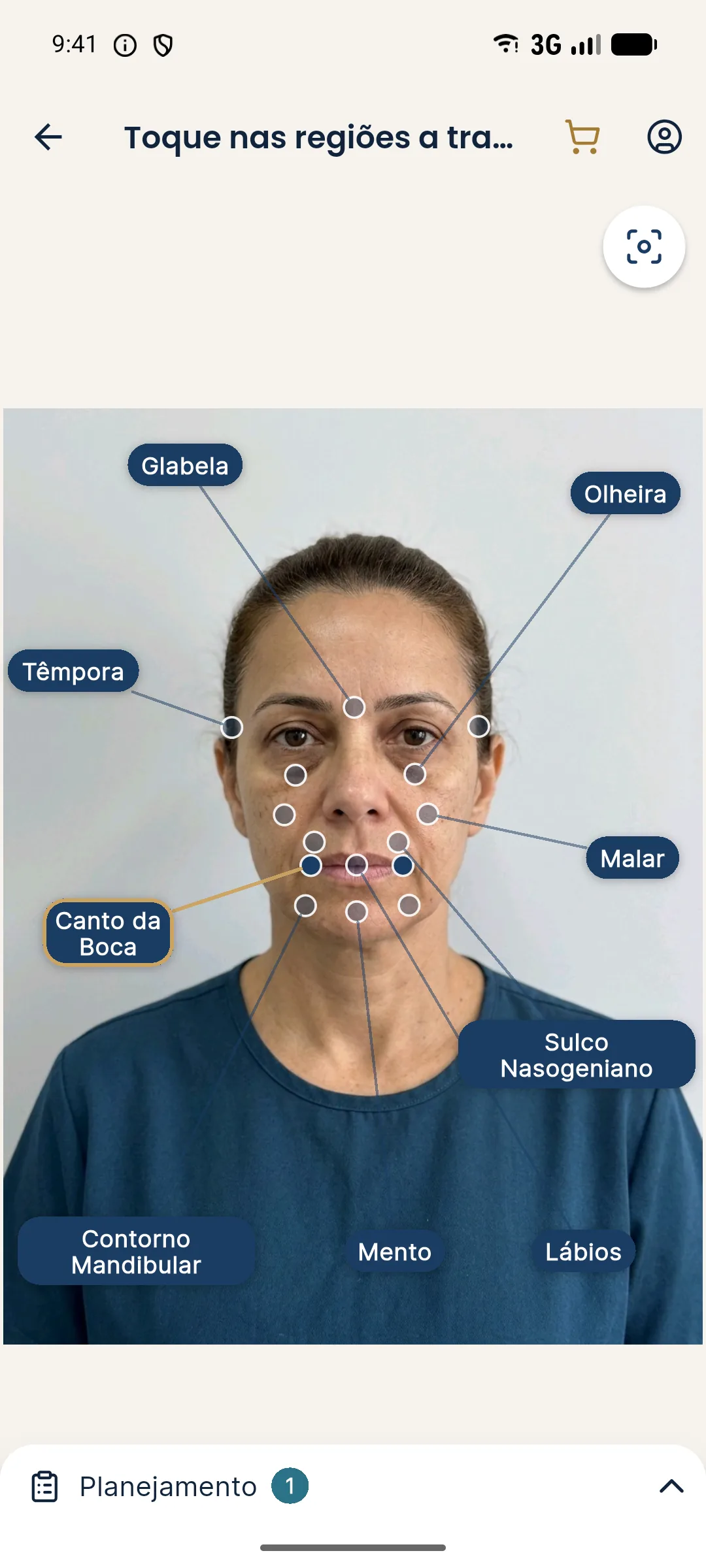
In Harmy, the "Mouth Corner" point is part of the marking. You can mark the area, set the ml in the plan and see the Before/After projection, used as support to align expectations with the patient. The simulation is illustrative, not a promise of results, and uses only the frontal photo.
To see the area in context, also read mouth corner filler and the area page for the mouth corners.
Myth or fact?
When to refer or postpone
Consider referring or postponing when there is a persistent lesion at the corner (fissure, scaling, crust), suspicion of a significant bite problem, an expectation incompatible with what the procedure can offer, or signs of body dysmorphic disorder. Documenting a decision not to treat is also part of good practice.
Final points of attention
The mouth corner calls for assessing the whole picture, and hyaluronic acid is one of the possible tools, never the automatic first answer. Understanding the modiolus, the muscle dynamics, the labial blood supply and the cause of the corner's droop avoids wrong indications, and a scheduled reassessment shows whether the decision was right. For the overview of areas, see hyaluronic acid by area and safety and complications.
Frequently asked questions
Can a drooping mouth corner be treated with hyaluronic acid alone?
Sometimes filler is part of the plan, but the cause has to be understood first. When the downward pull is muscular or the problem is laxity of the lower third, hyaluronic acid alone is usually not enough. The decision belongs to the practitioner, after assessment.
Why is the mouth corner a delicate area to fill?
Because it concentrates the modiolus, where several muscles meet and move a great deal, and it also has labial vessels nearby. Gel in this area is under constant traction and can become irregular or shift.
Can hyaluronic acid at the mouth corner migrate?
The gel can shift over time, especially in areas of a lot of movement and when the volume is too much for the space. That is why the area is described as having low tolerance for excess.
Does drooling at the mouth corner improve with filler?
In some cases the deep crease at the corner favors saliva and moisture buildup, and the practitioner may consider correcting the step. But other causes must be ruled out first, and the answer varies from patient to patient.
Does hyaluronidase need to be available for this procedure?
Yes. Whenever hyaluronic acid is used, hyaluronidase and the complication protocol must be available on site, according to the rules of your professional board.
Harmy images are illustrative simulations generated by AI from the patient's photo to support the conversation between practitioner and patient. They are not a promise of results. Indication, technique, product and volume are solely the decision of the licensed practitioner. This content is for information only and does not replace a clinical assessment.