
Observable goals in the HOF plan without promising results

Quick facts
- Topic
- Writing plan goals in an observable and reviewable way
- Core rule
- A goal describes what you want to observe, not what you guarantee
- When to use
- At the planning consultation, in the consent form and at follow-up
- Caution
- A vague or promised goal becomes a conflict with the patient
"I want to look younger." "I want a harmonious face." "I want to look rested." These are legitimate requests and impossible to verify. If the plan uses those phrases as goals, the follow-up becomes an argument about perception, in which the professional thinks they delivered and the patient thinks they did not. The solution is not to make the language fancier, but to translate the request into something observable, with a criterion and no promise.
This page shows how to write goals for the HOF plan: what an observable goal is, how to turn a subjective request into a criterion, how to record it, how to assess it at follow-up and how to keep the goal from becoming a guarantee. For the ethics behind this, read ethics of result simulation.
What is an observable goal?
An observable goal describes what you want to see, so that two different people looking at the same photos would agree on whether something changed. It does not describe a guaranteed result, but an intention and a criterion.
| Patient's request | Poorly written goal | Observable goal, no promise |
|---|---|---|
| "I want to look rested" | "Eliminate the under-eye hollow" | "Assess the softening of the shadow under the eye in a standardized frontal photo" |
| "I want more definition" | "Sharp jawline" | "Assess greater continuity of the contour line from the front" |
| "I want a more harmonious face" | "Perfect face" | "Balance the relationship between cheekbone and jaw, based on the starting photo" |
| "I want beautiful lips" | "Full lips" | "Assess the proportion between upper and lower lip, preserving naturalness" |
| "I want a less heavy gaze" | "Rejuvenate the gaze" | "Assess the symmetry of the gaze and the transition between eyelid and cheek" |
Note the verb: "assess", "balance", "observe". No goal uses "eliminate", "guarantee" or "transform". This is an ethical requirement, and a practical one too: it protects you and the patient from promises the face does not always keep. See explaining that a simulation is not a guarantee.
How do you turn a subjective request into a goal?
The path is a short guided interview, in four steps. The key question is: "When you look in the mirror, what exactly do you see that you would like to see differently?"
- Listen to the request in the patient's language, without correcting.
- Locate where it shows on the face, using the standardized photo.
- Describe what is observed in the photo, neutrally: shadow, line, volume, asymmetry.
- Write the intention as something to be assessed, with the comparison criterion.
This interview reuses what the assessment has already produced. For the sequence, see facial analysis in HOF: step by step and planning consultation checklist.
How do you record the goal in the plan?
The goal goes into the plan record, next to what was assessed and decided, with three elements: the observable description, the reference photo and the reassessment criterion.
The full plan record is in facial treatment plan form: fields and in what to include in the written treatment plan in HOF. For the patient's acknowledgment, the informed consent should state that results vary.
This template is only a support structure. The final wording and its fit with your professional board's rules and the law are your responsibility, and a legal review is advisable.
How do you assess the goal at follow-up?
The assessment is only fair if the photo conditions are the same. Light, distance, head position, expression and even makeup change the reading. See alignment errors when comparing photos, swelling gets in the way of comparing results and comparing projection and actual result.
At follow-up, look at the photos side by side with the patient and ask before pointing anything out: "What do you notice that is different?" The spontaneous answer is valuable data. Then show the agreed criterion. If there is a disagreement, record both perceptions and decide what to do, which may be to wait, adjust or not add more.
And the Harmy projection, does it count as a goal?
Not as a goal, but as support. The projection is an illustration generated from a frontal photo, which changes only the marked areas, with the chosen ml and intensity. It helps the patient understand the direction of the plan. If treated as a target, it becomes a promise.
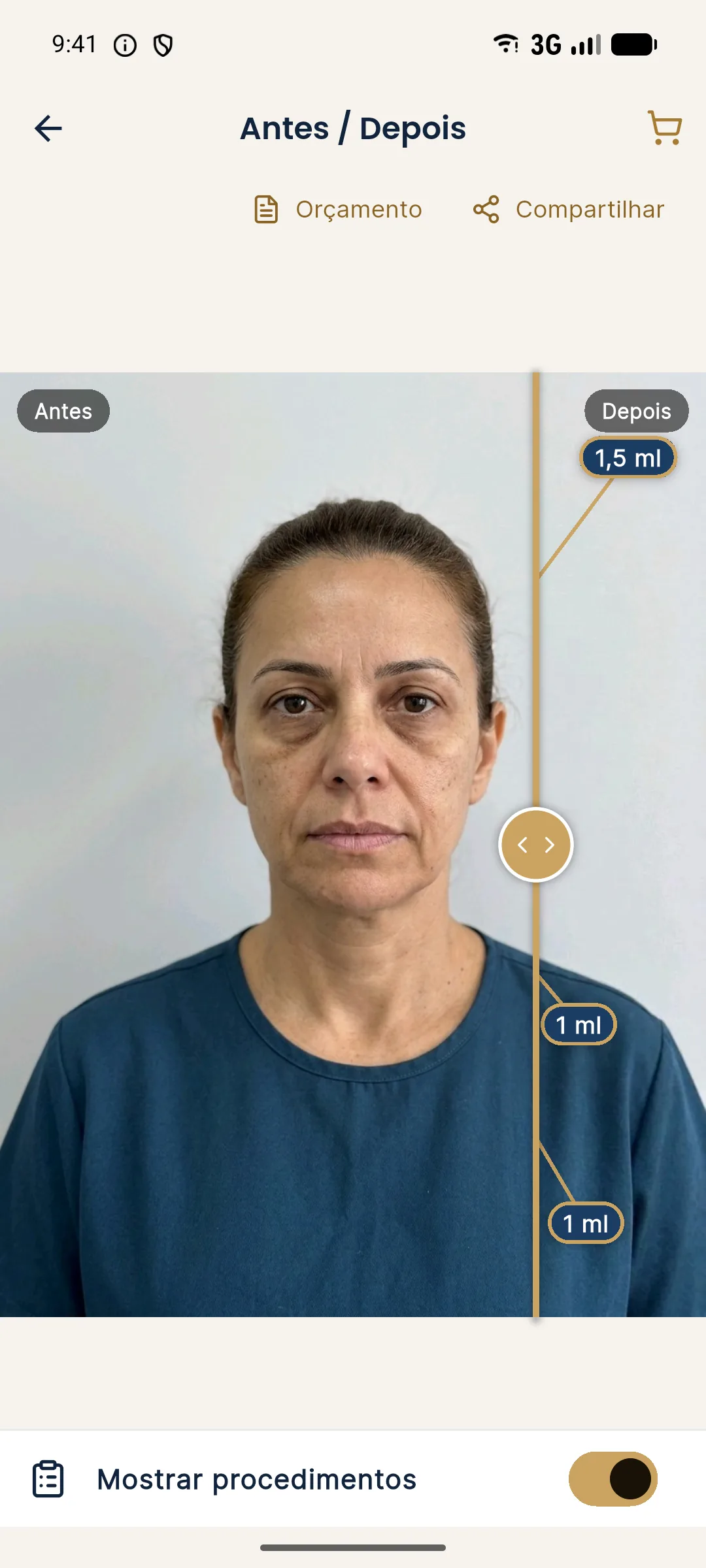
Every decision on plan, product, volume and technique belongs to the qualified professional, according to the rules of their professional board. No goal is a guarantee of results.
Frequently asked questions
What is an observable goal in the HOF plan?
It is a description of what you intend to observe in a comparable way, such as the reduction of a shadow or the continuity of a line, and not a promise of results.
Can I write that the plan will deliver a specific result?
No. Results vary with product, technique and patient. Write the intention of the plan and the assessment criterion, and make clear there is no guarantee.
How do I measure whether the goal was met?
By comparing standardized before and follow-up photos, with the same light, distance and position, and recording the patient's perception.
Can the Harmy projection be the goal of the plan?
Not as a commitment. It is an illustration for the conversation, not a target to be delivered. Treat it as support, and never as a promise.
Harmy images are illustrative simulations generated by AI from the patient's photo to support the conversation between practitioner and patient. They are not a promise of results. Indication, technique, product and volume are solely the decision of the licensed practitioner. This content is for information only and does not replace a clinical assessment.