
Temple filler: how many ml are used

 BeforeSimulation
- Artery
Quick facts
- Question
- How many ml of filler in the temples
- Usual range
- Moderate volumes, often split into stages
- What defines it
- Degree of hollowing, fat and bone loss, face shape
- Risk area
- High vascular risk; requires anatomical knowledge
The temples are one of the areas that change most with time and one of those patients notice least. When they ask "how many ml?", they have usually already heard it is "a lot of product" or that it is "dangerous", and the conversation needs to give context to both. Temple filler usually takes higher volumes than under-eyes and lips, and demands respect for vascular anatomy.
This page explains what defines the volume, why the area calls for stages and how to talk to the patient. Volume and technique are decisions for the licensed professional, according to the rules of their professional council (in Brazil).
Why the temple takes larger volumes
The temporal region loses fat, bone volume and muscle volume with age. The resulting hollowing gives the face a more tired look and accentuates the bone of the orbit and the cheekbone. The area is wide, and restoring volume covers a large territory. That is why the ml tends to be greater than in small areas.
| Factor | How it weighs |
|---|---|
| Degree of hollowing | Very hollow temples call for more replacement |
| Fat and bone loss | Greater loss, greater volume needed |
| Face shape | Narrow faces have less room; wide faces can look heavy |
| Age and skin firmness | Lax skin can accentuate the shape |
| Goal | Soften the hollowing or restore convexity |
| Product | Firmness suited to use in the area |
The relationship with aging is explained in explaining the temples to the patient.
Volume with respect for vascular risk
The temple is considered a high vascular risk area. Arteries such as the superficial temporal artery, the middle temporal artery and branches related to the circulation of the eye run through it. Complications such as vascular occlusion are rare but serious, and can have consequences for the skin and vision. Hyaluronidase must be available when hyaluronic acid is used.
That is why volume in the temples is planned with safety first. Greater volume in a single session is not the goal, and splitting into stages is a common practice.
Stages and assessment
Splitting the replacement into stages lets you observe the response, the symmetry and the patient's comfort. The first stage treats the essentials; the follow-up, with the swelling down, shows what is missing. This approach also reduces the risk of overfilling, which can "inflate" the side of the face.
When ml is not the answer
Not every hollow temple is just about volume. Muscle, bone and skin all contribute. In some cases, other approaches may enter the conversation, such as collagen stimulation. In others, the expectation of "lifting the brow" or "filling the side" needs to be aligned, because the gel replaces volume and does not pull tissue.
Simulation to align the volume
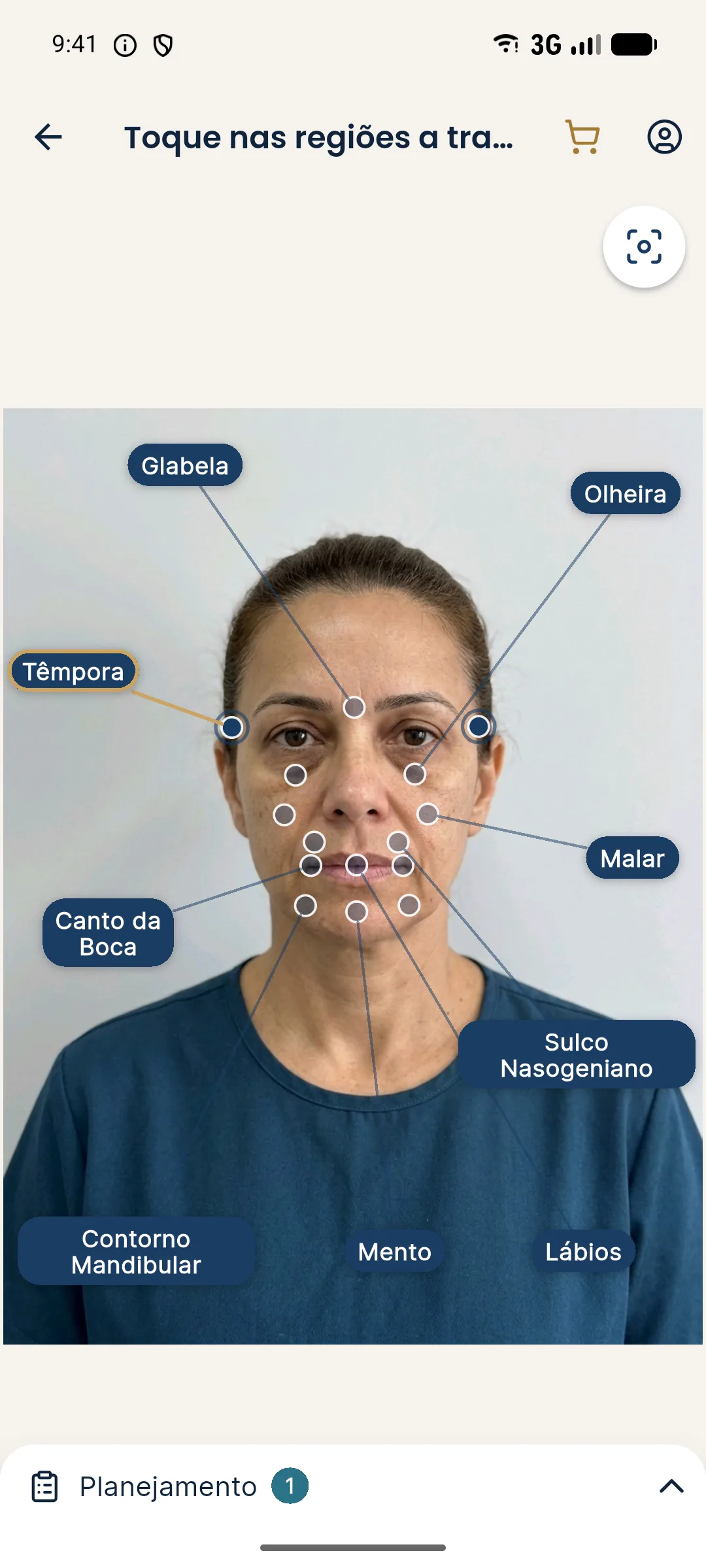
Harmy lets you mark the Temple point, choose the ml (from 0.5 to 5, in steps of 0.5) and the intensity (Subtle, Moderate or Pronounced). The app's official simulation for the area uses 2 ml. In bilateral areas, the ml is the total, split between the two sides. The projection illustrates the effect of volume on the frontal photo, helping the patient visualize the softening of the hollowing; it does not predict swelling and uses only the frontal photo.
Questions for the conversation
Relationship with other areas
The temple is part of the upper third and interacts with the forehead and the eyes. Treating it alone can change how the face reads, and many plans combine temples with cheekbone, under-eyes or toxin. See the reasoning in explaining facial aging to the patient.
Summary
Temple ml is greater because of the territory, but safety comes before quantity. Stages, anatomy and clear communication about risks are the pillars. Comparing totals between patients is less useful than comparing photos of the same patient.
Frequently asked questions
How many ml of filler are used in the temples?
Usually moderate volumes in total, split between the two sides and often into stages. The amount depends on how hollow the area is and is set by the professional.
Why do the temples hollow out with age?
There is loss of fat and of bone and muscle volume in the area, which accentuates the hollowing and gives the face a more tired look.
Is temple filler dangerous?
It is a high vascular risk area, because of arteries such as the superficial temporal artery. Injecting requires anatomical knowledge and hyaluronidase must be available.
Is the ml per side or total?
It depends on how the professional reports it. In Harmy, for bilateral areas, the marked ml is the total, split between the two sides.
Harmy images are illustrative simulations generated by AI from the patient's photo to support the conversation between practitioner and patient. They are not a promise of results. Indication, technique, product and volume are solely the decision of the licensed practitioner. This content is for information only and does not replace a clinical assessment.