
How to Price a Facial Third Harmonization Plan
Quick facts
- Challenge
- Pricing a multi-area plan without losing margin or clarity
- Method
- Add up costs per area, remove only real overlaps, apply margin
- Pitfall
- A package discount that time efficiency does not pay for
- Good practice
- Staged plan with a fixed price for each stage
When the plan involves more than one area, the price conversation gets complicated. The patient wants to know "how much for everything", the clinic wants to keep its margin, and the professional wants to recommend what is appropriate without price getting in the way. Here the most common mistake is adding up the list prices of each area and applying a "package" discount by gut feeling, without knowing whether the clinic really saves what it is giving away.
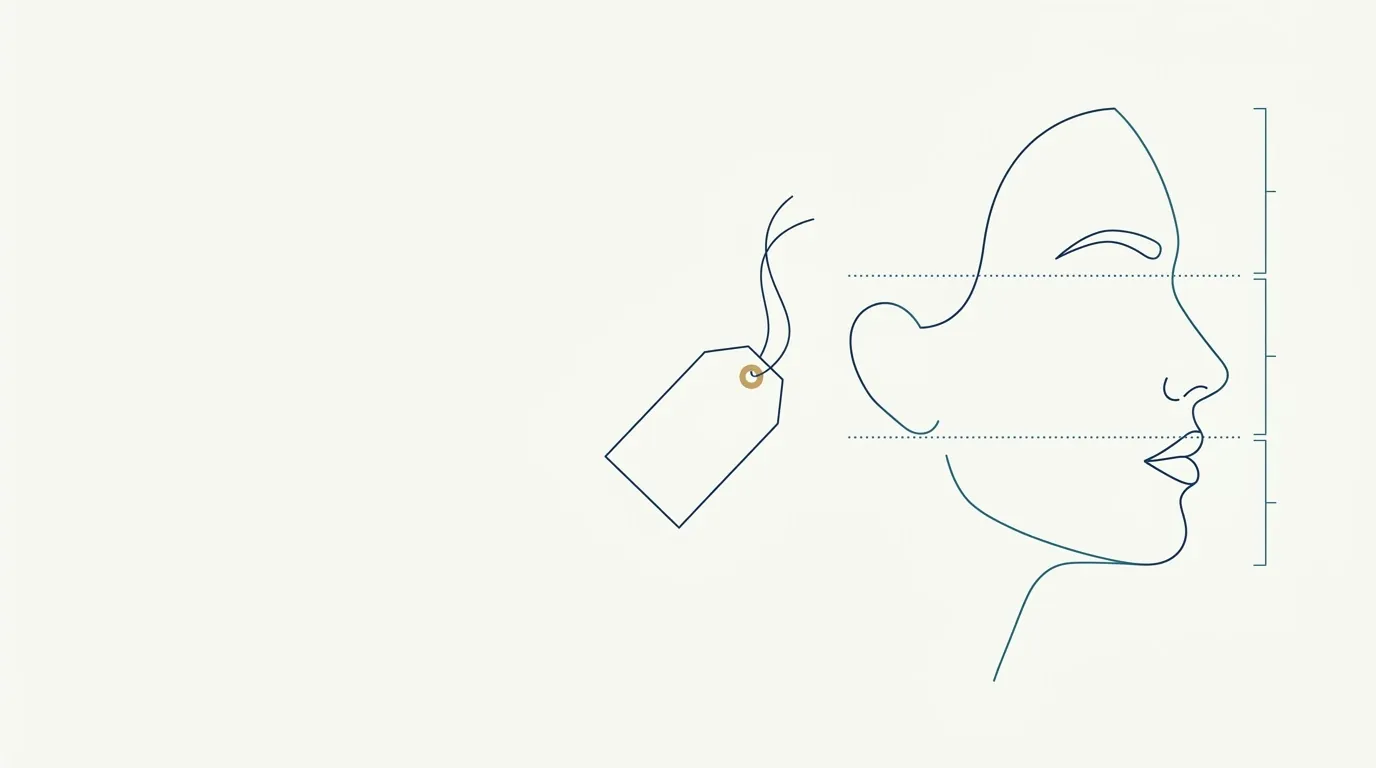
This guide shows how to build the price of a multi-area harmonization (for example, a combination of the middle and lower thirds) from real costs, with a hypothetical example. The indication, the combination of areas, the volumes and the technique are decisions for the qualified professional, after assessment. The facial thirds are presented in facial assessment by thirds; the entries on upper third, middle third and lower third explain the division.
Why a multi-area plan is not "the sum with a discount"
Each area has its own material and time cost. Doing two areas in the same session may save some things and not others.
| Item | Savings when areas are combined? |
|---|---|
| Assessment, medical history and consent | Yes, done once |
| Room preparation and asepsis | Yes, done once |
| Anesthesia and initial marking | Partially |
| Material and product | No, consumption is proportional |
| Procedure time per area | Little or none |
| Review | Partially, one review covers more than one area |
| Risk and responsibility | They do not decrease, and may increase |
The real savings are in fixed time (preparation, assessment, records), not in material or execution. That is why the package discount a clinic can give without losing margin tends to be smaller than the patient imagines.
Step 1: calculate the cost of each area
For each area in the plan, build the isolated cost: product (with losses), disposables, procedure time, part of the follow-up. Hypothetical example with three areas of a fictional plan:
| Area | Product | Disposables | Procedure time | Isolated cost |
|---|---|---|---|---|
| Cheekbone | R$ 420.00 | R$ 40.00 | R$ 210.00 | R$ 670.00 |
| Chin | R$ 315.00 | R$ 35.00 | R$ 140.00 | R$ 490.00 |
| Jawline | R$ 840.00 | R$ 60.00 | R$ 280.00 | R$ 1,180.00 |
| Sum | R$ 2,340.00 |
The values are made up. To calculate the cost per usable ml and the time, see product loss and waste in HOF and cost of the clinical hour in HOF.
Step 2: add shared costs only once
Now the costs that exist once per session, not per area:
| Shared cost | Hypothetical value |
|---|---|
| Assessment and medical history (45 min × R$ 280.00/h) | R$ 210.00 |
| Room preparation and asepsis | R$ 60.00 |
| Records, photos and instructions | R$ 70.00 |
| Review (0.75 h × R$ 280.00) | R$ 210.00 |
| Total shared | R$ 550.00 |
Anyone who prices each area separately repeats these R$ 550.00 three times, and the plan sold in pieces ends up more expensive than the single plan. That is the legitimate savings of the package: R$ 1,100.00 less in repeated costs, in the example.
Step 3: total cost and price
Cost of the full plan = R$ 2,340.00 + R$ 550.00 = R$ 2,890.00. If fees and taxes add up to 14% and the desired net margin is 30%, the cost is covered by 56% of the price: R$ 2,890.00 ÷ 0.56, about R$ 5,160.71.
Comparison with the sum of the areas sold separately, each with its shared costs repeated:
| Scenario | Cost | Price at the same margin |
|---|---|---|
| Areas separately (shared costs repeated 3 times) | R$ 3,990.00 | about R$ 7,125.00 |
| Single plan | R$ 2,890.00 | about R$ 5,160.71 |
| Difference | R$ 1,100.00 | about R$ 1,964.00 |
The price difference at the desired margin is about R$ 1,964.00, or 27.6% less. That is the maximum discount the package can support while keeping the 30% profit. In practice, the clinic can give less than that and keep part of the efficiency gain. The discount does not need to be the maximum.
Step 4: staged plan and price per stage
Not every full plan is done in one session, and often it should not be. Splitting it into stages allows you to watch the progress, adjust and reduce risk. The commercial question is: how do you charge?
| Method | Advantage | Caution |
|---|---|---|
| Fixed plan price, paid in installments | Predictable for the patient | If the plan changes, it must be renegotiated |
| Price per stage, paid at each session | Lower initial commitment | The package loses its discount if the patient does not return |
| Plan with deposit and balance per stage | Balances commitment and flexibility | Requires a clear contract |
Write down what happens if the plan changes after the first stage. See staged plan and procedure packages in HOF.
Step 5: present the full plan clearly
A good full-plan quote shows three things: what is included in each area, what is shared (assessment, review) and the payment terms. See a quote the patient understands.
In Harmy, the "Full harmonization" marking shortcut brings a starting point (cheekbone 2 ml, jawline 2 ml, chin 1.5 ml, lips 1 ml, nasolabial fold 1 ml, all Moderate; under-eye 1 ml Subtle), which the professional edits according to the assessment. "Show procedures" displays the ml for each area over the After image, and the quote in PDF lists the price per ml per area, with discount, validity and notes.
Adjusting when the patient wants only part of the plan
It is common for the patient to choose only some areas. Recalculate the plan with the chosen areas and the shared costs counted once. Do not automatically apply the full package discount, because the savings depend on how many areas are included. Explain it simply:
Common mistakes
Applying a fixed percentage discount to any package. Each combination has different savings.
Not accounting for extra time. Plans with more areas can increase total time and fatigue, and the price should reflect that.
Forgetting the review. Covering more areas usually means more points to review.
Using the package as bait. Promotional communication in healthcare calls for care; check your council's rules and see advertising harmonization prices.
Frequently asked questions
How do I price a harmonization plan with several areas?
Calculate the cost of each area (material, time, follow-up), add them up, subtract only the real savings in time and infrastructure, and apply the desired margin. The plan price is the result of that calculation, not the sum of list prices with a random discount.
Should the full plan have a discount?
It can, if the savings in time and infrastructure justify it. A discount larger than the savings eats into the margin. Define beforehand how much each area saves by being done in the same plan.
Is it better to charge for the whole plan at once or by stages?
It depends on the clinical indication and the clinic's strategy. By stages, the price of each one is easier to understand and the risk of a hasty decision is lower.
What if the patient wants only some areas of the plan?
Recalculate with the chosen areas, without promising the full package discount. The clinical indication remains the professional's, after assessment.