
Inward-turned lip: what changes in facial harmonization

 BeforeSimulation
- Highlighted area
Quick facts
- Concern
- The vermilion disappears when the mouth closes or the lip seems rolled inward
- Method
- Compare vermilion eversion at rest, when smiling and when speaking
- Structures
- Vermilion, orbicularis oris muscle, teeth and maxillary support
- Caution
- Filling without correcting support can create volume that is visible only on the inside
The "inward-turned" lip is a concern that rarely arrives under that name. The patient says the mouth has "disappeared", that lipstick doesn't show, or that the vermilion is hidden when they talk. In assessment terms, the question is whether there is lip retrusion (the vermilion sits back relative to the teeth and skin), reduced eversion (the vermilion doesn't turn outward) or both.
The page shows how to separate these situations and how to decide on the plan with caution. It connects with lips that faded with age, shrunken mouth and lip with no definition.
What makes the vermilion turn inward?
The vermilion of the lip rests on two things: the volume of the lip itself and the structure behind it, the teeth and the maxilla. The orbicularis oris muscle maintains the outline, and when it contracts often (a habit of pressing the lips together) the vermilion tends to draw in.
| Cause | How it presents | Note for the plan |
|---|---|---|
| Volume loss with age | Thin vermilion, faded white roll | Gradual replacement can be considered |
| Habit of pressing the lips | Vermilion vanishes when the patient thinks or talks | The muscle dynamics need to be discussed |
| Tooth position | Lip resting on a retroclined tooth | Refer to the dentist or orthodontist |
| Maxillary retrusion | Lip set back in profile | A limit of HOF, low expectation |
| Scar or local tension | Tethered or irregular lip | Assess before any volume |
An important note: filler in the vermilion without adequate support can give a fuller lip on the inside, which stays hidden when the mouth closes. The patient notices swelling in the mucosa, not the visible vermilion.
How to assess in the consultation
Dynamic assessment is essential. Ask the patient to talk, smile and relax, and record it all on a short video.
What facial harmonization can consider
At the qualified professional's discretion, the plan may include:
- Restoring support and vermilion volume, in a restrained amount, with reassessment before any addition.
- Defining the outline and the Cupid's bow when the shape is faded, always taking care not to create a "stuck-together" lip.
- Care for the surrounding skin, because vertical lines go along with the drawing in and call for other approaches.
- Dental referral when tooth position explains much of the concern.
Avoid promising an "outward-turned lip". What can be planned is to improve the presence and proportion of the vermilion in a discreet way.
Risks
Swelling, bruising, asymmetry, nodules and irregularities are expected as risks of lip filler. Vascular complications are rare, and the clinic should have hyaluronidase available when using hyaluronic acid. A history of cold sores calls for preventive measures at the professional's discretion. Repeated injections in a thin lip carry a higher risk of excess and migration, and the history needs to be read.
How to show it in Harmy
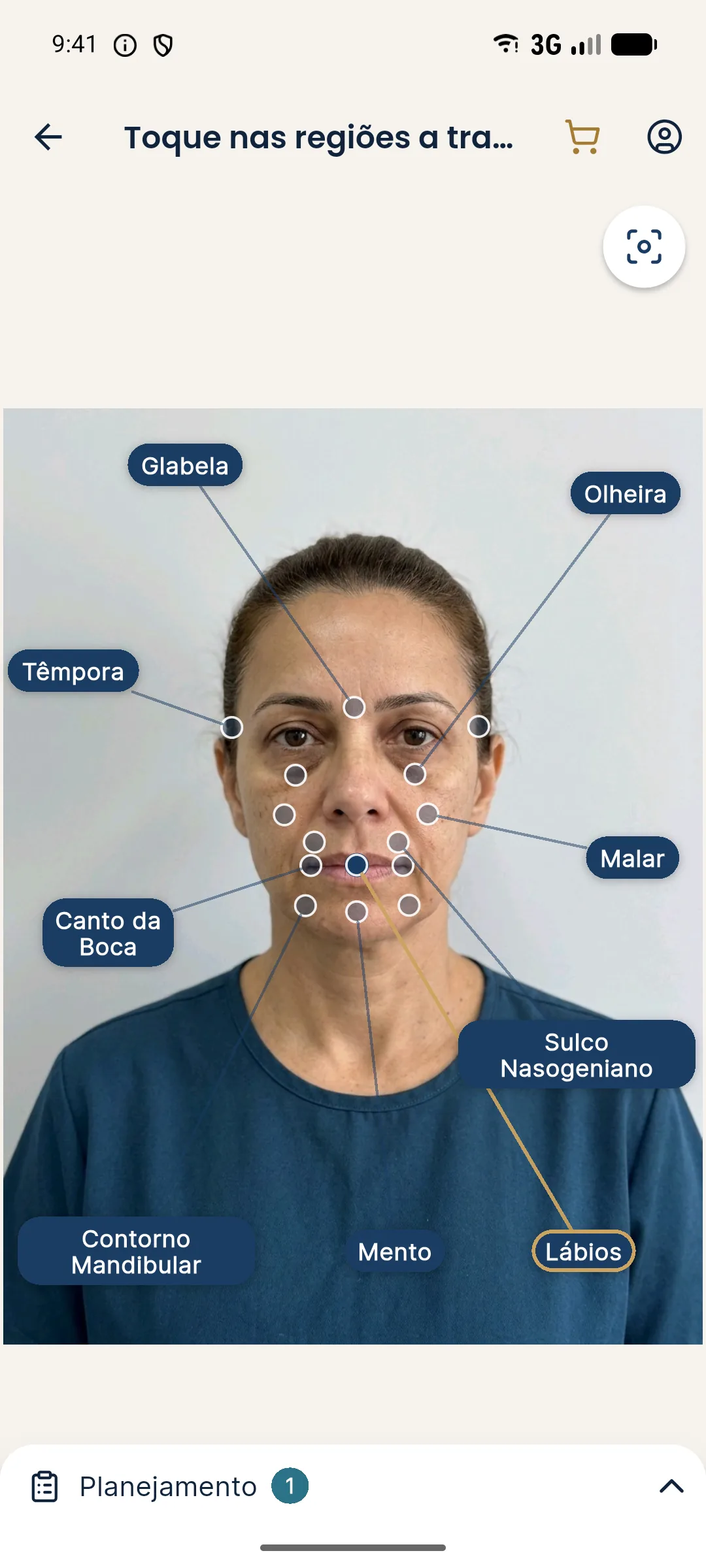
In Harmy, the Lips point simulates volume in the vermilion. The frontal photo at rest is the base, and the app does not show the lip in movement. Show the patient a projection at the Subtle intensity, then at Moderate, and discuss the difference. The "First time" shortcut already suggests lips with 1 ml at the Moderate intensity, but adjust it to each person's assessment.
Points of attention in the conversation
Some patients seek the "magazine" lip and bring a reference. Show the reference next to their photo and talk about what is possible within their anatomy. If the patient has very thin lips and wants a large volume in one session, propose stages and reassessment. Harmy helps make the conversation concrete, and the rule is that the simulation is never a promise.
Common mistakes with a drawn-in lip
The most frequent mistake is reading every drawn-in lip as a lack of volume. When the drawing in comes from the habit of pressing the lips, the new volume is drawn in too, and the patient sees no difference. Asking whether they notice the drawn-in lip mainly when concentrating, driving or using the phone helps separate habit from anatomy.
Another mistake is ignoring tooth position. Retroclined incisors remove the support of the lip, and no filler replaces that support. A professional who talks to the orthodontist before planning usually avoids unnecessary volumes.
There is also the mistake of trying to correct everything at once. A thin, drawn-in lip that receives a lot of volume in a single session tends to end up hard, with a "duck lips" look, and to migrate over time. Short stages with reassessment on photos make it possible to stop at the right point.
Records and return visit
Record a short video of the lip at rest, while speaking and while smiling, because dynamic data weighs the most. Note the perceived habit, the tooth position according to the dentist, the volume planned in each step and the guidance given on limits. At the return visit, compare with the same video and photos. If the patient keeps pressing the lips together, talk about the habit before thinking about an addition, because the functional cause can cancel any esthetic gain and the injected product will not fix the gesture.
Closing
Record the photos and video, the most likely cause, the staged plan and what was left out of scope (teeth, bone). For other lip cases, see lip with lip lines and thin lip and visible gums. Volumes and techniques are at the discretion of the qualified professional, following the rules of their professional council in Brazil.
Frequently asked questions
Why does my lip look turned inward?
It can be loss of volume and support with age, a habit of pressing the lips together, tooth position or a smile that draws in the vermilion. Assessing at rest and in movement separates the causes.
Does lip filler fix an inward-turned lip?
It can help restore support and vermilion display in suitable cases, at the qualified professional's discretion. When the cause is dental, muscular or skeletal, the result tends to be limited.
Does tooth position change the lip?
Yes. Projected or retroclined teeth change the support of the lip. A conversation with the dentist on the case is part of the assessment.
Can eversion be shown in the simulation?
Harmy simulates vermilion volume on the frontal photo, at rest. Eversion in movement has to be assessed with video or photos outside the app.
Harmy images are illustrative simulations generated by AI from the patient's photo to support the conversation between practitioner and patient. They are not a promise of results. Indication, technique, product and volume are solely the decision of the licensed practitioner. This content is for information only and does not replace a clinical assessment.