
Lips that thinned with age: assessment and plan

 BeforeSimulation
- Nerve
- Highlighted area
Quick facts
- Concern
- Thinner, flatter lips with a faded contour over the years
- Method
- Compare with an old photo and measure vermilion, contour and projection in profile
- Structures
- Vermilion, Cupid's bow, philtrum, perioral skin and dental support
- Caution
- Replacing lost volume is different from enlarging beyond what the patient had
Among the most frequent reasons people over 40 seek harmonization is a simple sentence: "my lips disappeared." The concern has concrete anatomy that can be measured, and an emotional side that weighs on the conversation. The professional's challenge is to recover proportion without transforming the face.
This page organizes the assessment and the plan, and ties in with sunken mouth, lip with no contour and aged face.
What changes in the lips with age?
Over the years, the lip loses vermilion volume, mainly in the upper lip, the Cupid's bow becomes less crisp and the philtrum loses the definition of its ridges. The upper lip can lengthen and roll inward, and the vertical static wrinkles around the mouth (the so-called barcode lines, or lip lines) deepen.
| Sign | What is observed | Impact on perception |
|---|---|---|
| Vermilion loss | Thinner lip, mainly the upper | "Sunken" mouth |
| Faded contour | Poorly defined white line | Lipstick that bleeds |
| Loss of projection | Flat lip in profile | Straighter profile |
| Thin perioral skin | Vertical wrinkles and texture | Tired look |
| Downturned corners | Descending commissures | Sad expression |
These changes do not always occur together, and the plan depends on which one dominates. In many cases the lip looks worse because of the surrounding skin, and treating only the vermilion leaves the result incomplete.
How to assess the loss
The secret is to compare the patient with themselves. Ask for photos from 5 to 15 years ago, preferably frontal and smiling. The professional reads the difference in volume, contour and tooth display.
Plan options, at the professional's discretion
The plan usually considers layers, depending on the case:
- Vermilion volume replacement with hyaluronic acid, in restrained amounts and with reassessment. Lip filler is the most common route.
- Defining the contour and the Cupid's bow, which often gives more of an impression of a present lip than volume alone.
- Mouth corners: when they droop, the lip loses expression. See mouth corner filler.
- Perioral skin quality, with approaches that may include collagen biostimulator in selected cases.
Timeline of a staged plan
Risks
Swelling, bruising, asymmetry, nodules and irregularities are among the possible complications. Vascular complications are rare and serious, and hyaluronidase must be available. Patients with recurrent cold sores need a preventive approach defined by the professional. The thin skin in the area calls for care regarding the Tyndall effect.
How to show it in Harmy
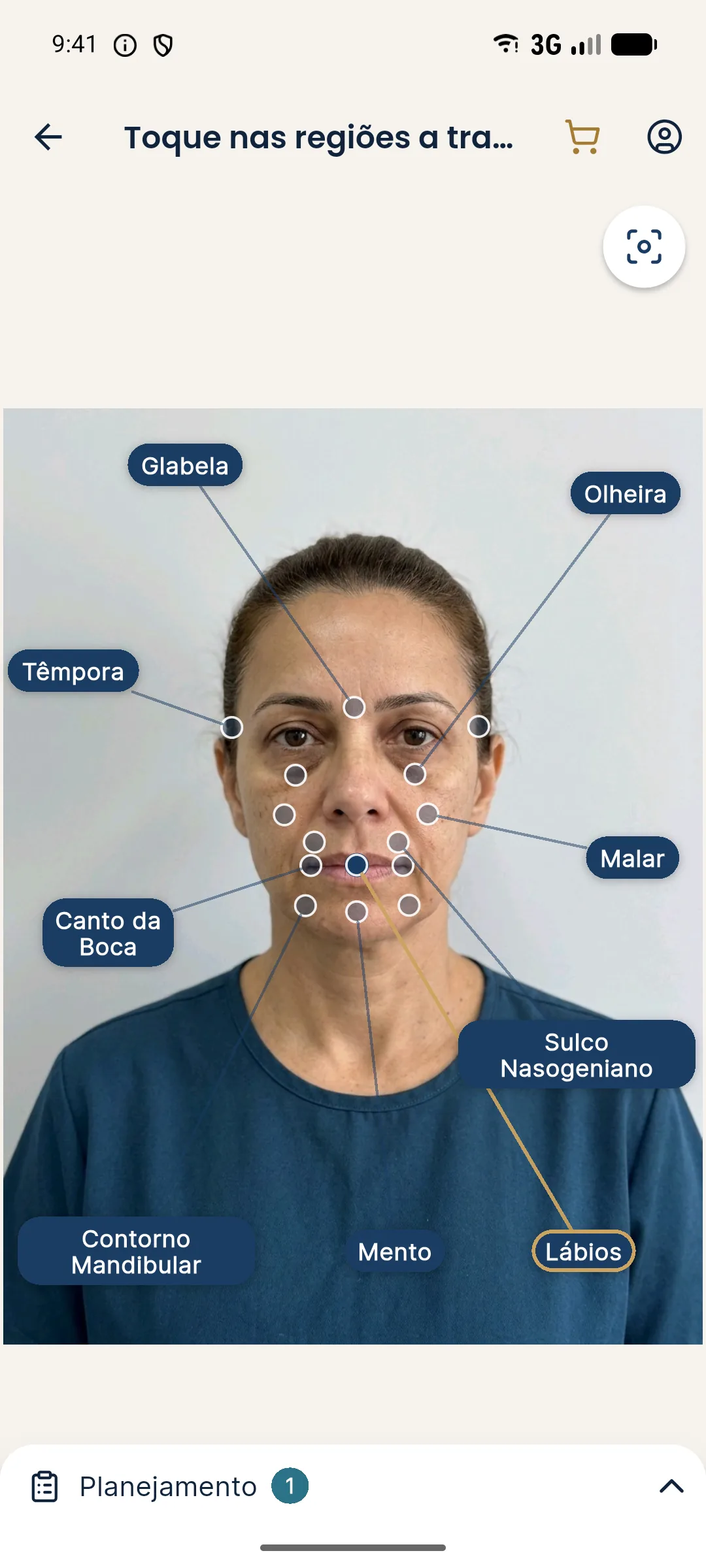
The Lips point in Harmy simulates a volume increase on the current photo. For the atrophic lip, the "Maintenance" shortcut suggests lips at 0.5 ml with Subtle intensity, a good entry point to show how much a discreet replacement already changes the presence of the vermilion. The app does not reconstruct the lip of the past: it shows a possible increase on top of the current photo.
Common mistakes in lip restoration
Restoring the lip of a 60-year-old as if it were that of a 25-year-old is the most visible mistake. The aging lip lives with different perioral skin, with vertical wrinkles and lower corners, and an oversized vermilion in that context looks out of place. The benchmark is the patient's own proportion, not the lip of a reference model.
Another mistake is forgetting the contour. Often what the patient misses is the outline, the line that held the lipstick, and not volume. Working the contour and Cupid's bow with a small amount can give more presence than filling the vermilion, with lower risk of excess.
It is also common to overlook the history. Patients who have had several sessions have modified tissue, with residual product, and the lip can look full without really being good. Examining by palpation and comparing with photos from each phase avoids stacking volume on top of volume.
Talking about expectations
Ask the patient how they want to be seen: natural, discreet or striking. In general, people seeking to recover what they lost want the discreet, but use words like "volume." Show their old photos and a Subtle simulation. If they ask for more, talk about stages. Record what was agreed, the planned reassessment date and what was left out of the plan, such as perioral skin, which may have its own follow-up. Clarity avoids the feeling that the lip "didn't turn out like in the movie."
Patient profiles and plan adjustments
Patients who have always had thin lips and those who lost volume over time call for different approaches. In the first group, the goal is usually to harmonize without changing the original design; in the second, the aim is to recover a familiar proportion.
People who wear lipstick daily notice the loss of contour sooner and tend to ask for definition; those who speak in public a lot may be bothered by stiffness, and the lip needs to stay mobile. Smokers and people with heavy sun exposure have deeper vertical wrinkles, and the plan should include that conversation.
In all cases, listen to the patient's routine before choosing volumes. The lip follows speech, smiling and eating, and a result that looks beautiful in a still photo but gets in the way of daily life is not a good result.
Wrap-up
Record the photos, the chosen reference, the staged plan and what will be addressed at another time (skin, corners, teeth). For related cases, see faded philtrum and loose skin around the mouth. Volumes and techniques are at the discretion of the licensed professional, in line with the rules of their professional council in Brazil.
Frequently asked questions
Why do lips get thinner with age?
There is a gradual loss of volume, collagen and elasticity, and the vermilion border becomes less defined. The surrounding skin also changes, which adds to the feeling of a thin lip.
Is lip filler the only option for lips that have thinned?
No. The plan can combine volume replacement, perioral skin care and, in some cases, a biostimulator, always at the discretion of the licensed professional and after an assessment.
How do you avoid an artificial look when restoring the lip?
By using the patient's old photo as a reference, with restrained volumes and in stages. The goal is to recover proportion, not to create a lip larger than the original.
Does the simulation show how the lip used to look?
No. The simulation shows a possible volume increase on the current photo, for illustration only, and does not reconstruct the lip of the past.
Harmy images are illustrative simulations generated by AI from the patient's photo to support the conversation between practitioner and patient. They are not a promise of results. Indication, technique, product and volume are solely the decision of the licensed practitioner. This content is for information only and does not replace a clinical assessment.