
Faded or short philtrum: how to assess the columns

 BeforeSimulation
- Nerve
Quick facts
- Concern
- Shallow, flat or short philtrum, with an upper lip lacking shape or looking elongated
- Key reading
- Measure philtrum length, column definition and the relation to the cupid's bow and the nose
- Common causes
- Aging, loss of definition, scarring, genetics and orbicularis dynamics
- Main caution
- Area with little margin for error; too much volume flattens the shape and looks artificial
The philtrum is a detail a few millimeters wide that changes how the whole face reads. When it is well shaped, it gives the upper lip an elegant shadow and a defined cupid's bow. When it is shallow, "faded" or seemingly long, the lip looks flat, and the patient complains of a "dull lip", a lip "with no shape" or a "long mouth".
This page helps you read the philtrum as a structure, separate what is skin, muscle and volume, and decide what fits in facial harmonization, always with a short margin. Related concerns: faded cupid's bow, lip without definition and long upper lip.
What does the philtrum look like underneath?
The philtrum has three visible components: two lateral columns, which are firm vertical ridges, and the central groove between them, deeper and shaded. Below, the columns meet the cupid's bow and the vermilion, where they form the peaks of the upper lip. At the center of the vermilion, the tubercle completes the shape.
Under the skin, the orbicularis oris forms the muscular base, and the labial vessels run close to the surface. This explains two practical points: definition depends on the relief of the skin and muscle, and technical errors are costly.
What does "faded" or "short" philtrum mean?
Patients use the terms loosely. For the professional, it is worth separating four situations, because each has a different cause:
| Patient's complaint | What it usually is | Reading |
|---|---|---|
| "Faded philtrum" | Poorly defined columns and a shallow groove | Loss of definition, aging or volume that flattened it |
| "Short philtrum" | Little distance between nose and lip | Anatomical trait, cannot be changed |
| "Long philtrum" | Large distance between nose and lip | Long upper lip, structural |
| "Crooked philtrum" | Asymmetric columns | Natural asymmetry, scarring or habit |
The distance between the nose and the lip is anatomical. What you can influence is perception: a well-defined philtrum makes the lip look more shaped and, in some cases, less long. For this reasoning, see long upper lip and PDO threads in the upper lip.
What makes the philtrum lose definition?
Some causes repeat:
- Aging: loss of elasticity and volume in the columns, with flattening of the relief. The upper lip lengthens and "rolls" inward. See aging of the lips and lips that disappeared with age.
- Excess product above the vermilion: the volume flattens the groove, erases the bow and gives a "duck lip" look. See filler migration above the lip and duck lip.
- Muscle dynamics: a strong orbicularis, with lip pressing, smoking and straw use, creates lines that invade the philtrum.
- Scarring: previous surgery, trauma or cleft change the relief and limit what can be achieved.
- Genetics: some people have a naturally shallow philtrum.
If there are associated vertical lines, the approach shifts from volume to skin quality and dynamics. See lip with vertical lines.
What fits in the plan?
The decision depends on the cause. As a line of reasoning, always at the licensed professional's discretion, after assessment:
- Loss of definition from aging or low volume: discreet replacement in the relief of the columns and the bow can bring back part of the shape. Less is usually more.
- Previous excess of product: the first step may be to reduce, not add. See hyaluronidase in the lip.
- Dominant muscle dynamics: treat the dynamics before volume. See toxin in the vertical lip lines.
- Short or long philtrum by anatomy: explain the limit. No promise of changing the distance.
- Upper lip without support: sometimes the base (maxilla, teeth, denture) is the issue. See dentures and lip support.
The proportion between the lips also matters. A faded philtrum often comes with a thin upper lip relative to the lower one; see thin upper lip and full lower lip and lips and mouth corners in the plan.
How do you show the plan without overdoing it?
In Harmy, the area is the Lips point, and the simulation shows the effect of a small volume in a restrained way, because the AI changes only what was marked. This is useful for the philtrum, where the goal is a discreet definition and not a bigger lip. Avoid marking a high volume: it does not represent what is wanted here and the patient starts expecting more than the area delivers.
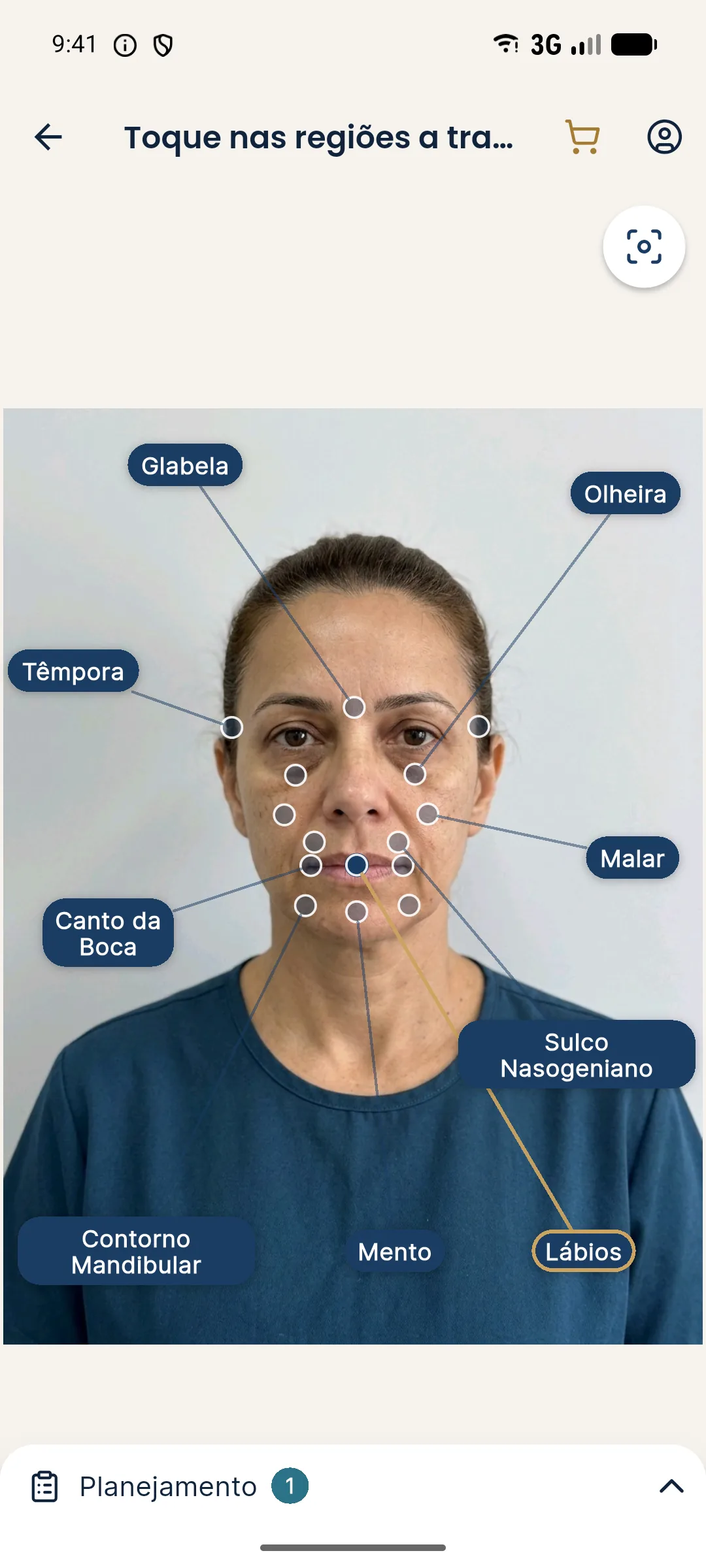
Explain that the simulation shows the overall volume and the possible definition, but cannot represent the fine relief of the columns precisely. That detail is a clinical decision, made at the time of assessment.
When not to treat?
There are situations where it is more prudent to postpone or decline:
- Active cold sore or a recent history in the area.
- Infection, injury or recent scarring in the area.
- Expectation of changing the size of the lip or philtrum structurally.
- Previous excess of product, where the first step would be to reduce.
- Concern out of proportion to the finding (consider body dysmorphic disorder).
Record keeping
Photograph front, profile and side light, note the probable cause, the agreed approach as a range and what was said about limits. At follow-up, repeat the same conditions. The history per patient keeps sessions organized, and an explanation based on the initial photos avoids the feeling that it "looks the same".
Frequently asked questions
What is the philtrum?
It is the vertical groove between the nose and the upper lip, bordered by two lateral columns and ending at the cupid's bow. The columns and the depth of the groove give definition to the upper lip.
Why does the philtrum fade?
From loss of column definition over time, flattening from excess volume, scarring, genetics or orbicularis muscle dynamics. Each cause calls for a different reading.
Is filler in the philtrum safe?
The area is vascular and delicate, with little margin for error. Complications such as swelling, nodules, asymmetry and vascular occlusion are possible, and hyaluronidase must be available. The decision belongs to the licensed professional, after assessment.
Can you lengthen or shorten the philtrum with facial harmonization?
The distance between the nose and the lip is anatomical and cannot really be changed. The perception of length can shift with the definition of the columns and the cupid's bow, in selected cases.
Harmy images are illustrative simulations generated by AI from the patient's photo to support the conversation between practitioner and patient. They are not a promise of results. Indication, technique, product and volume are solely the decision of the licensed practitioner. This content is for information only and does not replace a clinical assessment.