
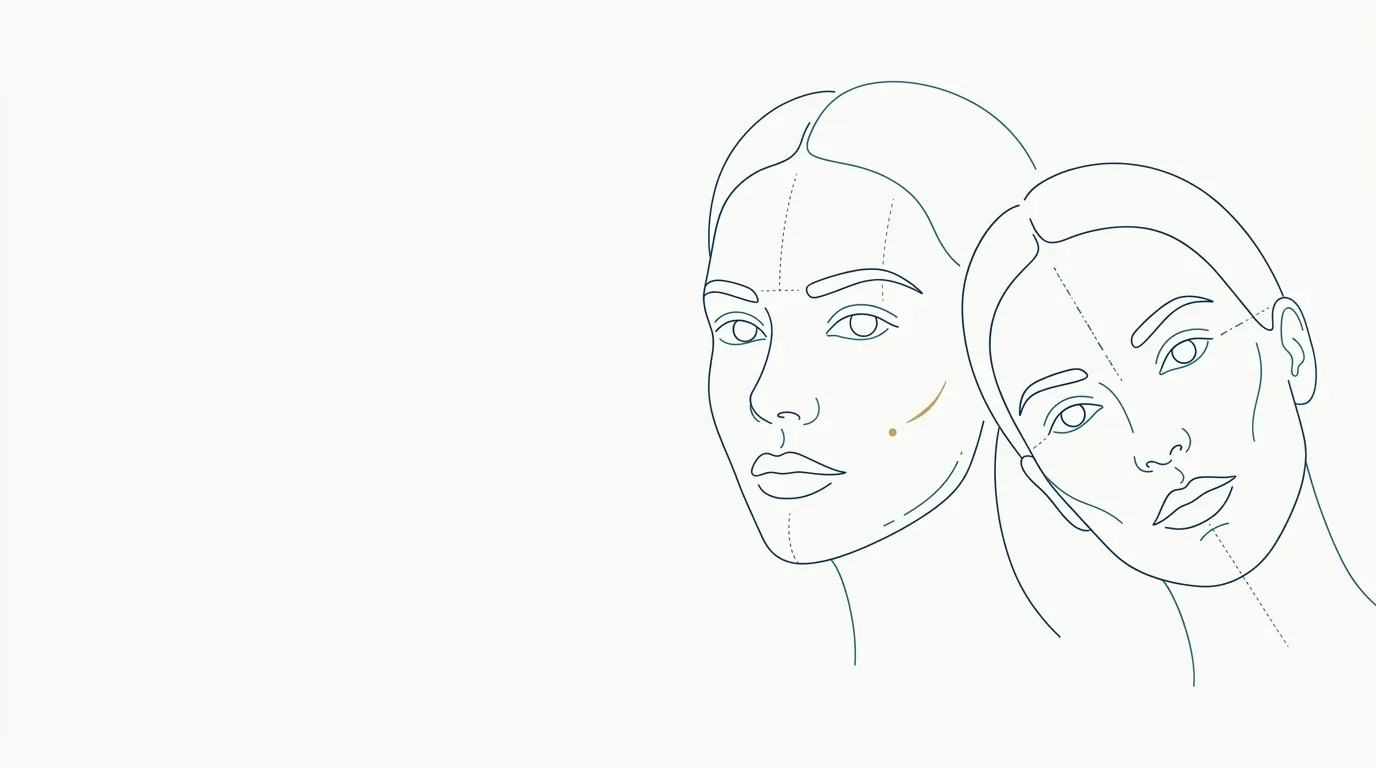
A Tilted Face in the Photo Changes Perceived Symmetry
Quick facts
- Problem
- Tilting or turning the head creates an apparent asymmetry that does not exist in the face.
- Types of error
- Lateral tilt, rotation to one side, chin raised or lowered.
- Correction
- Eye line horizontal, Frankfurt plane parallel to the floor, nose aligned with the midline.
- Rule
- Correct posture before the shot, never afterward in editing.
Someone asks the patient to "face forward" and takes the photo. On the screen, one eye is higher, the smile looks crooked and the jaw uneven. The professional knows the patient and knows the face is more symmetrical than the photo shows. The problem is not the face: it is the posture. A slightly tilted or turned head creates asymmetries that do not exist, and the clinical reading comes out misleading.
This page shows how tilt distorts symmetry, how to check posture and how to correct it before shooting.
How does head tilt fool symmetry?
The face is read by references: the line between the pupils, the line of the mouth, the midline from nose to chin. When the head tilts, all of them stop being horizontal or vertical relative to the frame. The eye on the lower side looks smaller, the corner of the mouth on that side looks more drooped and the contour gains an unevenness.
There are three distinct posture errors:
| Error | What the photo suggests | What actually happens |
|---|---|---|
| Lateral tilt (ear toward shoulder) | One eye higher, tilted mouth | Interpupillary line off horizontal |
| Rotation (face turned to one side) | One side wider, deviated nose | Loss of frontality, opposite side shortened |
| Chin raised or dropped | Lower third larger or smaller | Frankfurt plane off parallel to the floor |
Anyone assessing facial asymmetry from a photo has to be sure the asymmetry belongs to the patient and not to the pose. For clinical context, see natural facial asymmetry and how to measure facial symmetry.
How do you check that the head is straight?
Three simple references:
- Horizontal interpupillary line. The centers of the pupils should be at the same height. Use the camera grid to check.
- Horizontal Frankfurt plane. The line from the outer corner of the eye to the upper edge of the tragus should be parallel to the floor. Details in Frankfurt plane in clinical photos.
- Vertical midline. The facial midline (glabella, nasal tip, philtrum, chin) should be perpendicular to the interpupillary line, with no obvious deviation.
Why is rotation so misleading?
When the face turns a few degrees, the side moving away from the camera looks narrower, the nose looks deviated and the jaw asymmetric. Even a slight rotation changes the perception of cheekbone and contour volume. In a follow-up, that difference can be read as a treatment effect. That is why frontality applies to the photo as a whole, not just to the gaze.
One way to check rotation is to look at the ears and the proportion between the nostril wings: they should appear similar on both sides. In a profile photo, the criterion is different, described in profile photo of the face in the clinic.
How do you correct posture before the shot?
Use a short, physical script:
- "Sit with your back against the chair and your shoulders level."
- "Look at the point on the wall without moving your head."
- "Relax your neck and let your chin sit at its natural height."
- "Bring your right and left ears to a similar height, without tilting."
Mark positions on the floor and on the chair back, as in marking floor position for clinical photos. Lens height matters too: a camera above or below the eye line creates apparent tilt. See camera height in patient photos.
Can I correct the tilt in editing?
Partly. Rotating the file so the interpupillary line is horizontal corrects the image horizon, which is accepted in standardization (see cropping and rotating a clinical photo). But it does not correct posture: if the head is rotated, the asymmetry remains. Avoid warping the image to "symmetrize" the face, which would be editing the result and invalidates the record, as detailed in editing or not editing a clinical photo.
How do you standardize across visits?
The comparison depends on the posture being the same. A follow-up photo with a different tilt from the before can turn one slight asymmetry into another. To align photos that did not come out identical, the method is in aligning photos by the eyes to compare. And the overall routine is in standardizing photos between visits.
And in Harmy?
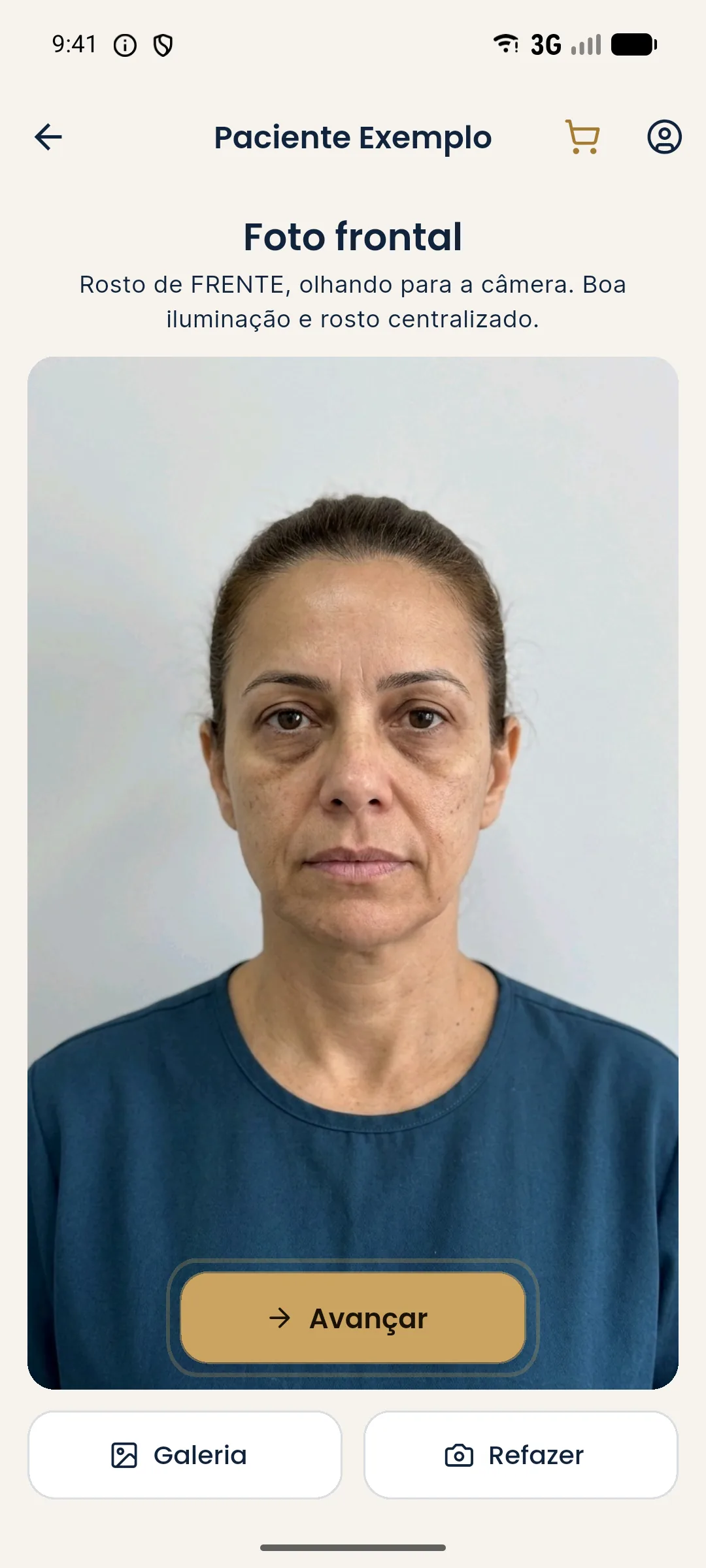
The app uses a single frontal photo, and ML Kit detects the contours on the device. If the head is turned or tilted, the marking points are shifted, and the illustrative simulation carries the pose. The prompt does not correct posture. That is why a straight, front-facing photo is the best starting point. More in frontal photo framing.
Summary
Level pupils, Frankfurt parallel to the floor, vertical midline and posture corrected before the shot. That way, the asymmetry that appears in the photo is the patient's, not the pose's.
Frequently asked questions
Does a tilted head change the face's symmetry in the photo?
Yes. Lateral tilt leaves one eye higher than the other and alters the angle of the mouth and jaw, creating an apparent asymmetry that may not exist.
How do I know if the patient's head is straight?
By the line between the eyes being parallel to the floor and by the Frankfurt plane, which joins the outer corner of the eye to the upper edge of the tragus, also horizontal. The camera grid helps.
Can I straighten the photo in editing?
Rotating the file corrects the image horizon, but it does not correct head posture. Head and neck rotation has to be resolved before the shot.
Does this affect Harmy's projection?
The frontal photo needs to be facing forward and straight. A turned or tilted head brings a false asymmetry into the app, and the illustrative simulation inherits that bias.
Harmy images are illustrative simulations generated by AI from the patient's photo to support the conversation between practitioner and patient. They are not a promise of results. Indication, technique, product and volume are solely the decision of the licensed practitioner. This content is for information only and does not replace a clinical assessment.