
Facial harmonization plan for an event with a set date

Quick facts
- Topic
- Facial harmonization plan for an event with a set date
- Principle
- Plan backward from the date
- Golden rule
- Nothing new in the final week
- Main risk
- Swelling or bruising coinciding with the event
- Ethical stance
- Decline when the timeline does not allow for safety
A wedding, a graduation, a shoot, a quinceañera, an interview: the date is set, and the patient wants to look their best. For the professional, this is one of the contexts with the most pressure and the highest risk of bad decisions. This page proposes a backward timeline, in weeks, with one central rule: the event cannot drive the plan to the point of compromising safety or promising a result.
Why does the event change the plan?
Because it creates an external deadline and an emotional charge. The patient wants "the best" and wants it "now", and the temptation is to squeeze everything into the last few weeks. But swelling, bruising and small asymmetries are expected and vary a lot, and the margin between the procedure and the date has to absorb them. See the conversation in I have an event coming up, the patient's question in harmonization before an event and the decision to decline in declining to treat a few days before an event.
How do you build the backward timeline?
Count backward from the date. The table below is an organizing guide, with illustrative weeks that the professional adjusts to the procedure, the patient and the product.
| Window before the event | What usually fits | What to avoid |
|---|---|---|
| More than 8 weeks | Consultation, planning, higher-impact procedures and touch-up | Nothing specific, other than rushing |
| 4 to 8 weeks | Procedures with moderate swelling, with room for adjustment | Adding many areas |
| 2 to 4 weeks | Small procedures the patient already knows | A new area or one with marked swelling |
| Final week | Skin care, rest, makeup and hair trial | Any new injectable procedure |
| Day of the event | Usual routine | Anything new |
A common rule among careful professionals is: nothing new in the final week. That includes skin products and procedures. See also the reasoning on intervals in interval between sessions in the harmonization plan and the specific case in harmonization plan for brides.
What is the recommended timeline?
The real timelines depend on the procedure, the product, the area and the patient. Do not copy them as a rule.
Which procedures are most sensitive to the date?
Those that tend to cause more visible swelling or bruising, such as lips, under-eye area and temples, call for more room. Toxin takes effect gradually, over days, and any adjustment needs time. Fillers settle progressively. Areas with vascular risk, such as the glabella, the nasolabial fold and the tear troughs, demand particular caution and are the first to be ruled out when the timeline is short. See vascular danger zones of the face, setting expectations about swelling and bruising and the specific question in under-eye filler before an event.
How do you use the simulation without promising?
The simulation helps agree on what will be done and calibrate expectations. In Harmy, the projection shows a subtle change, and that is useful: a patient who wants to "change their face for the event" sees that the result of a single procedure is discreet. Use the Before/After to align the conversation and not to promise how they will look on the day.
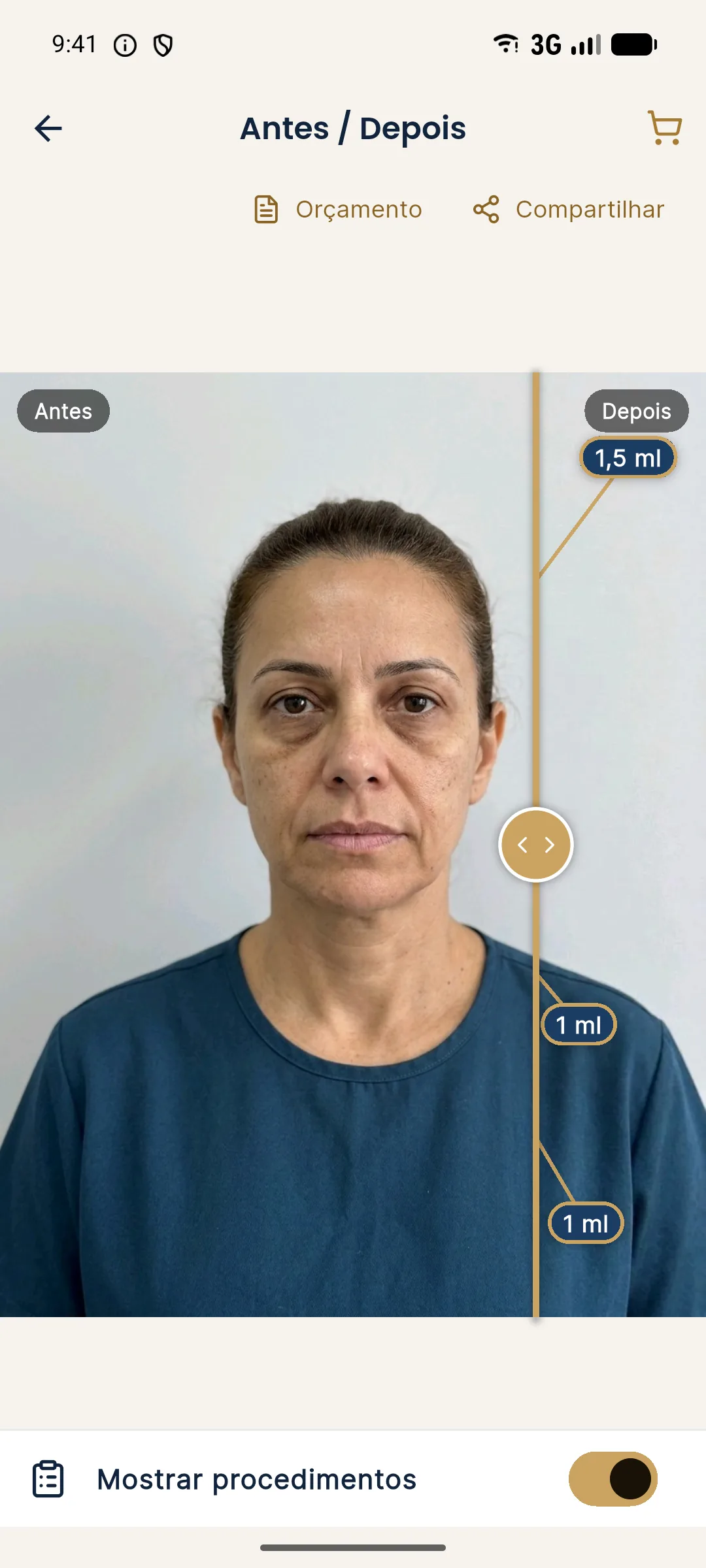
Remind the patient that the simulation is illustrative, that swelling changes the appearance in the first few days and that the final result takes time. See explaining that a simulation is not a guarantee and simulation to calibrate expectations.
When should you decline?
When the timeline is too short for the desired procedure, when the patient asks for big changes in the final week, when expectations are incompatible or when you sense the motivation is only the event and not the indication. Declining is a professional conduct and can be said with care, offering alternatives such as skin care, a plan for after the event or a smaller, familiar procedure.
Preparation checklist
What if swelling or bruising appears close to the date?
Have a contingency plan. Tell the patient to contact you right away, assess, and consider local care instructions. Corrective makeup is a practical option, and the patient should be told beforehand. Record photos. If there is a serious complication, the priority is treatment, not the event. See contingency plan in facial harmonization and bruise and swelling photos for follow-up.
Reasoning quiz
Summary
Plan backward, leave room for swelling and adjustments, put nothing new in the final week and never promise a result for the date. The simulation helps align expectations, and an honest refusal is also part of care.
Frequently asked questions
How far ahead of an event should you have facial harmonization?
It depends on the procedure, but in general the earlier, the more room for swelling, bruising and adjustments. Many professionals avoid doing anything new in the last few weeks. The decision is clinical.
Can I have toxin and filler in the same week as the event?
It is generally not recommended. Swelling, bruising and small asymmetries can appear and take time to settle. The professional may decline when the timeline is short.
What should the patient avoid before an event?
New procedures in the final week, harsh skin products, intense sun exposure and anything they have never used. The exact instructions come from the professional.
Is it possible to promise the result for the date?
No. The result depends on individual response, and swelling can last longer than expected. No promise about timing should be made.
Harmy images are illustrative simulations generated by AI from the patient's photo to support the conversation between practitioner and patient. They are not a promise of results. Indication, technique, product and volume are solely the decision of the licensed practitioner. This content is for information only and does not replace a clinical assessment.