
Face too thin: can filler bring the volume back?

 BeforeSimulation
Quick facts
- Question
- Can filler bring back volume in a thin face
- In general
- Can restore volume in key areas, without changing body type
- Risk
- Too much volume makes the face look artificial
- Who decides
- Qualified professional, after assessment
The short answer: filler can restore volume in key areas of a thin face, such as the cheekbone, temple, and tear trough, and improve the look of a hollow face. It does not change the patient's body type, and excess is the biggest risk: a thin face has little room to spare, and too much volume leaves an artificial look. This page helps you decide with caution and ask about the cause before treating.
First, the cause
A thin face has different origins, and each one changes the approach.
| Origin | What to think about |
|---|---|
| Build (always been thin) | Plan with realistic expectations; modest volumes |
| Recent weight loss | Wait for it to stabilize; look into health and diet |
| Aging | Volume replacement in support areas |
| Intense training and low body fat | Defined face; assess whether there is a real concern |
| Illness or loss with no clear cause | Refer for a medical assessment before any procedure |
The question "since when has it been like this?" usually clarifies things. Recent weight loss, involuntary loss, or loss linked to symptoms is not a filler case but a case for investigation. For the weight-loss context, see sagging face after weight loss.
Where volume usually matters
In a thin face, the feeling of "emptiness" tends to concentrate in a few spots. Restoring the essentials can improve the whole without needing large volumes.
- Cheekbone and midface. They support the face; the loss shows as a sunken cheek.
- Temples. The temporal hollow gives a skull-like look in thin faces.
- Under-eye area. The groove becomes more obvious when fat decreases.
- Jawline. In very thin faces, the contour can look too angular or poorly defined.
These areas have their own risks, with the temples and under-eye area requiring anatomical knowledge and hyaluronidase on hand. For the "skull-like" face, see skull-like face and gaunt face.
The danger of excess
In a thin face, the skin has little slack and the tissue little room. Excess volume shows as a bulge, forms "balls," or leaves the face out of proportion with the body. It can also add to the "filler face" look, discussed in face overdone with fillers.
The prudent approach is to start with small volumes, assess after the swelling, and add on. A patient who wants to be "full" all at once needs a conversation about the limit of naturalness of their own face.
Simulating with the patient in Harmy
In Harmy, the Cheekbone point takes ml (from 0.5 to 5 ml, in 0.5 steps) and intensity (Subtle, Moderate, or Pronounced). For a bilateral area, the ml is the total, split between the two sides. The "Maintenance" shortcut brings the cheekbone at 1 ml in Subtle, and "Full harmonization" at 2 ml in Moderate, as starting points for conversation.
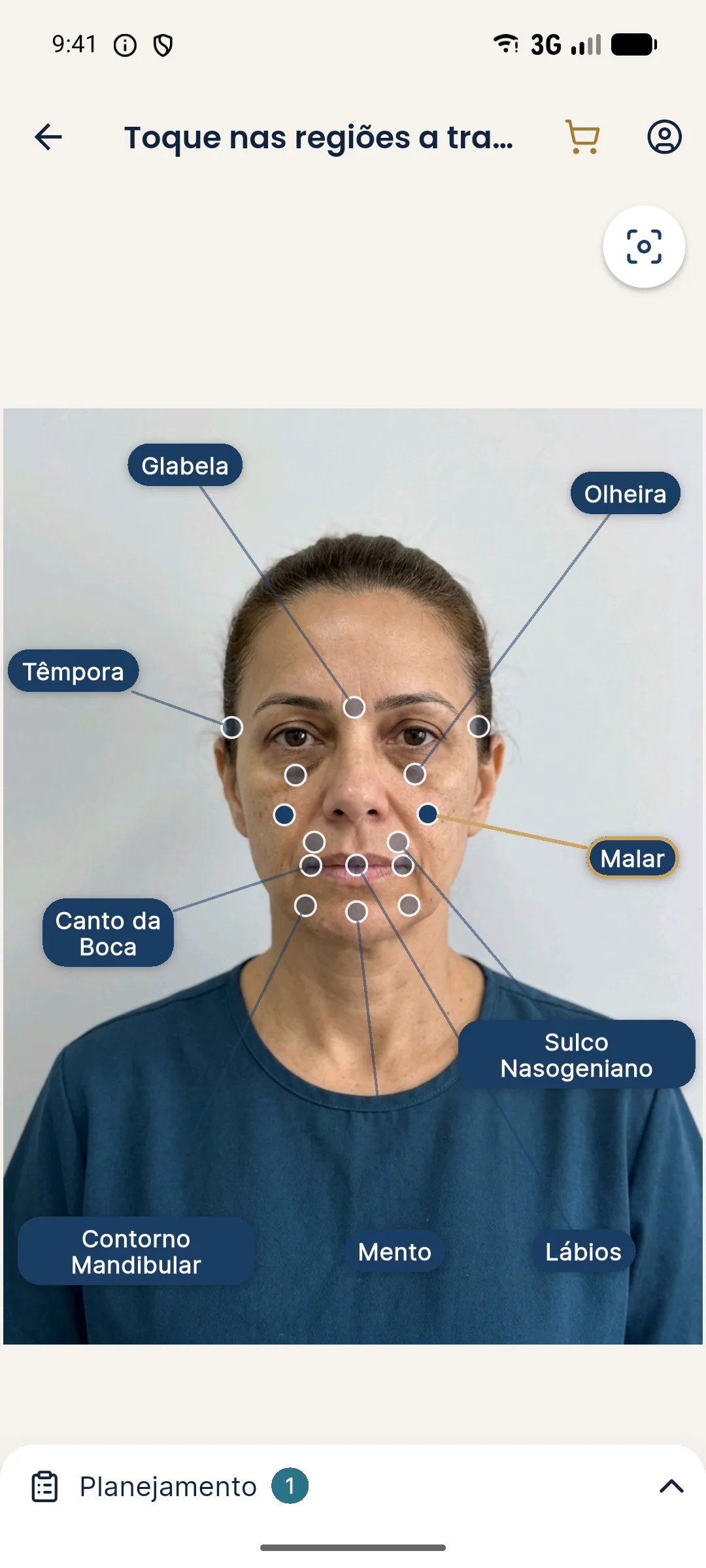
The simulation helps the patient see that a subtle change already alters the impression of volume, which reduces the pressure for high volumes. Remember that the image is front-facing and illustrative.
Biostimulator in a thin face
In some cases, the collagen biostimulator is discussed to improve tissue quality. In a face with little fat, the result depends on what the tissue can respond with, and expectations need to be realistic. The choice between products is the professional's, after assessment.
Timeline of a conservative plan
Testing your reasoning
Risks
Bruising, swelling, asymmetry, nodules, and, rarely, vascular occlusion, mainly in areas such as the temple and under-eye area. Hyaluronidase must be available. In thin skin, irregularities and the Tyndall effect are more visible.
Summary
- Find the cause of the thin face before treating.
- Restore a few key points, with modest volumes.
- Excess is the biggest risk: little room to spare, artificial look.
- Simulate two versions and let the patient choose.
- Management is at the discretion of the qualified professional, following the rules of their professional council (in Brazil, CFM, CFO, CFBM, COFEN, depending on the profession).
See cheekbone filler and the area in cheekbone.
Frequently asked questions
Can filler bring back volume in a face that is too thin?
It can restore volume in key areas, such as the cheekbone, temple, and tear trough, improving the look of a hollow face. It does not change the patient's body type and has a limit of naturalness.
What causes a face that is too thin?
It can be build, weight loss, age, intense training, or health conditions. Recent weight loss or loss with no clear cause deserves medical attention before any procedure.
How many ml does a thin face need?
There is no fixed number. Thin faces tend to have little room to spare, and the ideal is to start with modest volumes and reassess, always at the professional's discretion.
Does Harmy simulate a thin face?
Harmy simulates the areas you mark, such as the cheekbone, with the ml and intensity you choose. The image is an illustrative front-facing simulation, not a promise of results.
Harmy images are illustrative simulations generated by AI from the patient's photo to support the conversation between practitioner and patient. They are not a promise of results. Indication, technique, product and volume are solely the decision of the licensed practitioner. This content is for information only and does not replace a clinical assessment.