
Face at 70 or older: limits and choices
Quick facts
- Concern
- An older patient who wants to improve their appearance, feel more energetic or prepare for an event
- Key reading
- Safety and general health come before aesthetics, and small goals are usually the best accepted
- Supporting measurement
- Complete medical history, medications in use and assessment of skin and healing
- Limit
- The goal is to soften, not to rejuvenate by decades; promising that would be wrong
The patient aged 70 or older rarely wants to look young. They usually want less tiredness in the face, less dull skin, a livelier look or to feel good for an occasion. But safety at this age is different: the skin is more fragile, the risk of bruising is higher, and there are ongoing medications and chronic diseases that change the calculation.
This page guides how to assess, what is usually safe to propose, how to handle the family and how to align expectations. It complements face at 60, and the broader reasoning is in HOF plan after 60 and older patient in harmonization.
Why does safety come before aesthetics?
At 70, the face reflects the outcome of many decades, and the body responds differently. Thin skin tears and bleeds more easily, healing can be slow, veins are more fragile and the use of medications for the heart, blood pressure, diabetes or joints is common. None of this rules out HOF (orofacial harmonization, in Brazil), but it changes the planning.
Before proposing anything, review what the patient takes and what conditions they have. Anticoagulants and antiplatelets raise the risk of bruising, and some diseases affect immunity and healing. When in doubt, contacting the treating physician is a prudent course of action. The page anticoagulants and injectable procedures discusses the topic.
What is usually safe to propose?
There is no closed list, and the decision is individual. In general, conservative approaches, with low volume and in stages, tend to be better tolerated. Some directions discussed, always at the discretion of the qualified professional and after an assessment, are:
| Patient goal | Possible direction | Precautions |
|---|---|---|
| Less tiredness in the eyes | Temple and cheekbone support | Thin skin; minimal volume, vascular-risk area |
| A less hollow face | Conservative restoration of support | Avoid excess and a heavy look |
| More lively skin | Skin care and cautious biostimulation | Slower response |
| A less sagging contour | Assess threads or surgery | Excess skin limits the result |
| Lips | Hydration and light definition | Avoid disproportionate volume |
Each item depends on the state of the skin and on health. The layer-by-layer approach, described in facial aging by layers, organizes the reasoning, and caution applies to all of them.
The risks include swelling, bruising, asymmetry, nodules, infection and, rarely, vascular occlusion. They should be explained clearly, with time and accessible language, and the consent recorded. See safety and complications and informed consent.
How do you align expectations?
The most important point is clarity about the goal. The professional should ask what the patient wants to feel and see, and explain what is possible. Phrases like "look 50 again" or "go back to how I was" require a frank answer: the goal is to soften and provide support, not to reverse decades.
A good technique is to use the patient's own older photo to define the target. Instead of talking about "rejuvenating," talk about "recovering a little of the support that used to be there." This lowers expectations to a real level and shows respect for identity. See aligning expectations in mature skin and the patient's older photo as a reference.
And when the family takes part?
It is common for children, spouses or caregivers to accompany the patient and to offer opinions. Their participation can be positive, but the professional needs to hear the patient directly, ask what they want and check whether the request is theirs. In some cases, the wish comes from someone else. In others, the patient has difficulty expressing wishes. This calls for sensitivity.
The decision and the consent belong to the patient, when they are able to decide. If there is doubt about cognitive capacity, the professional should seek appropriate guidance and document it. For a broader discussion, see companion who gives opinions and patient pressured by others.
What is the role of surgery and other specialties?
At 70, excess skin is usually considerable, and not all patients are able or willing to have surgery. HOF can be a low-impact alternative, but it has a limit. When there is marked descent and the patient wants a "lifting" effect, the frank conversation is: volume and stimulation do not replace surgery. In other cases, a dermatological assessment is useful for skin lesions, spots and other conditions.
Some concerns, such as suspicious skin lesions, require a dermatologist before any procedure. See patient referral in HOF and concerns that HOF does not solve.
And Harmy?
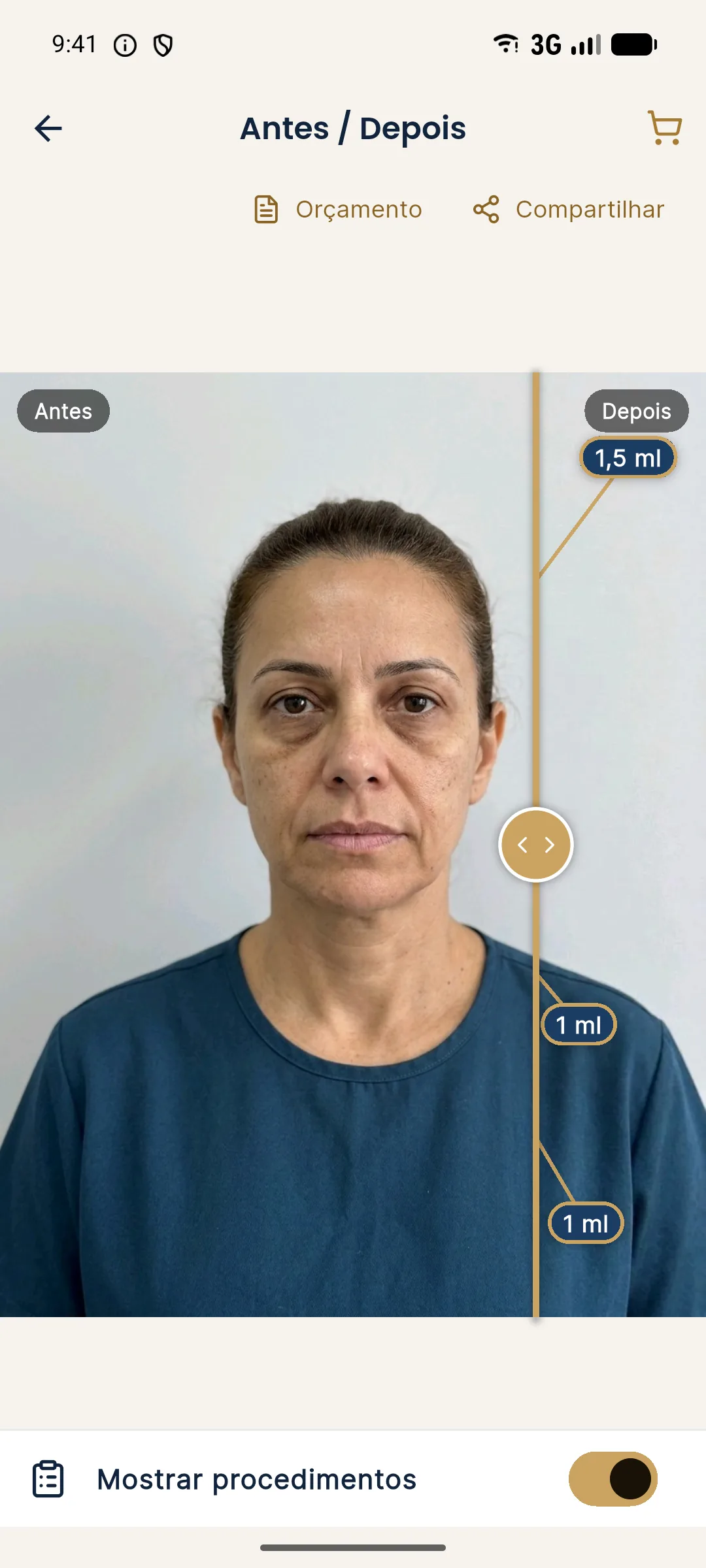
Harmy helps show the patient and family the real size of the change: the projection is subtle, and that helps align expectations. For the older patient, seeing an image with a discreet change is usually reassuring and avoids exaggerated requests. Remember that the app uses only the frontal photo and does not simulate skin, wrinkles or profile.
Record keeping
Record the complete medical history, the medications, the state of health, the standardized photos, the planned range, the risks explained, the participation of third parties and the patient's own consent. At follow-up, repeat the photos and observe healing. The history per patient and standardized clinical photography help keep the comparison.
Frequently asked questions
Can an older person have facial harmonization?
They can, as long as the clinical assessment indicates safety, there is a real concern and expectations are realistic. The plan is usually more conservative, with attention to medications and chronic diseases.
What special precautions apply at 70 or older?
Review medications (anticoagulants, antiplatelets), conditions such as diabetes and heart disease, healing, thin skin and capillary fragility. When in doubt, contacting the treating physician is a prudent course of action.
What is a realistic goal at this age?
Soften signs of tiredness, restore support and improve self-image, without trying to look decades younger. The focus is on naturalness, comfort and safety.
Can the family take part in the decision?
They can accompany and support, but the decision and the consent belong to the patient, if they are able to decide. The professional needs to hear the person's wishes directly.
Harmy images are illustrative simulations generated by AI from the patient's photo to support the conversation between practitioner and patient. They are not a promise of results. Indication, technique, product and volume are solely the decision of the licensed practitioner. This content is for information only and does not replace a clinical assessment.