
Uneven face after filler: assessment and plan

Quick facts
- Concern
- One side of the face has more volume than the other after filler
- First rule
- Wait for the swelling to go down before concluding there is asymmetry
- Usual window
- Reassessment at about two weeks, depending on the product and the area
- Options
- Observe, add to the smaller side or dissolve part of the product
The patient comes back after filler and says "one side came out bigger." It is one of the most frequent and most delicate concerns in the office, because it mixes emotion, expectation and clinical facts. The professional's role is to turn "it came out crooked" into an objective assessment: is it swelling, pre-existing asymmetry, uneven volume or migration? Each answer leads to a different approach.
This page organizes the reasoning and the replanning. It complements excess volume after filler, late swelling after hyaluronic acid and the consultation conversation in communicating post-procedure asymmetry.
Why can one side end up different from the other?
The list of causes is longer than it seems, and most are benign or temporary:
| Cause | How it presents | Usually evolves as |
|---|---|---|
| Uneven swelling | One side more swollen in the first days | Improves over days to weeks |
| Localized bruise | Volume with color change | Resolves as the blood is reabsorbed |
| Product hydration | Hyaluronic acid attracts water and changes volume in the first weeks | Stabilizes within weeks |
| Pre-existing asymmetry revealed | The face was already asymmetric and partial symmetry makes it more evident | Does not change on its own |
| Uneven distribution | Different amount or position between the sides | Persists until corrected |
| Product migration | Volume in a place other than planned | May require dissolving |
| Nodule or inflammatory reaction | Localized hardening | Assess and treat case by case |
The crucial point is time. Concluding there is asymmetry on day two is, almost always, concluding too early. See also swelling after hyaluronic acid.
How to assess step by step
The assessment needs method so it does not turn into a debate of impressions. Ideally, compare with the before photo, under identical conditions.
If any vascular warning sign is present (disproportionate pain, pallor, livedo, visual disturbance), the approach stops being aesthetic and becomes an emergency, with hyaluronidase on hand. See vascular occlusion and visual complication after filler.
What to do in each scenario
The options are always decided by the licensed professional, after assessment, and vary with the area and the material.
- Within the first two weeks, with no warning signs: advise, observe and schedule the follow-up. Avoid manipulating the product too early.
- Persistent asymmetry from too little volume on one side: consider adding to the smaller side, in a small amount, with reassessment.
- Asymmetry from excess on one side: consider dissolving part of the excess with hyaluronidase when the product is hyaluronic acid, aiming to dissolve the minimum necessary. See does hyaluronidase remove all the filler?.
- Migration or nodule: specific approach. See hyaluronic acid migration.
- Pre-existing asymmetry: explain using the before photo, adjust expectations and decide whether the plan should compensate for the difference or respect it.
A common mistake is correcting everything in one session. Doing too much creates a new imbalance and prolongs the cycle of touch-ups. A practical rule is one small adjustment, one reassessment, and only then another.
When the asymmetry belongs to the face, not the filler
Often the patient associates the difference with the procedure, when the face already had unevenness. Two things help: showing the before photo and explaining that perfect symmetry is not the goal. The pages perfect symmetry is not the goal and explaining natural asymmetry to the patient go further into the argument.
For concerns tied to specific areas, see asymmetric cheeks, asymmetric jaw and asymmetric chin. For lips, asymmetric lips: assessment.
Records and consent
Document everything: volume per side, date, photos, concern and approach. The consent form should mention asymmetry, swelling, bruising, nodules and the need for touch-ups as possibilities. This does not replace the conversation, but it protects the relationship. For record-keeping routines, see patient records and documentation in HOF.
How Harmy helps
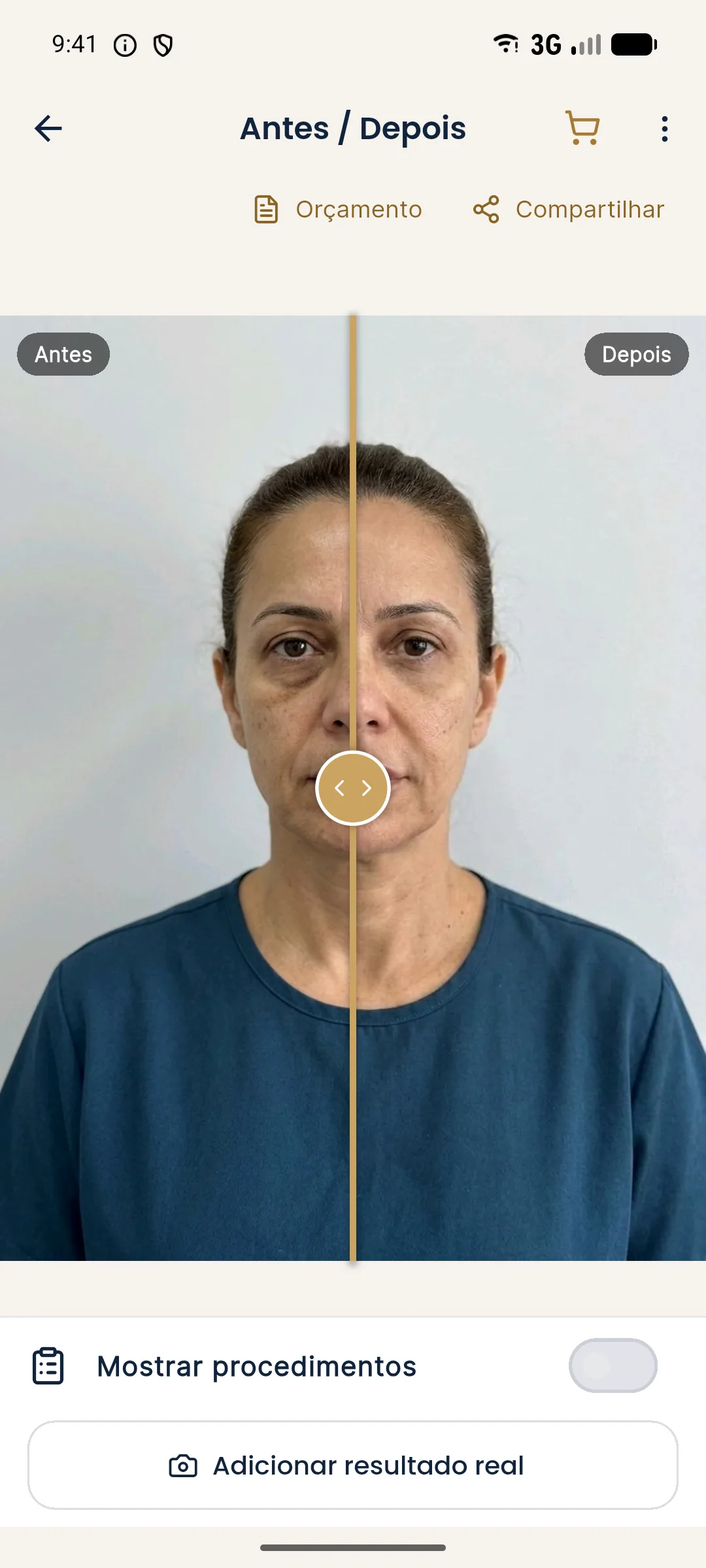
In Harmy, the projection can be made before the procedure, with volumes marked by area, and saved in the patient's History. After the filler, the professional can use Add actual result to store the photo aligned by the eyes and compare Projection, Actual result and Projection vs Actual. This gives an objective basis for the conversation: what was agreed, what the simulation illustrated and what actually happened.
When the concern returns after correction, think of a structural cause: bone, muscle or posture. See asymmetric face and simulation in a patient with asymmetry. Doses, sites and techniques are left to the discretion of the licensed professional, in line with the rules of their professional council in Brazil.
Common mistakes in handling the concern
Three mistakes repeat in practice. The first is responding too early: manipulating the product in the first week, when swelling and hydration are still changing the volume, usually creates a second asymmetry on top of the first. The second is dismissing the complaint without examining: saying "that is normal" without palpating, without comparing with the before photo and without watching the patient in motion conveys disinterest and damages the relationship. The third is correcting symmetrically a difference that is asymmetric, repeating the same amount on both sides.
A good practice is to agree with the patient, before the first injection, on what will happen if one side looks different: when they should come back, what to expect in the first week and which signs require immediate contact. This reduces anxiety and avoids calls at odd hours. Record in the patient record the exact volume per side, the area, the material and the lot number, because this information makes correction much more precise if it becomes necessary.
Frequently asked questions
How long should you wait to assess asymmetry after filler?
Generally about two weeks, because swelling and hydration of the hyaluronic acid change the volume over that period. In some areas and products it can take longer. The decision belongs to the licensed professional.
Is asymmetry after filler the professional's mistake?
Not always. Faces are already asymmetric, swelling can be uneven and the product settles differently. But clear, persistent asymmetry deserves reassessment and correction, with documentation and a frank conversation.
Can filler asymmetry be corrected?
Generally yes. Options include adding to the side with less volume or, with hyaluronic acid, dissolving part of the excess with hyaluronidase. The choice depends on the area and the material used.
Does hyaluronidase fix every asymmetry?
It only acts on hyaluronic acid, and dissolving more than necessary creates a new asymmetry. The usual practice is to dissolve the minimum and reassess. Other materials call for different approaches.
Harmy images are illustrative simulations generated by AI from the patient's photo to support the conversation between practitioner and patient. They are not a promise of results. Indication, technique, product and volume are solely the decision of the licensed practitioner. This content is for information only and does not replace a clinical assessment.