
Crossbite and Facial Asymmetry: Limits of HOF

- Nerve
- Highlighted area
Quick facts
- Concern
- Deviated chin, crooked-looking face and lower teeth that bite outside the upper ones
- Method
- Assess the bite, the midline and the contour together with the dentist
- Structures
- Maxilla, mandible, teeth, masseter and temporomandibular joint
- Caution
- Orofacial harmonization compensates perception, it does not correct the skeletal or dental cause
A crossbite is an abnormal relationship between the upper and lower teeth, in which some of the lower teeth sit outside, rather than inside, the upper ones. It can affect one side only (unilateral) or both. When the mandible has to shift in order to close properly, the chin deviates, the contour becomes asymmetric and the patient sees a crooked-looking face.
This page shows the limits of orofacial harmonization (HOF) and how to work together with orthodontics. It connects with asymmetric mandible, chin off the midline and asymmetric face.
How does a crossbite affect the face?
When the maxilla is narrow or the mandible deviates, chin position changes, muscles work unevenly and bone growth can become asymmetric. In adults, the picture is already established.
| Finding | What happens | Aesthetic effect |
|---|---|---|
| Chin deviation on closing | The mandible slides to one side | Chin off the midline |
| Uneven masseter | One side works harder | Wider contour on one side |
| Narrow maxilla | Midface with less width | Narrow smile, buccal corridor |
| Established bone asymmetry | Different bone | Limit of HOF |
| Muscle compensation | Closing habits | Uneven lines and folds |
The pogonion and the lower contour tell the story: when the chin deviates, the rest of the face organizes itself around that deviation. Facial asymmetry should be seen as both a process and a result.
What to assess
What harmonization can consider
When the underlying treatment is settled or was declined, and the goal is to improve perception:
- Chin and contour: asymmetric, restrained volume to soften the visual deviation. See chin filler and jawline filler.
- Masseter: if one side is hypertrophic, toxin may be considered. See larger masseter on one side.
- Skin quality and support in selected cases.
- Records: document the starting point and the limitations with standardized photos.
Expectations need to stay low when the cause is skeletal. The goal is to improve appearance within what is possible, without promising symmetry.
Risks
The risks follow the area treated: swelling, bruising, new asymmetry, nodules and irregularities. The jawline has the facial artery and the marginal mandibular branch of the facial nerve, and vascular complications are rare and serious. Hyaluronidase must be available when hyaluronic acid is used. Asymmetric compensations raise the chance of volume errors and call for a follow-up visit to adjust.
How to show it in Harmy
Harmy uses a front photo and projects volume in the Chin and Jawline areas, but because in a bilateral area the ml is the total split between the two sides, it does not make different compensations for each side. It also does not simulate the bite or the deviation. Use the app only to illustrate overall balance, and discuss asymmetric compensation outside the tool.
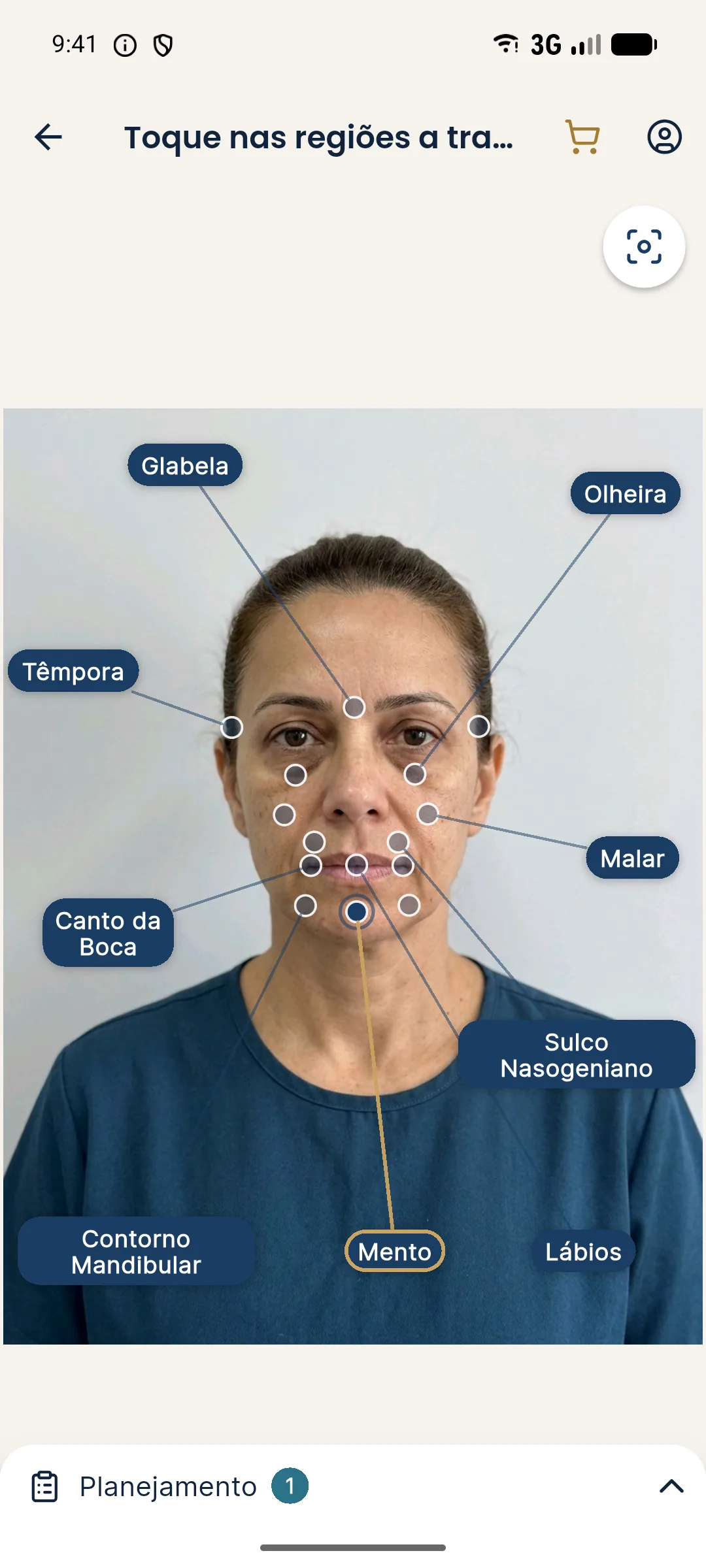
Common mistakes with a crossbite
The first mistake is treating chin deviation as only an aesthetic problem. A crossbite can affect the joint and chewing, and the patient deserves a dental assessment before any plan. The second is compensating for the deviation with asymmetric volume without knowing whether the bite will change. If orthodontic treatment corrects the deviation, the volume no longer makes sense.
Another mistake is ignoring the patient's age. In adolescents, growth is still under way, and injectable procedures are generally not the way to go. In adults, the structure is established and the assessment can be more definitive. It is also a mistake to promise symmetry: a significant bone asymmetry is not corrected with product.
Finally, do not neglect documentation. Photos with the mouth open and closed, and with the teeth clenched, show the mechanism of the deviation and help explain the reasoning behind the choices to the patient.
Working with orthodontics
Talk to the orthodontist about the plan and timing. In many cases, the recommendation is to wait for the end of treatment and only then assess aesthetics. When the patient decides not to treat the bite, HOF can contribute discreet compensations, always explaining the limits. Record the guidance and what was agreed. At follow-up, compare the standardized photos, without forgetting chin position on closing. Partnership between specialties reduces the risk of rework, and the patient benefits from a coherent plan and clear communication among the professionals involved.
Patient profiles and when to wait
In young adults who have not yet treated the bite, the ideal is to wait for the orthodontist's opinion. In adults who decided not to treat it, the aesthetic plan considers the current anatomy and communicates the limitations.
People with orthognathic surgery planned should wait for the end of treatment, because the structure will change. If surgery has already been done, the assessment starts from the new baseline, with recent photos.
In any scenario, the goal is to avoid rework and protect the relationship with the patient. A plan that respects the order between specialties tends to deliver more coherent and longer-lasting results.
Wrap-up
Record the photos, the orthodontist's opinion, what will be treated first and the expectation. For related cases, see open bite and appearance and orthodontics and profile change. Volumes and techniques are at the discretion of the qualified professional, according to the rules of their professional council in Brazil.
Frequently asked questions
Does a crossbite cause facial asymmetry?
It can contribute, especially when the mandible shifts to one side on closing. In children and adults, the relationship between bite and asymmetry is a matter for orthodontic assessment.
Does filler fix a face that is asymmetric because of a crossbite?
It does not fix the cause. It can partly compensate for the perception in the contour and chin, at the discretion of the qualified professional, but it does not replace treating the bite.
Can I get facial harmonization before braces?
It depends on the approach agreed on with the orthodontist. In many cases, it is better to wait for the treatment, because the position of the teeth and chin can change the plan.
Does toxin in the masseter help?
If there is muscle hypertrophy on one side, it can partly compensate, at the discretion of the qualified professional. It does not correct the bite.
Harmy images are illustrative simulations generated by AI from the patient's photo to support the conversation between practitioner and patient. They are not a promise of results. Indication, technique, product and volume are solely the decision of the licensed practitioner. This content is for information only and does not replace a clinical assessment.