
High cheekbones and hollow cheeks: assessment

 BeforeSimulation
- Highlighted area
Quick facts
- Concern
- The cheekbone shows too much and the cheek below looks sunken
- Method
- Separate prominent bony structure from loss of cheek fat
- Structures
- Zygoma, buccal fat pad, SOOF and Bichat's fat pad
- Caution
- Filling the high point worsens the difference, and removing volume worsens the hollow
Some people have a very defined cheekbone and, below it, a depression that gives the face a "hollow cheek" look. For some it is part of their identity; for others, a sign of tiredness and weight loss. The assessment decides whether there is anything to treat and how much.
This page covers the clinical reasoning and connects with gaunt face, sunken cheeks and skeletal-looking face.
Prominent structure or fat loss?
The confusion comes from treating two different phenomena as the same problem. High cheekbones are a feature of the zygomatic bone, which projects laterally. The hollow cheek is the concavity below it, and it depends on the volume of the buccal fat pad, partly the Bichat's fat pad and the deep medial compartment.
| Scenario | Bone | Fat | Appearance |
|---|---|---|---|
| High cheekbones with preserved fat | Prominent | Normal | Defined, healthy face |
| High cheekbones and hollow cheek | Prominent | Reduced | Angular, tired face |
| Normal cheekbones and hollow cheek | Normal | Reduced | Gaunt face |
| Recent weight loss | Variable | Acute loss | New concavity |
In patients who lost weight quickly, the concavity tends to be new and the skin is still adjusting. For someone who has always looked this way, the assessment is different. Factors such as intense training, a previous buccal fat removal and the use of weight-loss medications are part of the history.
How to assess with judgment
What the plan can consider
At the discretion of the licensed professional, the goal is not to "fill" the cheekbone, which is already high, but to balance the transition:
- Support of the deep cheek, with restrained volume, to reduce the concavity without increasing lateral projection. See cheekbone filler.
- Care with zygomatic projection: in many cases, the bone should not receive more volume. See zygomatic filler.
- Skin quality, in selected cases.
- Habits: weight, training, sleep and diet come into the conversation, without moralizing.
Risks
Swelling, bruising, asymmetry, nodules and irregularities. The midface has branches of the transverse facial artery and of the infraorbital nerve, and vascular complications are rare and serious; hyaluronidase should be available when hyaluronic acid is used. In thin skin, the Tyndall effect and persistent swelling are possible. Excesses call for specific management, as in excess volume after filler.
How to show it in Harmy
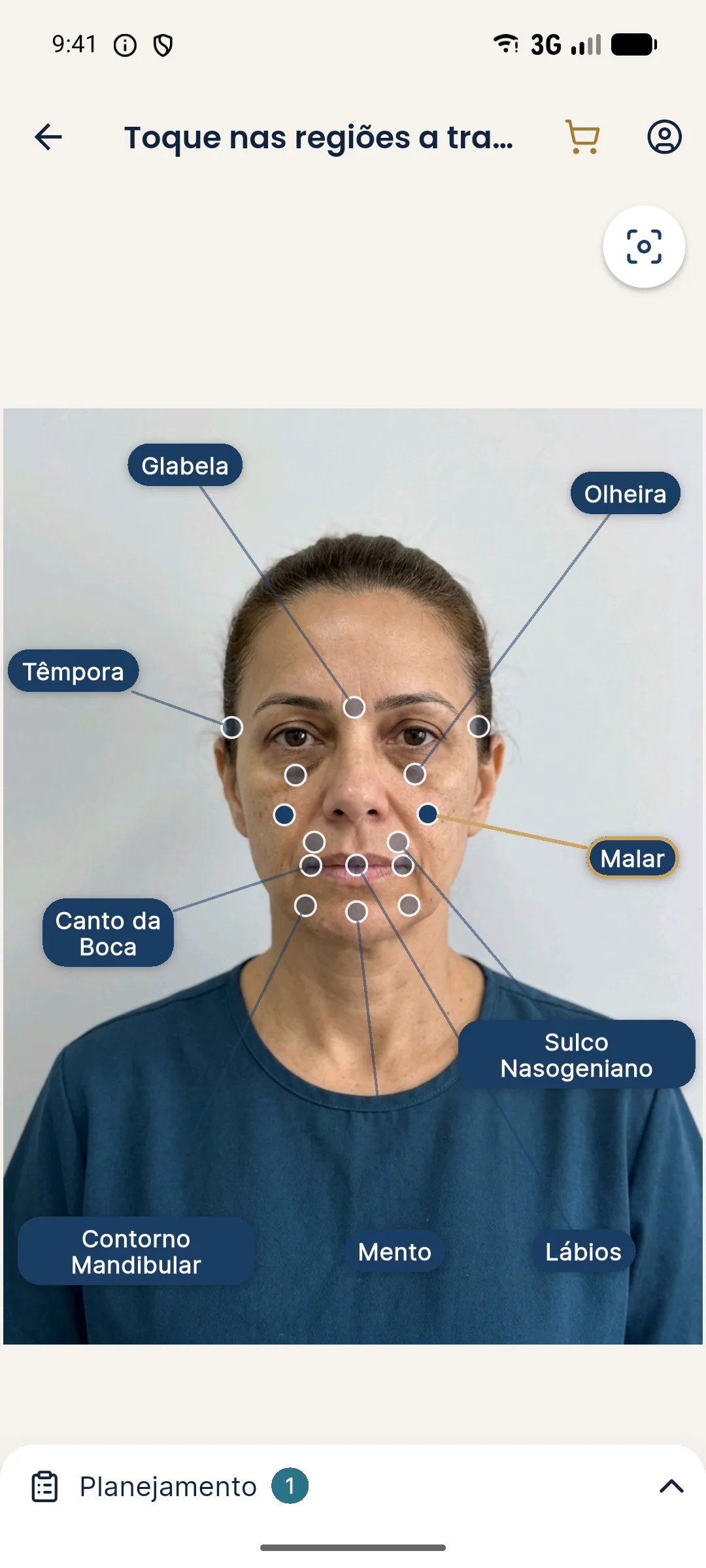
The Cheekbone point in Harmy simulates support of the area and shows the effect of volume in the front photo. For this kind of concern, it is worth showing the Subtle intensity and talking about what changes in the shadow of the cheek. The app does not tell bone from fat and does not reduce bone: the projection changes only what was marked.
When it is better not to treat
When the patient's concern is a "pronounced bone structure" and the face is harmonious, the best plan is to talk it through and document the decision not to treat. Facial harmonization also has room for "no": it avoids excess and preserves identity. Record the decision, the photos and the guidance given.
Common mistakes with hollow cheeks
The most common mistake is filling a cheekbone that is already high, which accentuates the difference between bone and cheek. The focus should be on the concavity below and on the transition, not on the point of greatest projection. The second mistake is treating the concavity as a flaw without asking the patient: many value the definition of the bone.
Another mistake is ignoring weight variation. Someone who lost weight recently has a cheek in transformation, and the plan should wait for stabilization or be designed in short stages. It is also a mistake to forget the surgical history: a previous buccal fat removal or other surgery changes the midface, and the remaining volume may be small.
Finally, beware of too much enthusiasm for deep volume. In thin skin, a product placed too superficially shows up as an irregularity or as Tyndall, and the patient notices it before the professional does.
An honest conversation with the patient
Ask what they would like to change and show, with photos, what is bone and what is soft tissue. Explain that the bone does not change and that volume can be adjusted with caution. Record the decision, even when it is not to treat. If the plan includes volume, define the reassessment interval and the comparison photos. Give guidance on warning signs and on the possibility of reversal with hyaluronidase when hyaluronic acid is used. This approach protects the patient from excess and gives the professional a defensible course of action, based on assessment and not on a trend.
Patient profiles and precautions
Patients who are naturally thin rarely need large volumes, and the conversation is often about accepting their anatomy. Patients who recently lost weight have a cheek in transformation, and a rushed plan may turn out inadequate if their weight changes again.
Athletes and people with low body fat also show this pattern, and the decision to treat should be careful, because injected volume does not follow the body's variations. Older patients combine fat loss and bone resorption, and the plan involves skin quality and support.
In every case, listening to what the patient values about their own face avoids interventions that strip away their character. Often the wisest decision is to postpone and reassess.
Wrap-up
Record photos, weight change, the bone and fat components and the conservative plan. For related concerns, see face without definition and full cheeks and weak chin. Volumes and techniques are at the discretion of the licensed professional, in accordance with the rules of their professional council in Brazil.
Frequently asked questions
Are hollow cheeks caused by a lack of fat?
Often it is a combination of small or lost fat, prominent bone and thin skin. The assessment separates what is structure from what is volume.
Does filler fix hollow cheeks?
It can soften the transition between the cheekbone and the cheek with volume in the right places, at the discretion of the licensed professional. The amount should be conservative.
Does buccal fat removal make hollow cheeks worse?
Removing cheek fat can accentuate the concavity, especially in a thin face or with aging. That is why the indication calls for careful assessment.
Do high cheekbones need treatment?
Not always. It may simply be a feature of the person, liked or not. The plan comes from the patient's concern and the assessment, not from the shape itself.
Harmy images are illustrative simulations generated by AI from the patient's photo to support the conversation between practitioner and patient. They are not a promise of results. Indication, technique, product and volume are solely the decision of the licensed practitioner. This content is for information only and does not replace a clinical assessment.