
Prominent forehead: what harmonization can offset

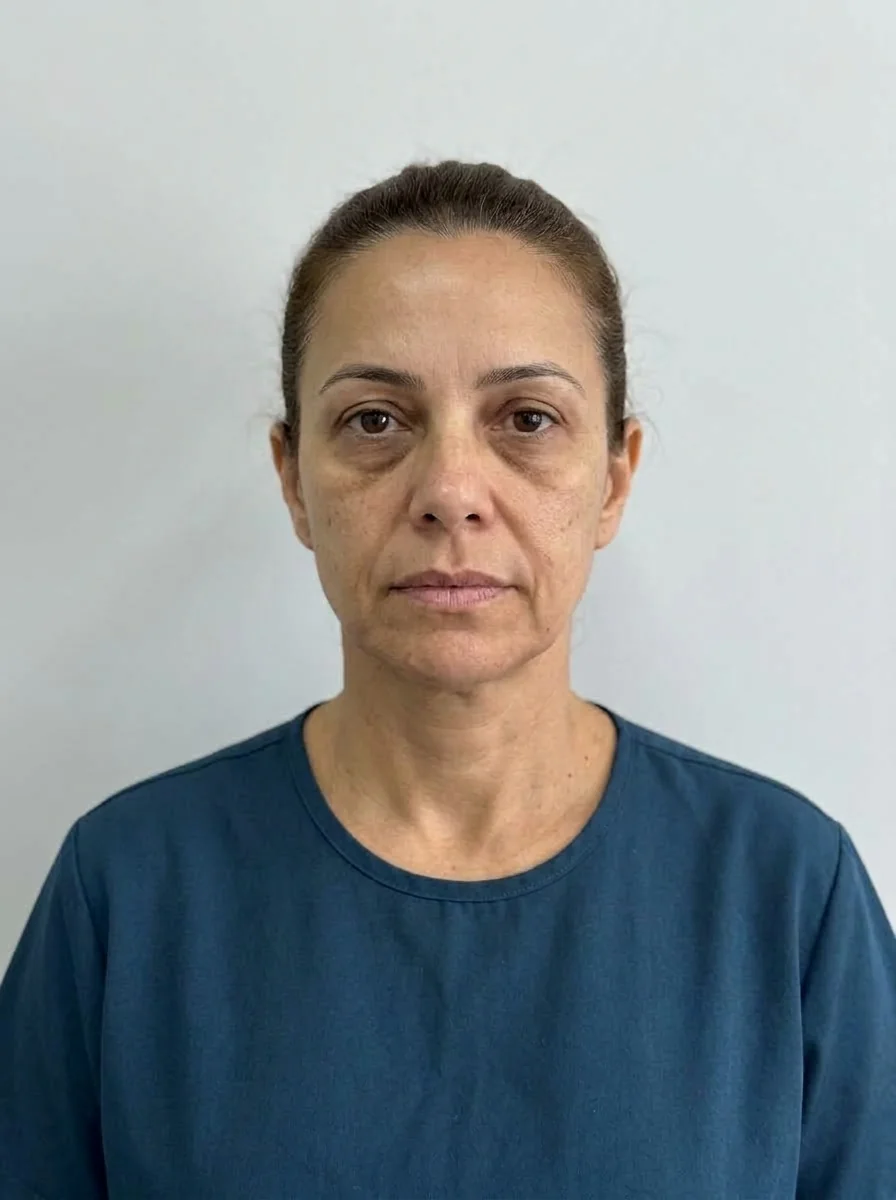 BeforeSimulation
- Highlighted area
Quick facts
- Concern
- A forehead that projects forward, with a prominent brow ridge and a gaze that looks shadowed
- Key question
- Does the projection come from bone, the frontal sinus, the brow ridge, or surroundings that look recessed?
- HOF limit
- Injectables do not reduce bone. They offset the surroundings and the expression, with a clear expectation
- Plan risk
- Promising a reduction, or overtreating the glabella and weighing down the gaze
A prominent forehead has a particular trait: patients are far more likely to tolerate it than to ask for treatment. When they do come in, the annoyance is usually the gaze. They say "my gaze is heavy", "I look angry", "my face looks hard". What lies behind it may be a combination of a prominent brow ridge, a frowning glabella, and surroundings that look recessed.
An honest conversation starts here: HOF (facial harmonization, in Brazil an orofacial harmonization specialty in dentistry) does not reduce the forehead. What it does is balance the surroundings and soften the expression. This page organizes that reasoning. The opposite concern, a flat forehead, is in flat forehead, and the proportions of the third in disproportionate upper third.
What makes a forehead look prominent
Forehead projection depends on the frontal bone, the superciliary arch, the bony glabella, and, in part, the frontal sinus, the air cavity that increases the thickness of the bone in the central region. The nasofrontal angle defines the transition between the forehead and the nose, and a closed angle leaves the glabella more prominent.
The impression of prominence changes with the surroundings. An under-projected midface, concave temples, and a low eyebrow make the whole more evident. The same bone, in a face with a projected cheekbone and full temples, looks more discreet. That is why the assessment is not limited to the forehead.
Four components of the concern
| Component | How it presents | What HOF can do |
|---|---|---|
| Bone and brow ridge | Constitutional projection, more marked in profile | Nothing directly; expectations and referral, if desired |
| Frowning glabella | Vertical lines and shadow that harden the gaze | Toxin in selected cases, at the professional's discretion |
| Concave temples | Contrast between the forehead and the face | Volume replacement with vascular caution |
| Under-projected surroundings | Flat middle third, gaze without a frame | Reinforcing the middle third, when indicated |
The table shows that HOF acts on three of the four components, and none of them is the bone. The conversation with the patient should be organized around that: "the bone does not change, but we can soften the expression and the surroundings".
The glabella and the gaze
In many patients, the concern is less about bony projection than about expression. A frowning glabella accentuates the shadow under the brow ridge and conveys an impression of seriousness. Botulinum toxin in the frowning muscles, including the corrugator, is an approach discussed to soften this expression, at the professional's discretion, after assessing the dynamics.
The risk is excess. Heavy relaxation of the glabella and forehead can lower the eyebrow and give the gaze an expressionless or tired look, which is the opposite of what the patient wants. Dose and distribution are decisions for the licensed professional. For the procedure, see toxin in the glabella and, for the complaint of heaviness after the injection, heavy forehead after botox.
The temples and the frame of the gaze
When the temples are concave, the forehead and the brow ridge seem to project more. Replacing volume in the area can soften this transition and give the upper third a more continuous frame. The area is vascular, and the decision, the technique, and the emergency response belong to the licensed professional, with hyaluronidase on hand. Read hollow temples and vascular occlusion in the temples.
The middle third also comes into play. A flatter cheekbone leaves the forehead standing alone in profile. Reinforcing the middle third can balance the whole without touching the forehead, as discussed in disproportionate middle third.
When to talk about surgery
If the patient wants a structural reduction, the path goes through craniofacial or plastic surgery, with specialist assessment and its own risks. The HOF professional should only inform the patient that this route exists and is outside their scope. That transparency avoids impossible expectations and protects the relationship.
A useful opening question is: "what would you like to see differently when you look at your profile?". The answers vary widely and help separate a profile concern from a gaze concern.
How to organize the plan
- Photograph in profile, three-quarter view, and from the front, with the glabella at rest and frowning.
- Palpate the brow ridge and the glabella.
- Separate what is bone, expression, temples, and surroundings.
- Talk about limits before any proposal.
- If toxin is indicated, use a conservative dose and reassess the eyebrow.
- Consider the temples and the middle third when the contrast is evident.
Safety
Toxin in the glabella has known risks: eyelid ptosis, eyebrow ptosis, asymmetry, and headache. Review ptosis after botulinum toxin and complications with botulinum toxin. With volume in the temples, the possible complications are swelling, bruising, asymmetry, nodules, the Tyndall effect, and, rarely, vascular occlusion. The glabella, when it receives filler, is a high vascular risk area and demands special care.
How to use Harmy in this conversation
Harmy has the Glabella point, and the simulation helps show the effect of softening the area. It keeps the expression in the photo and does not alter the bone or the profile, and that needs to be said. The projection uses only the frontal photo and, in a prominent forehead, the profile is precisely what the app does not show. It is an illustrative simulation, not a promise of results.
Questions to test your reasoning
What to record in the patient record
Record the profile, three-quarter, and frontal photos, the palpation, the classification of the components, and what was explained about limits. Note the specific consent for the treated areas and any referrals. For the photo standard, see standardized clinical photography.
Frequent mistakes
The first mistake is promising a reduction of bone. The second is using too much toxin and lowering the eyebrow. The third is assessing only from the front, without seeing the profile where the prominence shows.
Summary for the decision
A prominent forehead is a bony trait that HOF does not reduce. What it can do is soften the expression of the glabella and balance the surroundings, with the temples and the middle third. Photograph in profile, separate the components, talk about limits, and use conservative doses and volumes. Keep hyaluronidase on hand, document, and act at the discretion of the licensed professional, in line with the rules of your professional council in Brazil, without promising results.
Frequently asked questions
Can a prominent forehead be reduced with facial harmonization?
No. The projection is bony, and HOF does not reduce bone. What can be done is to balance the surroundings and the expression, which changes perception, and structural reduction is a matter for surgery.
Does toxin in the glabella help when the brow ridge is prominent?
It can soften the frowning expression, which accentuates the shadow and the hardness of the gaze. It does not alter the bone, and the indication depends on the patient's dynamics.
Does filling the temples make the forehead look less prominent?
It can soften the contrast between the forehead and the face when the temples are concave. The effect is one of perception and should be discussed with caution.
Is a prominent forehead more common in men?
The brow ridge tends to be more pronounced in men, but it occurs in everyone. Aesthetic expectations vary, and the conversation starts with what the patient wants to see differently.
Harmy images are illustrative simulations generated by AI from the patient's photo to support the conversation between practitioner and patient. They are not a promise of results. Indication, technique, product and volume are solely the decision of the licensed practitioner. This content is for information only and does not replace a clinical assessment.