
Hollow Temples: Causes and Upper Third Assessment

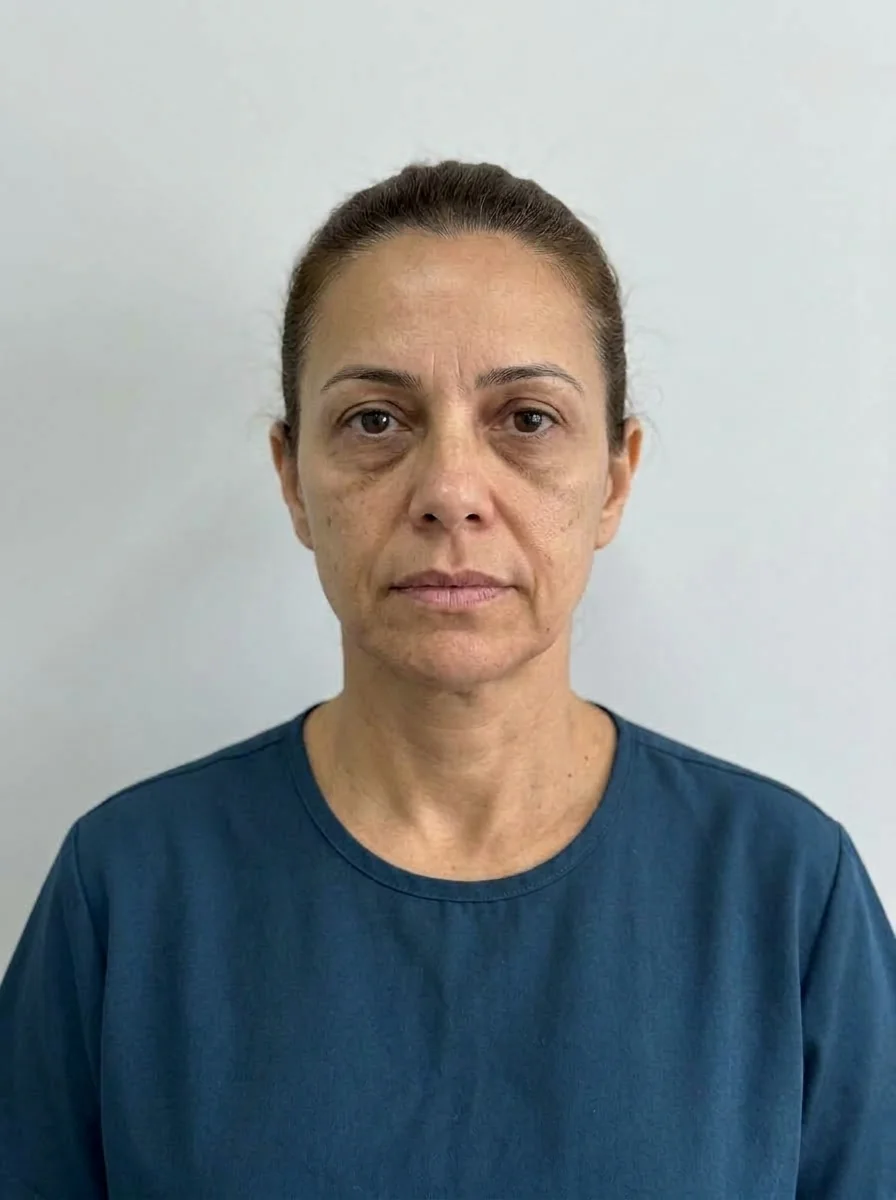 BeforeSimulation
- Highlighted area
Quick facts
- Concern
- Concavity at the temples that gives the upper third a bony, skull-like or tired look
- Key question
- Is the concavity from lost fat, muscle, skin or the contour of the bone?
- Relation to the face
- A hollow temple narrows the upper third and emphasizes the forehead, the zygomatic arch and the brow
- Plan risk
- Dense vascular area, with risk of occlusion, bruising and Tyndall effect under thin skin
The concern comes up in different ways: "my face looks like a skull", "my forehead looks huge", "my temples caved in". In all of them, the patient is talking about the same thing: the transition between the forehead and the face, once continuous, now has a concavity. For the professional, the challenge is to understand how much of the concavity is lost fat, how much is muscle or skin and how much is bone, before thinking about product.
This page brings together the reasoning for assessing hollow temples as an upper third concern. For the patient's question, see hollow temples: why it happens and how to treat them, and for the procedure, temple filler.
What happens in the temporal fossa
The temporal fossa is a bony depression occupied by the temporalis muscle and a fat pad, covered by fascia and, on top, by scalp and skin. In a young face, this set fills the area and creates a smooth curve from the forehead to the zygomatic arch.
Over time, three processes add up. Temporal fat shrinks and makes the fossa more evident. The muscle can lose volume, especially in people who chew little or lost weight. And the skin, thinner, begins to show the bony relief underneath. Bone also remodels, and the orbital rim and zygomatic arch can become more prominent. The result is a more angular upper third. The full anatomical reading is in temporal anatomy for injectables and aging of the temples.
Why a hollow temple draws so much attention
The temple is one of the areas that most changes how the upper third reads. When hollow, it emphasizes the forehead, makes the brow look lower and the zygomatic arch more prominent. In some patients, the concern comes with a "heavy gaze" or an "aged face", even without significant wrinkles.
It also stands out because it is sensitive to weight loss. Patients who lose weight quickly notice the temples before other changes, and it is common for them to arrive with this concern. See the follow-up in biostimulator for people who lost weight with injectable pens.
Conditions that get confused
| Condition | What is seen | Note |
|---|---|---|
| Loss of the fat pad | Smooth, symmetric concavity, skin of good thickness | Tends to respond to gradual volume replacement |
| Temporalis muscle atrophy | Deeper concavity, sometimes asymmetric | Look into chewing, bruxism, diseases and medications |
| Thin, sun-damaged skin | Visible veins, marked bony relief | Higher risk of a bluish tone with superficial filler |
| Bone and natural contour | Lifelong constitutional concavity, no change | Expectations need to be aligned; not every concavity is a deficit |
A patient can have two or three conditions at once. What matters is knowing which one dominates, because the choice of product and the expectation depend on it.
What volume can do
Volume replacement in the temples, usually with hyaluronic acid, is one of the options discussed to soften the concavity. The logic is to restore the curve between the forehead and the zygomatic arch, reducing the shadow of the fossa. The realistic expectation is softening, not elimination, and the amount depends on the size of the fossa, the skin and the patient's wishes.
The area carries vascular risk: branches of the superficial temporal artery, the middle temporal artery and the middle temporal vein run through it, along with the temporal branch of the facial nerve. This requires anatomical knowledge, cautious technique and readiness for complications. See vascular occlusion in the temples.
Biostimulator and other options
In patients with thin skin or significant loss of tissue quality, the collagen biostimulator can be discussed as a gradual alternative. It is the professional's decision, and the risks, including nodules and irregularities, and the response time must be explained. Read biostimulator in the temples. Threads also come up in some discussions, and the topic is covered in PDO threads in the forehead and temples.
The Tyndall effect is a real risk when product stays superficial in thin skin. To understand prevention, see Tyndall effect in the forehead and temples.
The effect on neighboring areas
Changing the temple changes how the brow, forehead and cheekbone read. A fuller temple can make the tail of the brow look higher and the zygomatic arch softer. That is why upper third planning is done as a whole, as in temples and brow in the plan and temples and cheekbone in the plan.
For a view of the whole third, reading complete upper third in the plan helps place the temple among the other decisions.
How to organize the plan
- Understand the dominant cause of the concavity and the context (weight, bruxism, illnesses).
- Assess the upper third as a whole: forehead, brow and zygomatic arch.
- Decide whether the temple is the priority or another area should come first.
- If volume is indicated, plan a conservative amount, with reassessment.
- Schedule a follow-up for comparison photos and possible adjustment.
How to use Harmy in this conversation
Harmy shows the temple with volume on a frontal photo, which helps the patient see how the upper third changes. The projection changes only the Temple point and does not simulate muscle or bone, and the patient needs to be reminded that this is an illustrative simulation, not a promise of results.
For the conversation, explaining the temples to the patient gathers supporting phrases, and how many ml of filler in the temples answers the most common question.
Questions to test your reasoning
What to record in the patient record
Note the description of the concern, standardized photos, the weight and health context, the dominant cause you identified, the planned products and amounts and the specific consent, covering the risks of vascular occlusion and the Tyndall effect. Record the follow-up and progress. For photos, see standardized clinical photography.
Common mistakes
The first mistake is treating the temple in isolation, without looking at the brow and forehead. The second is planning a large volume in one session, raising the risk of irregularity and complications. The third is overlooking the possibility that the concern is constitutional and that the patient expects a change the procedure does not offer.
Summary for the decision
Hollow temples result from fat, muscle, skin and bone, in different proportions. Examine with light from above, compare both sides, consider the weight and health context, assess the upper third as a whole and choose a gradual approach. The area is vascular, hyaluronidase must be available, and the decision always belongs to the qualified professional, in line with the rules of their professional board, without promising results.
Frequently asked questions
Why do the temples hollow out with age or weight loss?
Mainly because of loss of the temporal fat pad, combined with changes in muscle, skin and bone. Weight loss speeds the process because facial fat shrinks along with body fat.
Is a hollow temple always an indication for filler?
No. It is a concern that calls for assessment. In some cases volume is discussed, in others a biostimulator, and in others it is better to treat another area of the upper and middle thirds first.
Does filling the temples change the shape of the face?
It can soften the transition between forehead, brow and zygomatic arch, which changes how wide the upper third looks. The effect depends on the patient and is discussed case by case.
Is temple filler dangerous?
The area has important vessels and requires anatomical knowledge and readiness for complications. When done by a qualified professional with suitable technique and product, the risk is reduced, but it is not zero.
Harmy images are illustrative simulations generated by AI from the patient's photo to support the conversation between practitioner and patient. They are not a promise of results. Indication, technique, product and volume are solely the decision of the licensed practitioner. This content is for information only and does not replace a clinical assessment.