
How to Show a Patient's Concern in the Visual Projection

Quick facts
- Concern
- How to turn a concern expressed in words into a visual plan the patient understands
- Method
- Concern, area, ml and intensity, then projection and conversation
- In the app
- Marking, Plan, Before/After, Show procedures and presentation mode
- Caution
- The projection is illustrative, never a promise of results
A patient's concern rarely arrives as an anatomical area. It arrives as "I look tired", "my face is sagging" or "my mouth looks sad". The professional's job is to turn that sentence into areas, volumes and a plan the patient can see. Harmy was designed for that moment: from the concern to the Before/After in a few minutes.
This page explains the path, taking care not to promise what the simulation does not deliver. It complements vague concern: how to investigate, concern with several areas and showing the simulation on a phone or tablet.
From the concern to the area
The first step is translating the sentence. The table below shows examples of matches, only as a starting point; clinical assessment rules.
| Concern in words | Areas that may be assessed | Point in Harmy |
|---|---|---|
| "Tired face" | Under-eye, cheekbone, temple | Tear Trough, Cheekbone, Temple |
| "Sad mouth" | Mouth corners, fold, chin | Mouth Corner, Chin |
| "Thin lips" | Lips, contour | Lips |
| "Small chin" | Chin, contour | Chin, Jawline |
| "Face lacking definition" | Jaw, chin, cheekbone | Jawline, Chin, Cheekbone |
| "Frowning forehead" | Glabella, forehead | Glabella |
Concerns about the nose, skin, spots and neck have no point in the app. In those cases, the projection does not apply, and it is better to tell the patient so than to improvise with a neighboring area.
The path in the app
The flow is short and always the same.
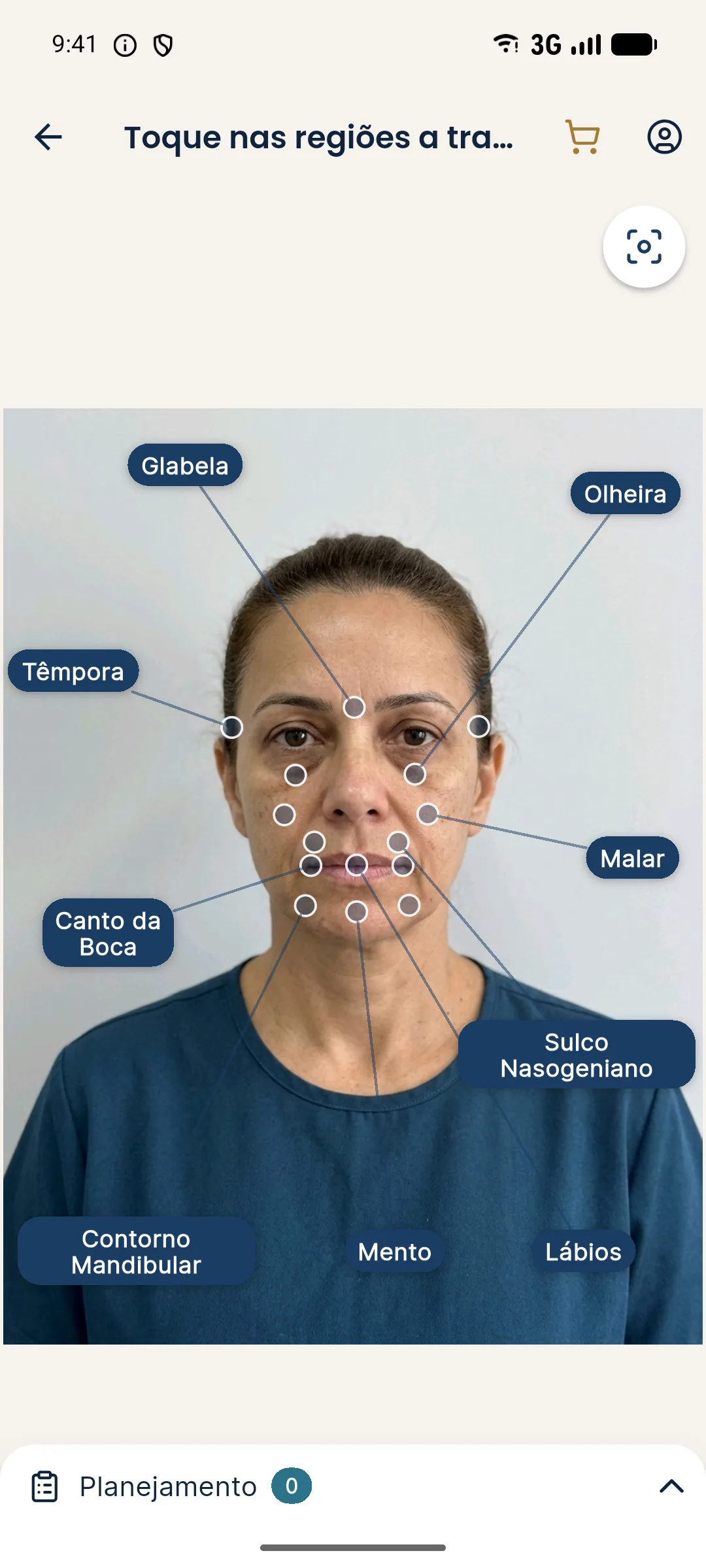
The marking shortcuts help you get started. "First time" proposes lips 1 ml at Moderate and tear trough 1 ml at Subtle. "Maintenance" proposes lips 0.5 ml, nasolabial fold 1 ml and cheekbone 1 ml, all at Subtle. "Full harmonization" proposes cheekbone 2 ml, jawline 2 ml, chin 1.5 ml, lips 1 ml and nasolabial fold 1 ml at Moderate, and tear trough 1 ml at Subtle. These are starting points for conversation, never a prescription.
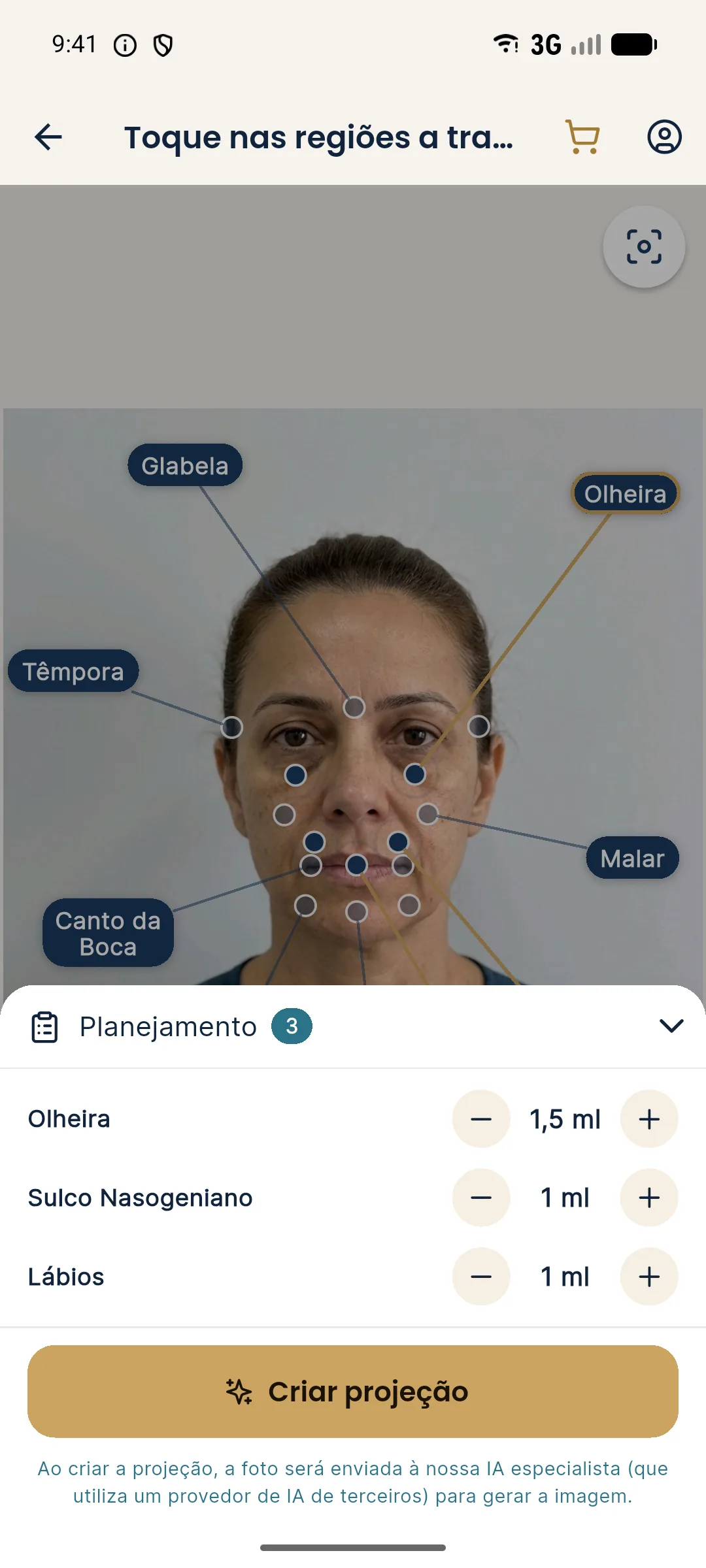
What to decide before creating the projection
The photo is sent to a third-party AI to generate the image, with the professional's consent in the app; the face contours are calculated on the device and are not stored. In a bilateral area, the ml is the total split between the two sides.
How to guide the conversation
The projection is a conversation tool. It works best when the professional follows a simple order: first, repeat the concern in the patient's words; second, show the Before/After in presentation mode (full screen with only the slider); third, use the magnifier to enlarge the treated area, with before and after side by side; fourth, open "Show procedures" to talk about ml.
The projection changes only what was marked: the app's prompt forbids makeup, skin retouching, and changes to expression, background, hair and lighting. That is why the changes are subtle and realistic, and that is an advantage in terms of honesty. Explain to the patient why the change is not dramatic.
What not to show
- Guaranteed result: the simulation is not a promise.
- An area that will not be treated: avoids creating expectations.
- Comparison with other patients: the patient's image belongs to them, and public routes never return names.
- Price without a closed plan: the PDF quote comes afterward, with informational installments, validity and a notice.
Each projection costs R$ 3.99, with no subscription; a new account gets a welcome projection. That encourages planning well before creating.
Common mistakes when showing the projection
The first mistake is showing the projection before listening to the concern. The patient anchors on the image and stops describing what really bothers them. The second is using the image as a sales argument: showing the more pronounced After to close the plan undermines trust and conflicts with advertising rules and the ethics of consent.
Another mistake is forgetting that the projection is frontal. Profile, nose or neck concerns call for other resources, and forcing the simulation can lead to improper promises. It is also a mistake to send the image to the patient without the simulation notice or without the context that explains it.
Finally, never advertise the simulation as if it were a patient's actual result. The projection is a conversation and planning tool, and advertising follows the rules of your professional council and of advertising law in Brazil.
Wrap-up
After the conversation, record in the History the projection, the photos, the concern and the agreed plan. If the patient agrees, build the PDF quote. To understand the limit of expectations, see concerns HOF does not solve. Volumes and techniques are at the discretion of the qualified professional, according to the rules of their professional council in Brazil.
Frequently asked questions
How do I turn a concern into a Harmy projection?
Identify the area related to the concern, mark the matching point, set the ml and the intensity, and create the projection. Then show the before and after and guide the conversation about what is possible.
What if the concern has no area in the app?
The app has nine marking points. For concerns outside them, such as the nose, skin or neck, the projection does not apply, and the conversation needs other resources.
Can I show the patient more than one intensity?
Yes. Making projections at Subtle and Moderate helps set expectations and choose the conservative path. Each projection uses one credit.
How do I keep the patient from taking the projection as a promise?
By saying, before and after showing it, that it is an illustrative simulation, that anatomy and technique influence the result, and that the plan will be adjusted at follow-up.
Harmy images are illustrative simulations generated by AI from the patient's photo to support the conversation between practitioner and patient. They are not a promise of results. Indication, technique, product and volume are solely the decision of the licensed practitioner. This content is for information only and does not replace a clinical assessment.