
Artificial-looking face: why it happens

- Nerve
- Highlighted area
Quick facts
- Concern
- A face that looks "done," without naturalness, even with no single large error
- Key insight
- Artificial rarely comes from one area, it comes from the sum of volumes unrelated to each other
- Supporting measure
- Frontal, oblique and profile photos compared with an old photo of the patient
- Limit
- Removing excess and reviewing proportion comes before adding anything
The patient arrives saying they cannot explain what is wrong, but that it "doesn't look like me anymore" or "looks like a doll's face." There is rarely a single large error that justifies the phrase. What usually exists is a sum of reasonable decisions made in isolation that together produced a face with no internal relationship between its parts.
This page organizes how to read that concern: where to look in the photo, which patterns repeat, how to separate too much volume from volume in the wrong place, and how to rebuild a plan that restores identity. The focus is assessment, not technique. For the case where the patient already knows they have excess, see also overdone face after fillers.
What does the patient mean by artificial?
The word "artificial" is an emotional shorthand. When you ask the patient to point, they usually indicate one area, but the cause lies in the relationship between areas. Four perceptions appear often:
- A face that is too uniform, where lips, cheeks and chin seem to have the same degree of filler and no feature leads the whole.
- A surface without shadow, where light slides across the face because volumes were smoothed beyond what that patient's bone and fat justify.
- Exaggerated symmetry, which the human eye reads as strange, because real faces have small differences between the sides.
- Altered expression, with stiff movements or a smile that does not follow the eyes.
Write down the words the patient uses. "It looks like a mask" points to surface and expression. "It looks like someone else" points to identity and proportion. Listening helps you decide where to start.
Which proportion errors produce this look?
The eye looks for a relationship between parts. When one of them overshoots, the others look wrong by contrast. The most common mismatches when reading the photo are these:
| Pattern seen | What the eye interprets | Question for the assessment |
|---|---|---|
| Lips very projected for the size of the chin | A mouth that "comes out" of the face | Does the chin keep up in projection? |
| High, wide cheekbone with a narrow lower third | An exaggerated heart-shaped face | Does the cheek width respect the jaw? |
| Long, pointed chin with the rest soft | A "beak" profile | Was the chin planned together with the lower lip? |
| Lateral face very full | A pillow effect | Did the volume go forward or sideways? |
| All areas at the same intensity | A homogeneous mask | Is there one area that should be the main one? |
Use the classical proportions as support, never as a mold. The guide to thirds and fifths serves to locate where the imbalance is, not to demand that every face meet the ruler. Assessment by facial thirds is a good starting point.
Too much volume or volume in the wrong place?
This distinction changes the approach. Too much volume calls for reduction, usually by dissolving when the material allows. Volume in the wrong place calls for replacement in another area to restore the relationship, or a combination of both. A good clinical question is: if I removed this area from the face, would the whole look more coherent?
Here is a hypothetical example. In a patient with a well-filled cheekbone and a barely projected chin, the face may look rounded instead of defined. The "artificial" concern lessens in part when the chin is given structure, without touching the cheekbone further. In another patient, the problem is a lip too large for the lower third, and the conversation is about partial dissolving, not about more volume around it.
How is facial identity lost?
Identity is the set of features that make a person recognizable. It might be a defined nose, a subtle asymmetry of the smile, a stronger jaw. When the plan treats every face as a variation of the same ideal, those features get smoothed, and the patient feels the loss even without being able to name it. The page on facial identity covers the topic in depth.
In practice, ask for an old photo of the patient, from a time when they liked their own face. Compare it side by side with the current photo. Mark what changed beyond aging: the distance between lip and nose, the height of the cheek, the line of the jaw. The old photo as a reference is one of the cheapest and most honest tools in the consultation.
Are swelling or material still affecting the reading?
Before deciding on any correction, confirm that the current appearance is stable. Recent swelling can give the impression of an excess that disappears within days or weeks. Filler that is still hydrated can look larger than it will in the final result. In general, it is advisable to wait the appropriate time for the product used before concluding there is excess, at the professional's discretion. The topic of swelling that interferes with comparison details how to avoid hasty decisions.
If the appearance persists and the patient was treated by another professional, ask for the records of the injections. Without knowing the material and the area, there is no way to assess dissolving safely. See also comparing plans from two professionals to handle that conversation respectfully.
What to do in the consultation?
The outline below organizes the approach without promising an outcome. The order matters: understand, measure, decide, agree.
When hyaluronic acid needs to be dissolved, hyaluronidase must be available and the indication is up to the qualified professional, according to the rules of their professional council. Explain what to expect, that there may be transient swelling and that the process is usually carried out in stages. For the criteria, see dissolving filler: criteria for indication. When the patient comes with several accumulated sessions, the page on a plan to correct prior excess shows how to structure the stages.
How can Harmy help?
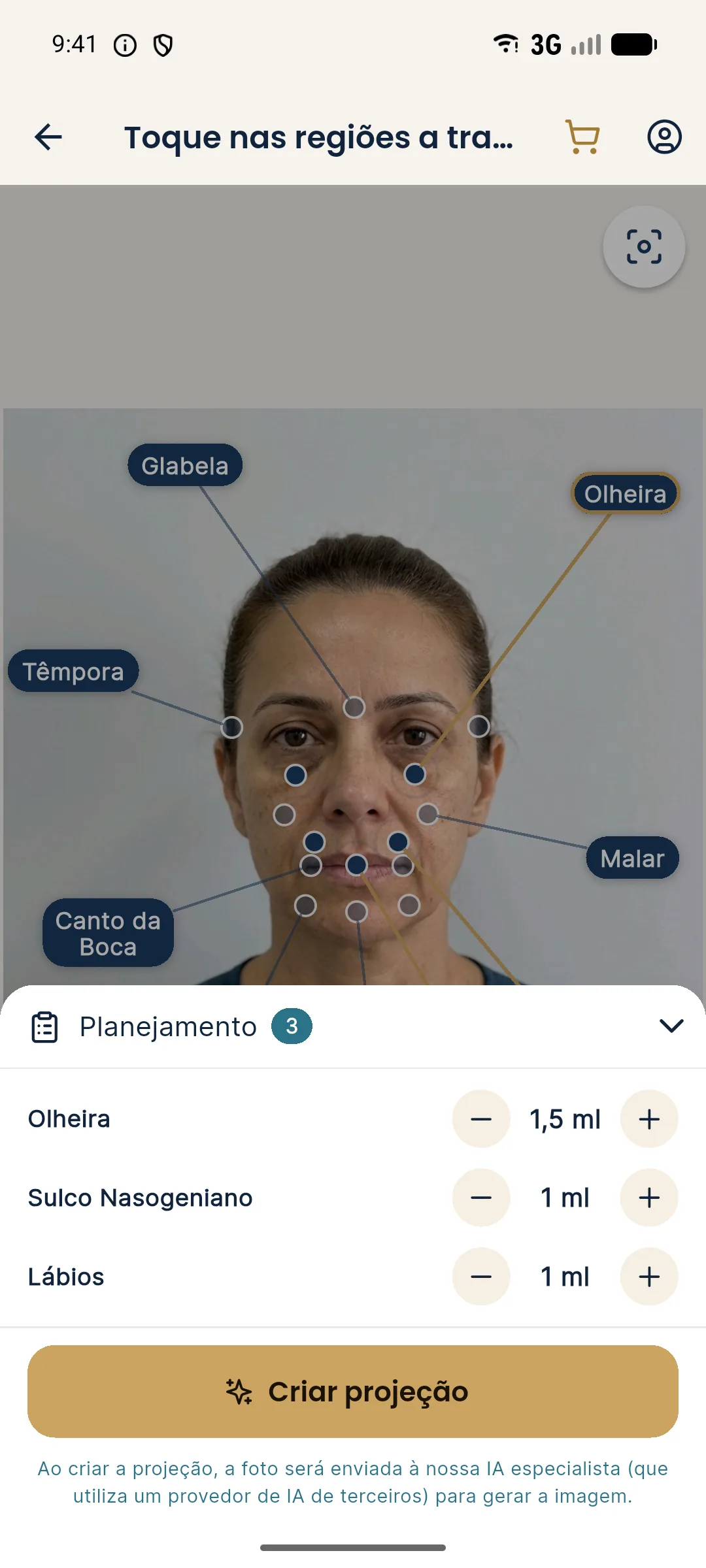
In Harmy you mark only the necessary areas and use the Subtle, Moderate or Pronounced intensity to show the patient how small amounts change the whole. This contrasts with the "more volume everywhere" plan and gives the patient a visual reference for moderation. The projection uses only the frontal photo and is an illustrative simulation, not a promise of results.
How to keep the concern from coming back?
Preventing the artificial face is, above all, a planning decision. Working in stages, with intervals to reassess, lets you notice the point where the face is already good. Many artificial cases start from sessions in which "just a little more" was added several times. The logic of the interval between sessions and the concept of structure before detail help keep the course.
Another useful habit is to record, at each session, what the patient said they liked about their own face. That record works as an identity contract: when the next suggestion collides with it, it is a signal to stop and talk. Patients with high expectations or distorted body image deserve special attention, and when the distress seems disproportionate to what is visible, the conversation should consider a referral, as described in concerns that HOF does not solve.
Frequently asked questions
What makes a face look artificial after facial harmonization?
Usually it is the sum of volumes out of proportion with each other, areas without transitions, excessive symmetry and loss of the features that gave the face its identity. A single point rarely explains the concern.
Can excess filler be undone?
Hyaluronic acid can be dissolved with hyaluronidase, at the discretion of the qualified professional, after assessment. Other materials behave differently and call for a different conversation.
How do you avoid an artificial face in planning?
By planning by proportion and in layers, with conservative volumes and reassessment between sessions, preserving the features the patient recognizes as their own.
Does simulation help avoid an artificial look?
It helps you discuss proportion before injecting, because it shows a subtle change. It is an illustrative simulation, not a promise of results.
Harmy images are illustrative simulations generated by AI from the patient's photo to support the conversation between practitioner and patient. They are not a promise of results. Indication, technique, product and volume are solely the decision of the licensed practitioner. This content is for information only and does not replace a clinical assessment.